


- Products
- Catalogs
- News & Trends
- Exhibitions
Chemical Resistance Guide 10

Chemical Resistance Guide 10
The Chemical Resistance Guide is a detailed resource for assessing the compatibility of various materials with different chemicals, specifically for use with Xylem pumps. It is based on laboratory and field tests, as well as industry data. The guide advises that actual use should determine suitability, and it does not guarantee against chemical attacks on pump materials.
The guide uses a rating system to evaluate material resistance:
- A Rating: Little effect on material properties (Generally Satisfactory).
- B Rating: Minor to moderate effect (Generally Satisfactory but should be tested).
- C Rating: Significant change in properties (Generally Not Satisfactory, must be tested).
- D Rating: Rapid deterioration or chemical attack (Not Satisfactory).
The guide details the resistance of various elastomers:
- Buna-N: Excellent against petroleum-based fluids, vulnerable to ozone, ketones, esters.
- EP/PP Blend (Santoprene): Resistant to solvents and chemicals, vulnerable to hydrocarbons.
- EPDM: Excellent against ozone and chemicals, poor against petroleum-based fluids.
- FFKM (Kalrez): Excellent chemical resistance.
- FKM (Viton): Excellent oil and air resistance, vulnerable to ketones.
- Fluoro-silicone: Moderate chemical resistance, vulnerable to brake fluids.
- Natural Rubber: Excellent physical properties, poor against petroleum-based fluids.
- Neoprene: Good weathering resistance, moderate against petroleum-based fluids.
- Silicone: Excellent temperature properties, fair physical properties.
Xylem pumps should not be used with gasoline or fluids with a flash point below 100°F (38°C).
The tables rate various materials (plastics, elastomers, alloys) from A to D based on their resistance to specific chemicals, such as acids, alcohols, and hydrocarbons. These tables are crucial for selecting appropriate materials for specific chemical exposures.
This guide evaluates the chemical resistance of materials like plastics, elastomers, and alloys, structured into tables categorizing their resistance to different chemicals.
- Materials Evaluated: Includes Polypropylene, Nylon, Polyethylene, Acetal Copolymer, Kynar, FKM, Buna, Silicone, EPDM, EP/PP blend, FFKM, 316 stainless steel, and Hastelloy.
- Chemicals Assessed: Covers a wide range of chemicals, including acids, alcohols, oils, fuels, and industrial chemicals.
- Resistance Ratings: Uses a grading system (A, B, C, D) to rate material resistance, with 'A' indicating high resistance and 'D' indicating low resistance.
- Applications: Useful for selecting materials for manufacturing and industrial applications where chemical exposure is a concern.
- Plastics: Generally show good resistance to many chemicals, but performance varies with specific chemicals.
- Elastomers: Exhibit varied resistance, often performing well against oils and some acids but less so against strong solvents.
- Alloys: Metals like 316 stainless steel and Hastelloy offer excellent resistance to a wide range of chemicals, suitable for harsh environments.
When selecting materials for chemical exposure, consider the specific chemical environment and consult the resistance ratings in this guide to ensure material compatibility and longevity.
Catalog excerpts

Chemical Resistance Guide 10 Introduction Chemical Resistance Guide
Open the catalog to page 1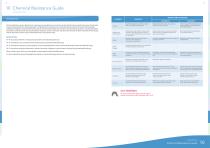
GENERAL CHEMICAL RESISTANCE Many hydrocarbons, fats, oils, greases, hydraulic fluids, chemicals. Excellent resistance to petroleum-based fluids. Good physical properties. EP/PP blend (Santoprene) This Chemical Resistance Guide is offered to assist in selecting pump materials that are most resistant to the chemicals that may be used with a Xylem pump. The information is based on Xylem laboratory tests, field testing programs, and general data from industry sources. It should be used only as a guide in the selection of pump materials. Suitability for the application should be determined by actual...
Open the catalog to page 2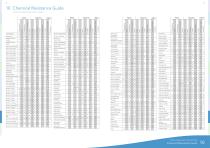
10 Chemical Resistance Guide CHEMICAL RESISTANCE GUIDE TABLES Aluminum Oxychloride Acetate Solvents (pure) Acetic Acid, Glacial Acetic Anhydride Acetyl Chloride Acetylene Tetrabromide Acetylesalicylic Acid Adipic Acid Alcohol – Benzyl Alcohol – Isobutyl Alcohol – Isopropyl Alcohol – Methyl Alcohol – Octyl Alcohol – Propyl Aluminum Chloride Aluminum Citrate Aluminum Flouride Aluminum Formate Ammonia, anhydrous Ammonia (liquid) Ammonium Chloride Ammonium Hydroxide Ammonium Thiosulfate Amyl Alcohol Amyl Chloride Aqua Regia Aromatic Hydrocarbons Arsenic Acid Barium Chloride Barium Cyanide Barium...
Open the catalog to page 3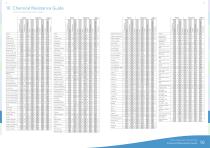
CHEMICAL RESISTANCE GUIDE TABLES Chemical Resistance Guide Tables
Open the catalog to page 4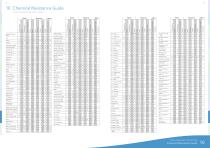
10 Chemical Resistance Guide CHEMICAL RESISTANCE GUIDE TABLES Lactic Acid Lead Acetate Lead Chloride Lead Nitrate Lead Sulfamate Linoleic Acid Magnesium Carbonate Magnesium Chloride Magnesium Carbonate Magnesium Nitrate Magnesium Sulfate Maleic Acid Maleic Anhydride Mercuric Chloride Mercuric Cyanide Oil – Diesel Fuel Oil – Fuel Methyl Cellosolve Methyl Dichloride Methyl Ethyl Ketone Methyl Isobutyl Ketone Methyl Isopropyl Ketone Nickle Sulfate Oleic Acid Oxalic Acid Palmitric Acid Nitric Acid (concentrated) Plating Solutions – Iron Plating Solutions – Lead Plating Solutions – Silver Phosgene...
Open the catalog to page 5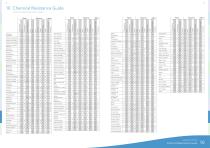
CHEMICAL RESISTANCE GUIDE TABLES
Open the catalog to page 6All Xylem catalogs and brochures
 23680 Technical Data Sheet
2 Pages
 23610 Technical Datasheet
2 Pages
 18670 Technical Datasheet
4 Pages
 18660 Technical Datasheet
4 Pages
 18220 Promotional Datasheet
2 Pages
 General_Industrial_Catalo
24 Pages
 Jabsco Marine Toilets
16 Pages
 Oil_Change_Diesel
6 Pages
 Flexible Impeller Pumps
54 Pages
 Marine Product Catalog
7 Pages
 Additional Information 11
4 Pages
 Specialty Products 09
6 Pages
 Sliding Vane Pumps 08
2 Pages
 Oscillating Pumps 07
2 Pages
 Rotary Lobe Pumps 06
3 Pages
 Industrial Pumps Catalogue
94 Pages
 FLOJET Beverage Run Rise Charts
10 Pages
 Washdown Pumps
2 Pages
 Water Pressure Systems
10 Pages
 Toilet Systems
14 Pages
 Livewell/Baitwell Pumps
6 Pages
 Bilge Pumping Systems
24 Pages
 Aerogen Wind Generator
3 Pages
 Speciality Products
5 Pages
 Sliding Vane Pumps
5 Pages
 Oscillating Pumps
2 Pages
 Rotary Lobe Pumps
3 Pages
 Hand Pumps
2 Pages
 Gear Pumps
2 Pages
 Diaphragm Pumps
15 Pages
 Centrifugal Pumps
19 Pages
 MODEL 34754-0000
2 Pages
 MODEL 34744-0000
2 Pages
 4125 SERIES
4 Pages
 4105 series
4 Pages
 2760-SERIES
2 Pages
 Exploded View
2 Pages
 Impeller Replacement
10 Pages
 Searchlights
8 Pages
 Ventilation Blowers
4 Pages
 General Purpose Pumps
8 Pages
 Oil Change & Diesel
6 Pages
 Washdown Pumps
2 Pages
 Water Pressure Systems
10 Pages
 Livewell/Baitwell Pumps
6 Pages
 Toilet Systems
12 Pages


Archived catalogs
 Bilge Pumping Systems
26 Pages
 Service Parts
80 Pages
 OVERVIEW OF PARTS
2 Pages
 59000_aqua_filta_promo
2 Pages
 Type III MSD Waste
18 Pages
 52600 Series
18 Pages
 SELF-PRIMING
4 Pages
 VENTED LOOP SOLENOID
1 Page
 233SL Dual Beam Searchlight
2 Pages
 MINI ACCUMULATOR TANK
2 Pages
 Par-Max Series
2 Pages
 Jabsco
2 Pages
 Impeller Replacement
16 Pages
 Searchlights
12 Pages
 General Purpose Pumps
14 Pages
 Oil Change & Diesel
10 Pages
 FLOJET BevJet
12 Pages
 Marine Product Guide
24 Pages
 Brochure
4 Pages


- Xylem boat pump
- Transfer pump
- Boat sensor
- Xylem 12 V pump
- Xylem impeller pump
- Xylem 24 V pump
- Xylem bilge pump
- Xylem self-priming pump
- Boat floodlight
- Oil pump
- Boat switch
- Engine cooling pump
- Positive-displacement pump
- Boat toilet
- Nautical searchlight
- Submersible pump
- Nautical hand pump
- Bilge blower
- Halogen floodlight
- Electric toilet