

- Company
- Products
- Catalogs
- News & Trends
- Exhibitions
SQUARE RIG

SQUARE RIG
This document provides a detailed overview of the construction and design of spars used in both traditional and modern sailing vessels, with a focus on the materials and techniques employed by Woodspars.
Square rigging masts are complex structures designed to support sails and transmit wind forces to the boat. They require precise construction for stability and performance. Yards, the horizontal elements, are crucial for sail control and are attached to masts with fittings and ropes.
The bowsprit extends from the bow of the boat, supporting headsails like the jib or genoa. It includes fittings for sail attachment and safety devices, and its construction must withstand tension and bending forces.
Woodspars uses glulam, primarily Oregon pine, for its durability. The method involves bevel finger-jointing, enhancing rigidity and strength, allowing for hollow masts that reduce weight and prevent issues like cracking.
Finishes protect the wood from UV damage and moisture, preventing mechanical degradation and maintaining structural integrity.
Gaff rigs use inclined spars and quadrangular sails, requiring careful design for stability. The boom and gaff are essential for sail control, designed to withstand wind forces while minimizing weight.
The Bermudan rig is designed for upwind sailing and ease of handling, featuring a single-section mast with spreaders and shrouds to ensure stability and performance.
The Lateen rig, common in Mediterranean regions, allows for efficient wind management with a short mast and long, inclined antenna.
Woodspars employs artisanal methods focusing on durability and performance, with finishes applied to protect against UV damage and moisture.
Custom fittings and appendages are designed to meet specific requirements, including spreaders, cleats, and masthead electronics.
The document emphasizes the importance of expert design and construction in ensuring the stability and performance of sailboat rigs, with Woodspars providing reliable solutions through high-quality materials and innovative techniques.
Catalog excerpts

Woodspars 45 ZA de Kerran 56740 Locmariaquer Three-masted Le Français Picture Rick Tomlinson Characterized by its rectangular sails, this type of rig was widely used in historic ships, offering a large sail area for efficient long-distance sailing. This type of rig was particularly popular from the 16th to the 19th century, before being largely replaced by more modern, efficient rigs. Bricks or Brick Goélettes, 3-masted schooners, square or bark are all examples of this type of rig. Square rigging masts are the most complex in terms of assembly. Most often built in pairs or threes, these spars are not only multiplied in number, but also in composition: multi-story assemblies, each supporting a yard. The main role of these masts is to support the sails and transmit the thrust of the wind to the boat. In traditional square rigging, the mast passes through the deck hole, the étambrai, and rests on the keel, or on a sponge if attached to the deck. They are built to withstand the forces exerted by wind-driven sails. The shrouds allow better distribution of the forces exerted on the
Open the catalog to page 1
Woodspars 45 ZA de Kerran 56740 Locmariaquer mast, by converting the bending exerted by the wind into compression in the mast axis. The design and construction of these masts therefore demands particular expertise; each component, each part is carefully adjusted to ensure the vessel's stability and performance in a wide range of conditions. are the horizontal elements of the square rigging, essential for supporting and controlling the sails on ships. They play a crucial role in distributing the forces exerted by the wind. In square rigs, there are usually multiple yards, attached at different...
Open the catalog to page 2
Woodspars 45 ZA de Kerran 56740 Locmariaquer used in the construction of spars is glulam, mainly Oregon pine because of its exceptional mechanical properties and durability, making it an ideal choice for harsh maritime conditions. Woodspars favors an artisanal method, uncommon in the manufacture of industrial glulam, with bevel finger-jointing rather than straight finger-jointing. This creates a bonding surface between the planks that is almost parallel to the grain of the wood, reducing torsional and bending stresses and ensuring even load distribution along the mast. This specific orientation...
Open the catalog to page 3
Woodspars 45 ZA de Kerran 56740 Locmariaquer longitudinal direction of the wood, resulting from drying shrinkage. Logs selected for ship refurbishments are generally selected shortly before they are to be used; and as the wood dries in depth by around 1 cm.yr-1, it is necessarily used green on site. This prevents carpenters from isolating the wood from the air by applying epoxy resin or marine varnish, and forces them to prefer oils or lasers, which penetrate the wood without creating a film, protecting the support and allowing it to breathe; cracks can then open to a greater or lesser extent...
Open the catalog to page 4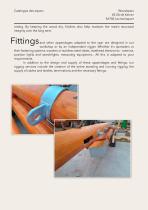
Woodspars 45 ZA de Kerran 56740 Locmariaquer rotting. By keeping the wood dry, finishes also help maintain the mast's structural integrity over the long term. and other appendages adapted to the spar are designed in our workshop or by an independent rigger. Whether it's spreaders or their fastening systems, wooden or stainless steel cleats, masthead electronics - antenna, position lights and searchlights, measuring equipment... All this is adapted to your requirements. In addition to the design and supply of these appendages and fittings, our rigging services include the creation of the entire...
Open the catalog to page 5
Woodspars 45 ZA de Kerran 56740 Locmariaquer Gaff rig Vanuatuan Lugger « Rembrandt van Rijn » The gaff rig is distinguished from other rigs by the use of one or more spars inclined aft, “gaff” or “jibs”, and the presence of auric sails, which are quadrangular sails. This type of rigging is often associated with emblematic sailboats, such as schooners with two or more masts, ketches or yawls. In the case of ketches, the foremast is shorter than the mainmast, while the opposite is true for yawls. Over time, the auric rig has been adopted by a variety of maritime cultures, finding its way onto traditional...
Open the catalog to page 6
Woodspars 45 ZA de Kerran 56740 Locmariaquer The main role of these masts is to support the sails and transmit the thrust of the wind to the boat. In traditional square rigging, the mast passes through a hole in the deck known as the “partner”, and rests on the keel or a sponge if attached to the deck. They are built to withstand the forces exerted by wind-driven sails. The shrouds allow better distribution of the forces exerted on the mast, by converting the bending exerted by the wind into compression in the mast axis. The design and construction of these masts therefore demands particular...
Open the catalog to page 7
Woodspars 45 ZA de Kerran 56740 Locmariaquer The spar is usually attached to the end of the sail by cars or sliders, allowing the angle of the sail to the wind to be adjusted. It can also be used to trim and spread the sail to optimize its performance in different wind conditions. is a spar located at the upper end of an auric sail, often used on traditional auric-rigged sailboats. It plays a crucial role in controlling and handling the sail, as well as optimizing its performance when sailing. It reinforces the structure of the sails and helps control their shape, and is designed to withstand...
Open the catalog to page 8
Woodspars 45 ZA de Kerran 56740 Locmariaquer is a part of a sailboat's rigging that extends horizontally from the stem, often protruding beyond the bow. It is used to support part of the headsails, such as the jib or genoa, away from the ship to improve their performance. The bowsprit is generally attached to the front of the main mast by the bowsprit or as an extension of the bowsprit, depending on the yacht's configuration. The length of the bowsprit can be adjusted to allow precise sail trim according to sailing conditions. The bowsprit is fitted with various accessories and devices, such...
Open the catalog to page 9
Woodspars 45 ZA de Kerran 56740 Locmariaquer produced in this way increases the durability of the spars, and more particularly the mast, as well as making it possible to manufacture hollow masts, which reduces the weight of the mast. Indeed, while the use of solid masts for maturing remains popular for the renovation of old rigging, it gives rise to a number of problems that glulam easily solves. In all cases where solid masts have been used for refurbishment, cracks, or girders, appear in the longitudinal direction of the wood, resulting from drying shrinkage. Logs selected for ship refurbishments...
Open the catalog to page 10All WoodSpars catalogs and brochures
 Woodspars Catalog
15 Pages
 Woodspars_29/03/2024
1 Page
Archived catalogs
 Fabricant de mât bois
1 Page