
- Catalogs
- Victron Energy
- ArgoDiode Battery Isolators

- Products
- Catalogs
- News & Trends
- Exhibitions
ArgoDiode Battery Isolators

ArgoDiode Battery Isolators
Catalog excerpts

Argo Diode Isolator 120-2AC Argo Diode Isolator 140-3AC victron energy LUE POWER Diode battery isolators allow simultaneous charging of two or more batteries from one alternator, without connecting the batteries together. Discharging the accessory battery for example will not result in also discharging the starter battery. The Argo Battery Isolators feature a low voltage drop thanks to the use of Schottky diodes: at low current the voltage drop is approximately 0,3 V and at the rated output approximately 0,45 V. All models are fitted with a compensation diode that can be used to slightly increase the output voltage of the alternator. This compensates for the voltage drop over the diodes in the isolator. Please see our book 'Energy Unlimited' or ask for specialist advice when installing a diode isolator. Simply inserting the isolator in the cabling between the alternator and the batteries will slightly reduce charge voltage. The result can be that batteries are not charged to the full 100% and age prematurely. Alternator energize input Some alternators need DC voltage on the B+ output to start charging. Obviously, DC will be present when the alternator is directly connected to a battery. Inserting a Diode or FET splitter will however prevent any return voltage/current from the batteries to the B+, and the alternator will not start. The new 'AC' diode isolators feature a special current limited energize input that will power the B+ when the engine run/stop switch is closed. Argo Diode Battery Isolator BLUE POWER Victron Energy B.V. | De Paal 35 | 1351 JG Almere | The Netherlands General phone: +31 (0)36 535 97 00 | Fax: +31 (0)36 535 97 40 E-mail: [email protected] | www.victronenergy.com
Open the catalog to page 1All Victron Energy catalogs and brochures
 Blue Smart IP22Charger
1 Page
 Blue Smart Charger
2 Pages
 MPPT 250/60 and MPPT 250/70
2 Pages
 BMV-712 Smart
2 Pages
 Centaur Charger
2 Pages
 Quattro Inverter/Charger120V
2 Pages
 Isolation Transformers
2 Pages
 Telecom Batteries
1 Page
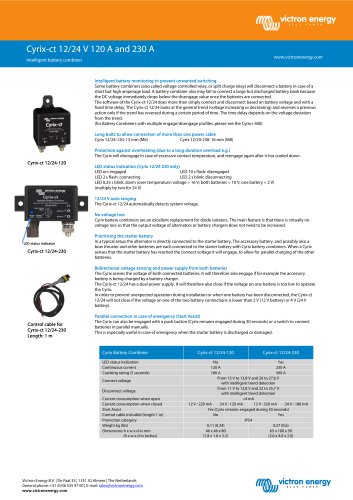 Cyrix-ct 12/24V120A and 230A
2 Pages
 Cyrix Li-ion 230A series
2 Pages
 Cyrix Li-ion 120 A series
2 Pages
 BatteryProtect
1 Page
 Phoenix Battery Charger
2 Pages
 Skylla 24/48V
2 Pages
 EasySolar 12V & 24V, 1600VA
2 Pages
 Gel and AGM Batteries
4 Pages
 Color Control GX
4 Pages
 Shore Power Cable
1 Page
 Battery Balancer
2 Pages
 Lynx Shunt VE.Can
32 Pages
 Filax 2
1 Page
 2021 Marine
120 Pages
 BlueSolar PWM-Pro
1 Page
 Mobility
8 Pages
 Energy Storage
64 Pages
 EasyPlus
4 Pages
 Autotransformer 120/240V -
2 Pages
 BatteryProtect 48V-100A
1 Page
 2016 Marine
108 Pages
 Skylla-i Battery Charger 24V
2 Pages
 Quattro 3kVA - 10kVA 230V
2 Pages
 Autotransformer 32A and 100A
2 Pages
 Phoenix Inverter 3000VA - 5000VA
96 Pages
 solarswitch
8 Pages
 vgr
vgr4 Pages
 victron multipower
4 Pages
 ECOmulti
2 Pages
 Brochure marine
108 Pages
 BlueSolar MPPT 150/70
1 Page
 BlueSolar MPPT 100/15
1 Page
 BMV-700 series
2 Pages
 Skylla-i
2 Pages
 Quattro
2 Pages
 Phoenix Charger
2 Pages




Archived catalogs
 Converters
2 Pages
 Marine Alternator
6 Pages
 Phoenix Inverter
2 Pages
 Battery Monitor
2 Pages
 Centuar Charger
2 Pages
 Phoenix MultiPlus
2 Pages
- Boat indicator
- Boat battery
- Boat monitoring and control panel
- Boat switch
- Boat charger
- Lithium battery
- Nautical display
- Boat cable
- 12 V battery
- Nautical battery switch
- Marine inverter
- Boat display
- Digital indicator
- DC converter
- Voltage converter
- Rigid solar panel
- Lead battery
- Electrical circuit switch
- 36 cells solar panel
- Boat selector