
- Catalogs
- Ullman Dynamics
- Slamming Standards


- Company
- Products
- Catalogs
- News & Trends
- Exhibitions
Slamming Standards

Slamming Standards
The document addresses the challenges of impact exposure on high-speed boats, emphasizing the link between such exposure and injury risk. It critiques current standards based on whole-body vibrations and stresses the importance of retaining raw data for accurate analysis.
Specifications and Standards
The European Union Directive 2002/44/EC sets conservative limits on impact exposure for professional boats, but these are often impractical. ISO standards focus on vibration rather than direct impacts, leading to potential underestimation of injury risks. The 2000 HSC CODE's Annex 10 addresses seat structural integrity but not shock mitigation.
Procedures and Recommendations
Boat builders often seek exceptions from EU directives by implementing shock-mitigation technologies. The document suggests using pain as an indicator of potential injury and advises operators to avoid discomfort-inducing conditions.
Research and Debate
Ongoing research aims to measure slamming impacts accurately and develop practical safety rules. Various methods like RMS, VDV, and Crest Factor are discussed, each with limitations.
Key Data and Analysis
Tests show suspension seats reduce high-g impacts significantly, but current standards fail to capture the severity of single impacts, risking structural failures and injuries.
Impact and Vibration
The document differentiates between impact and vibration, noting that mean vibration values do not predict injury risk from high-energy impacts.
Data Collection and Standards
Standardized methods for measuring whole-body impact exposure are needed. Current standards are outdated and do not reflect injury risks accurately. Sampling at 500 Hz to 800 Hz is recommended.
Safe Exposure Limits
There is no consensus on safe exposure levels, and existing standards may not prevent injury. New standards are necessary.
Technological Advancements
New devices with user-friendly interfaces facilitate impact exposure measurement. A major study will use these devices in a powerboat race.
Design and Safety Recommendations
Recommendations include using deeper-V hull shapes, implementing suspension seating, maintaining good posture, and avoiding standing during impacts.
Conclusion
Minimizing dangerous impact exposure requires good hull design, responsive drivetrains, proper seating, and skilled driving. More research is needed to establish relevant standards.
About the Author
Johan Ullman, an orthopedic specialist, founded Ullman Dynamics and the High-Speed Boat Operations Forum, advocating for improved standards and safety in high-speed boating.
Catalog excerpts

The magazine for those working in design, construction, and repair NUMBER 149 SLAMMING STANDARDS JUNE/JULY CAPSIZE: LESSONS LEARNED 2014 DAVID JONES & ASSOCIATES
Open the catalog to page 1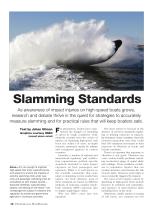
Slamming Standards As awareness of impact injuries on high-speed boats grows, research and debate thrive in the quest for strategies to accurately measure slamming and for practical rules that will keep boaters safe. Text by Johan Ullman Graphics courtesy HSBO (except where noted) Above—It’s not enough to engineer high-speed boat hulls, superstructures, and systems to endure the impacts of extreme slamming while under way; crew and passenger well-being must be considered as well. Impact injuries— fractured vertebrae, ruptured disks, sprains, and tearing of soft tissue—are increasingly the subject...
Open the catalog to page 2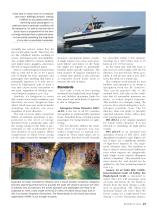
A fast boat in motion even on a relatively calm sea is bafflingly dynamic, making it difficult to accurately predict the slamming loads passengers in a particular boat in particular conditions will be exposed to. It’s safe to say that risk of acute injury is proportional to the level of energy absorbed from a particular slam, but accurately predicting the magnitude of any slam is practically impossible. structure, mechanical failure results. A single impact can cause such struc tural failure and injury in the body but might not register as potentially harmful under specific standards. The total...
Open the catalog to page 3
Some of the most extreme slamming must be endured by military, rescue, and other government employees engaged in hazardous duties. This jet-powered 50' (14.9m) Combat Boat 90 (CB90), built for the Swedish special forces by Docksta Shipyard (Docksta, Sweden), can deliver to beach landings as many as 18 fully equipped soldiers at speeds up to 50 knots. Seats claimed to comply with this standard are known to have failed, contributing to operator injury. This standard has no bearing on the shock-mitigating function or perfor mance of suspension seats. Maritime and U.K. Coastguard Agency Marine Guidance...
Open the catalog to page 4
Free fall Steady state Platform filtered Seat filtered Platform raw Seat raw Platform 10 Hz LPF Seat 10 Hz LPF Time (ms) Graphing filtered and raw impact data of seat testing shows how even a good filter can somewhat skew specifics. The difference in magnitude of accelerations is as much as 10%, but there is also a slight displacement in time of the impacts, measured here in milliseconds. As commonly applied by some researchers, a low-pass filter (LPF) at 10 Hz reduces the 11.7 g raw platform impact (dark blue line) to just 5.9 g (purple line). This is why it’s useful to retain original (raw)...
Open the catalog to page 5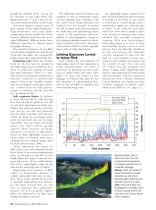
The difference between impact and vibration is easy to understand: watch a boxer jumping rope (vibration), and the same boxer being knocked out (impact). It is not possible to predict the risk of injury caused by that impact by analyzing and quantifying mean values of the preceding vibration. Indeed, it is the limitations of many of the existing standards based on wholebody vibrations that drive discussion and research efforts to better quantify injury risks on high-speed boats. Linking Exposure Levels to Injury Risk Pain remains the best indicator of impending injury. If the slamming is really...
Open the catalog to page 6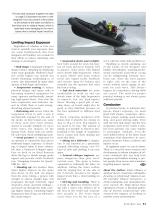
The test boat employed to gather the data on page 53 illustrates that even a welldesigned V-hull can present a flat surface to the surface of the water and deliver a hard slam and an oblique impact, which is potentially more damaging to the crew’s spines than a vertical impact would be. Limiting Impact Exposure Regardless of whether or how you want to quantify your exposure, here are some fundamentals that boat designers and builders can consider in their efforts to reduce slamming, and damage to passengers. • Hull shape is important. Deeper-V shapes reduce slamming by displacing water more gradually....
Open the catalog to page 7
better boats begin september 30–october 2, 2014 | Tampa ConvenTion CenTer, Tampa, Florida new CiTy. new TeChnology. a whole new experienCe. IBEX brings its marine technology showcase to the Tampa Convention Center in 2014 with thousands of new products, advanced processes, and impressive innovation. Docks filled with boats, exciting networking, easy travel, and training seminars you won’t find anywhere else make IBEX 2014 an event you will NOT want to miss. www.ibexshow.com/pbb 54 Professional BoatBuilder
Open the catalog to page 8All Ullman Dynamics catalogs and brochures
 The Atlantic document
3 Pages
 Atlantic Crew Fold UP
3 Pages
 Designing Consoles for Speed
9 Pages


- ULLMAN 1-person seat
- ULLMAN boat seat
- Helm seat
- Seat with armrests
- Adjustable seat
- High-back seat
- Black seat
- Ship seat
- Fold-down seat
- ULLMAN seat with suspension
- Bucket seat
- Seat with lumbar support
- Aluminium seat
- Operator seat
- Offshore power boat seat
- Stainless steel seat
- Yacht seat
- Reclining backrest seat
- Sliding seat
- Jockey seat