
- Catalogs
- Ullman Dynamics
- Designing Consoles for Speed


- Company
- Products
- Catalogs
- News & Trends
- Exhibitions
Designing Consoles for Speed

Designing Consoles for Speed
High-speed boats are increasingly used by military, coast guard, sea rescue, and law enforcement agencies, as well as for recreational purposes. Advances in propulsion technologies, hull design, and composite materials have enhanced speed and power. However, these advancements necessitate optimizing safety and comfort due to increased physical impacts and reduced reaction times for operators.
The design of steering consoles is crucial for enhancing safety, control, and comfort. Key recommendations include:
- Top Surface: Should slant down forward to minimize dead-space and shed water, ensuring clear visibility over the bow.
- Screens: Plotter screens should be inclined 12°–16° forward to reduce glare, with the center line pointing just below the operator’s chin. Screens should be high enough to maintain peripheral visibility of the sea.
- Helm and Throttle: Should be inclined 45°–60° from horizontal, with the throttle positioned for easy forward-backward adjustments.
An open console should provide wind and spray protection, allowing operators to maintain a balanced posture with optimal vision and control. Side-by-side seating facilitates communication and control access in emergencies. Single-driver consoles are only recommended for boats with a narrow beam.
Console sidewalls should converge forward to optimize wind and spray deflection. A well-designed windscreen with a negative angle can create a protective airflow bubble, reducing wind impact on operators.
The semi-standing straddle position is optimal for impact resistance and control. Console design should accommodate a range of body heights without adjustable seat heights, focusing instead on alternative foot supports.
Effective console design, considering ergonomics and aerodynamics, is essential for the safety and performance of high-speed boats. These designs should be verified through practical sea trials to ensure optimal functionality.
Catalog excerpts

Designing Consoles for Speed Optimizing steering console geometry on high-speed boats enhances their safety, control, and comfort. Text and graphics by Johan Ullman Above—The console of this Russ 750 GTR, from the French company Russ RIBS, was designed in consultation with author Johan Ullman. In this example of good console design for high-speed operations, even though the helmsman and passengers sit in bucket seats instead of in the optimal semi-standing straddle seats, shown in the following pages. 62 Professional BoatBuilder H igh-speed boats are being built in growing numbers for military, coast guard, sea rescue, and law enforcement agencies, and builders of recreational boats are taking similar advantage of advances in propulsion technologies, hull design, and composite materials to deliver ever-faster boats to the boating public. Indeed, civilian models of military vessels and military styling on recreational vessels are popular trends in the design and marketing of new powerboats. Whether they are recreational or professional, these models offer increased speed and power over more conventional boats and the suggestion that they are capable of operating at speed in harsh conditions. Naturally, these trends increase the need to optimize safety and comfort on board. Higher speeds expose boat operators and passengers to higher impacts, causing significant physical fatigue and increasing the risk of injuries such as vertebral fractures and disk herniations. As a practical operational limitation, higher speed also reduces the time helmsmen have to perceive unexpected events and to correct operational mistakes. Performance, control, comfort, and safety can be greatly enhanced on these vessels simply by getting the
Open the catalog to page 1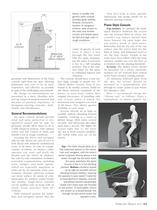
14° 14° 13.8" (35cm) 51.6" (131cm) 92° 130° Shown in profile, this generic helm console provides good visibility forward, convenient location of navigation screens, easy access to the helm and throttle control, and ample space for feet and legs, even in rough conditions. center of gravity of each torso is above a line Wheel hub through the hip joints 37.4"–39.4" 25.6" with the spine maintain(95cm–100cm) (65cm) ing the same S-curvature it has in a full standing position. This is the optimal shape for the spine to withstand impacts and vibration. The console should have a rear surgeometry and dimensions...
Open the catalog to page 2
Left—The wheel should be mounted so the steering column points toward the operator’s shoulders. That way, any bracing force applied by the helmsman during high-speed operations will be in the same general direction as the wheel shaft. Right—Orient throttle controls so that at cruising speed they point straight up; this allows for better fine adjustment by a hand at about elbow level. Left—Below the helm and throttle plane, the console should be cut away (about 45° from vertical) to provide space for the operator’s knees to flex. The area should be clear of obstructions such as ignition or power...
Open the catalog to page 3
Aerodynamics Left—Placing helmsman and navigator side by side puts two sets of eyes on the water, a real advantage during high-speed operations in rough weather or sea conditions. It also facilitates nonverbal communication and enables two people to reach the boat controls in the event of an accident or injury. Right—A slight “kick” angle at the trailing edge of the console will help deflect wind and spray. or her right hand and placing the controls within the copilot’s reach in an emergency. (Note: The inverse is true for left-side-travel countries, where throttles and shifters are most commonly...
Open the catalog to page 4
Closed or Semi-open Cabin A cabin dashboard in a high-speed vessel should have the same geom etry as one in a console dashboard. The inside width of a cabin should be at least 59" (150cm) to allow passage past a second row of occupied seats. The width of a semi-open console for just two can be narrower. T-Top Optimally, the legs supporting a T-top should have a diameter of 2.2" (55mm) or less so they will not reduce the field of vision. Pupillary distance is normally 2.2"–2.8" (55mm–70mm), meaning that a narrower object will allow the brain to the see the whole picture behind it without a blind...
Open the catalog to page 5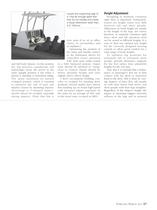
Locate the supporting legs of a T-top far enough apart that they do not overlap and create a visual obstruction wider than 2.2" (55mm). and full body balance. In this position the leg muscles—quadriceps and hamstrings—keep the pelvis in the same upright position it has when a person is standing or horseback riding. The spine maintains its natural S-shaped posture, which is essential to minimize the risk of pain and injuries caused by slamming impacts. Slouching—a C-shaped spine— should always be avoided, especially during impacts. (Note that this is how most of us sit in office chairs, in automobiles,...
Open the catalog to page 6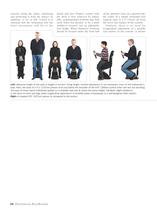
muscles along the spine, stabilizing and protecting it from the impact. In addition, to be in full control it is essential that the helmsman feel the boat’s movements with his or her hands and feet. Positive contact with the deck is best achieved by adjustable, nonsuspended footrests that fold away when not needed, or by a fixed multilevel footrest, not an adjustable seat height. When deployed, footrests should be located under the front half of the operator’s foot. As a general rule, the center of a simple horizontal foot support pipe is 5.1" (13cm) aft from the lower rear surface of the console....
Open the catalog to page 7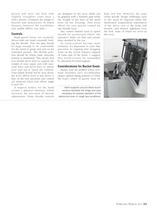
person will drive the boat with slightly straighter arms than a taller person. (Compare the design to bicycles and motorcycles, in which distance between the handlebars and saddle differs very little.) Controls High-speed boats are normally driven with one hand constantly holding the throttle. Thus the grip should be large enough to be comfortable for the hand to grasp and rest on for extended periods. The throttle position should be where static muscular tension is minimized. This means that you should never have to support the weight of your upper arm with muscular force and never have to stretch...
Open the catalog to page 8All Ullman Dynamics catalogs and brochures
 The Atlantic document
3 Pages
 Atlantic Crew Fold UP
3 Pages
 Slamming Standards
8 Pages

