
- Catalogs
- Trelleborg Marine and Infrastructure
- Guide - Rubber Compound Specification


- Products
- Catalogs
- News & Trends
- Exhibitions
Guide - Rubber Compound Specification

Guide - Rubber Compound Specification
The document emphasizes the importance of rubber type and compound composition in the performance of marine fenders. It highlights that the correct formulation is crucial for ensuring a long and robust service life.
Key Factors Affecting Fender Performance
Three main factors influenced by rubber grade and compound formulation are velocity factor, temperature factor, and longevity. The document stresses that rubber compound composition should be included in specifications to guarantee performance and lifecycle.
Specification for Chemical Composition
This specification is intended to guide specifiers in ensuring the correct rubber compound composition. It does not apply to standard cylindrical and extruded fenders unless requested.
Testing Procedures
Before Production: Vendors must provide a tensile slab for testing at an independent laboratory to ensure compliance with specifications. Testing includes TGA and FTIR.
After Production: Vendors must submit two samples from the final product for testing. The samples can be thin pieces sliced from the fender body without causing damage.
Rubber Compound Specification
The document lists specific standards for density, polymer content, carbon black, ash, and rubber filler ratio. Compliance with these specifications is verified through independent testing.
Quality Control Practices
Physical properties are typically tested at the manufacturer's laboratory. However, chemical composition tests are essential both before and after production to guarantee results.
Physical Property Standards
The document provides detailed standards for various physical properties, including tensile strength, elongation at break, hardness, compression set, tear resistance, ozone resistance, seawater resistance, abrasion, bond strength, and dynamic fatigue. Each property has specific testing standards and conditions that must be met to ensure high performance and longevity of the fenders.
Catalog excerpts

Rubber Compound Specification By far the most important factor affecting fender performance is rubber type and rubber compound composition. However, the behaviour of rubber under stress is unique, so it’s essential that precisely the right formulation is specified and – critically, finds its way to the final product – to ensure a long and robust service life. Three key factors – velocity factor, temperature factor and longevity are affected by rubber grade and compound formulation in marine fenders. The properties of fenders vary dramatically depending on their composition, as such; rubber compound composition should be built into specifications in order to guarantee performance and lifecycle. This model specification is intended to guide specifiers in ensuring the correct rubber compound composition. Please copy and paste from this document when specifying rubber fenders to ensure your supplier can provide the compound composition and physical properties required to optimise performance and guarantee longevity. Specification for chemical composition of moulded fenders Test Polymer (rubber) Carbon Black Rubber filler ratio * Does not apply to standard cylindrical and extruded fenders; however, can be supplied upon special request. Testing your supplier’s products Before production: The vendor is required to provide a tensile slab measuring 150mm L x 150 mm W x 2mm T. [Insert name of specifier] will submit this sample for testing at an independent third party laboratory, to determine compound complies with specification. Testing will include TGA and FTIR testing to ensure compliance with the above rubber compound composition specification. After production: The vendor will be required to submit two samples (approximately 50 grams each collected in the presence of the buyer or a third party appointed by the buyer) from the final product. The fender will be selected at random by [Insert name of specifier]. The sample does not necessarily have to be in one piece, it can be thin pieces sliced or scraped by a sharp knife, from the fender body without damaging the fender. If the fender sample collection is damaged, it should be repaired before the product is desp
Open the catalog to page 1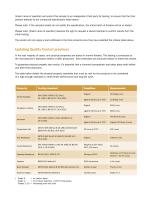
[Insert name of specifier] will submit this sample to an independent third party for testing, to ensure that the final product adheres to the compound specification listed above. Please note: if the samples tested do not satisfy the specification, the entire batch of fenders will be re-tested . Please note: [Insert name of specifier] reserves the right to request a second sample to confirm results from the initial testing. The vendor will only apply a test certificate to the final products once they have satisfied the criteria listed above. Updating Quality Control practices In the vast majority...
Open the catalog to page 2All Trelleborg Marine and Infrastructure catalogs and brochures
 Bollard infographic
1 Page
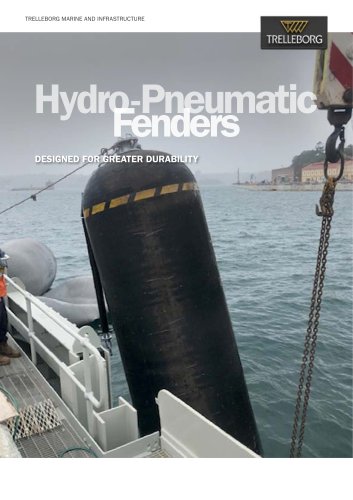 Hydro-Pneumatic Fenders (HPNE)
10 Pages
 Foam Fenders & Buoys
24 Pages

Archived catalogs
 SafePilot brochure
20 Pages
 Fender Systems
86 Pages
 AutoMoor Brochure
24 Pages
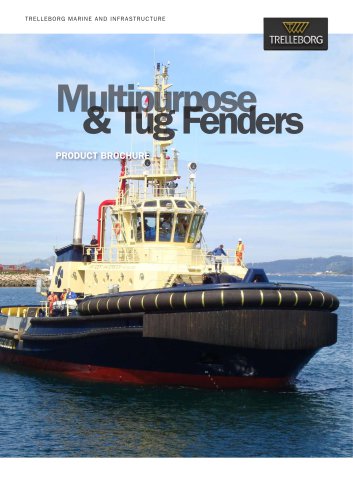
 Multipurpose and Tug Fenders
44 Pages
 Solid SmartFender Factsheet
2 Pages
 Fender Application Design Manual
88 Pages
 Bollards
28 Pages
 Pneumatic Fenders brochure
28 Pages
 DynaMoor
20 Pages
 Rolling Fenders and Safety
18 Pages
 Ship-Shore Links Factsheet
4 Pages
 TRELLEBORG’S Tugger Winch
2 Pages
 Universal Safety Link
3 Pages
 Docking & Mooring
88 Pages
 Performance Monitoring
3 Pages
 SmartDock ® Display Board
4 Pages
 LNG Infographic
8 Pages
 SmartMoor Series II
7 Pages
 Surface Buoyancy
24 Pages
 TRELLEBORG DYNAMOOR
4 Pages
 Accessories
10 Pages
 SmartDAS Factsheet
2 Pages
 Capstans
4 Pages
 Remote Release System
6 Pages
 lload monitoring software
2 Pages
 Barometer Report 2
7 Pages
 lload monitoring systeme
5 Pages
 Guide - Fenders
8 Pages
 Mini Guide - Foam Fenders
5 Pages
 Barometer Report 3
16 Pages
 Hawser Hooks
6 Pages
 Whitepaper - Correction Factors
10 Pages
 Buoy Range Table
2 Pages
 SafePilot CAT XT System
2 Pages
 AutoMoor Datasheet
4 Pages
 Ship Shore Link System
3 Pages
 Combined ESDS & SSL
3 Pages
 Prelude LNG
1 Page
 Floating Fenders
48 Pages
 Emergency Shutdown Link
3 Pages
 Safepilot SmartPort System
16 Pages
 SafePilot User Guide
30 Pages
 Docking and mooring
2 Pages


- Nautical buoy
- Ship winch
- Motorboat fender
- Dock fender
- Plastic buoy
- Floating boom
- Cylindrical fender
- Black fender
- Hydraulic drive winch
- Trelleborg harbor fender
- Containment boom
- Inflatable fender
- Trelleborg pier fender
- Manual ladder
- Nautical mooring buoy
- Nautical capstan
- Polyethylene buoy
- Sheltered waters boom
- Anchor chain