
- Catalogs
- Tikal Marine Systems
- Chemical Resistance TIKALFLEX Contact 12

- Products
- Catalogs
- News & Trends
- Exhibitions
Chemical Resistance TIKALFLEX Contact 12
Chemical Resistance TIKALFLEX Contact 12
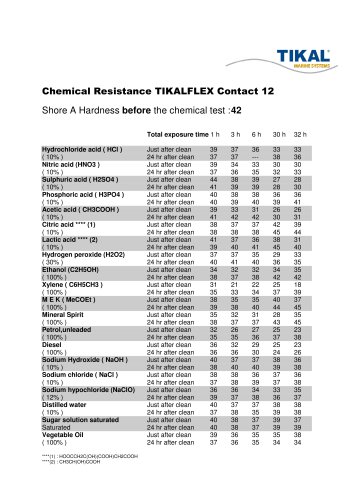
- Hydrochloric Acid (10%): Hardness decreased to 33 after 32 hours, with slight recovery after 24 hours.
- Nitric Acid (10%): Hardness reduced to 30 after 32 hours, with minor recovery after 24 hours.
- Sulphuric Acid (10%): Significant decrease to 28 after 32 hours, with partial recovery after 24 hours.
- Phosphoric Acid (10%): Maintained hardness around 36-41 throughout the test.
- Acetic Acid (10%): Hardness dropped to 26 after 32 hours, with recovery to 31 after 24 hours.
- Citric Acid (10%): Hardness increased to 44 after 32 hours, showing good resistance.
- Lactic Acid (10%): Hardness increased to 45 after 32 hours, indicating strong resistance.
- Hydrogen Peroxide (30%): Hardness decreased to 33 after 32 hours, with some recovery after 24 hours.
- Ethanol (100%): Hardness increased to 42 after 32 hours, showing good resistance.
- Xylene (100%): Hardness decreased significantly to 18 after 32 hours, with recovery to 39 after 24 hours.
- MEK (100%): Hardness increased to 45 after 32 hours, indicating strong resistance.
- Mineral Spirit (100%): Hardness increased to 45 after 32 hours, showing good resistance.
- Petrol, Unleaded (100%): Hardness decreased to 23 after 32 hours, with recovery to 38 after 24 hours.
- Diesel (100%): Hardness decreased to 23 after 32 hours, with minimal recovery.
- Sodium Hydroxide (10%): Hardness remained relatively stable, around 36-40.
- Sodium Chloride (10%): Hardness remained stable, around 36-39.
- Sodium Hypochlorite (12%): Hardness remained stable, around 33-38.
- Distilled Water (10%): Hardness remained stable, around 35-39.
- Sugar Solution (Saturated): Hardness remained stable, around 37-40.
- Vegetable Oil (100%): Hardness decreased slightly to 34 after 32 hours.
Catalog excerpts

Chemical Resistance TIKALFLEX Contact 12 Shore A Hardness before the chemical test :42 Total exposure time 1 h 3 h 6 h Mineral Spirit Sodium Hydroxide ( NaOH ) Sodium chloride ( NaCI) Sodium hypochloride (NaCIO) Distilled water Sugar solution saturated Just after clean 39 37 36 Just after clean 39 34 33 Just after clean 44 38 39 Just after clean 40 38 38 Just after clean 39 33 31 Just after clean 38 37 37 Just after clean 41 37 36 Just after clean 37 37 35 Just after clean 34 32 32 Just after clean 31 21 22 Just after clean 38 35 35 Just after clean 35 32 31 Just after clean 32 26 27 Just after clean 36 32 29 Just after clean 40 37 37 Just after clean 38 38 36 Just after clean 36 36 34 Just after clean 40 37 37 Just after clean 40 38 37 Just after clean 39 36 35
Open the catalog to page 1All Tikal Marine Systems catalogs and brochures
 Tikalflex Contact 12 /Clear 10
10 Pages
 Prop Gel
2 Pages
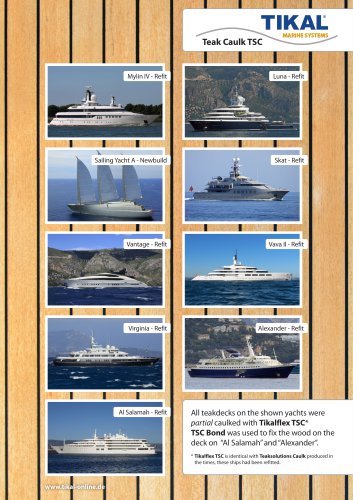 Teak Caulk TSC
1 Page
 TIKALFLEX clear 10
1 Page
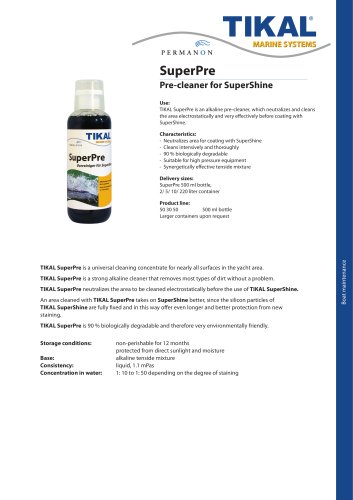 ti_tikal_superpre
1 Page
 ti_tikal_supershine_en
1 Page
 ti_tikal_basic_en
1 Page

Archived catalogs
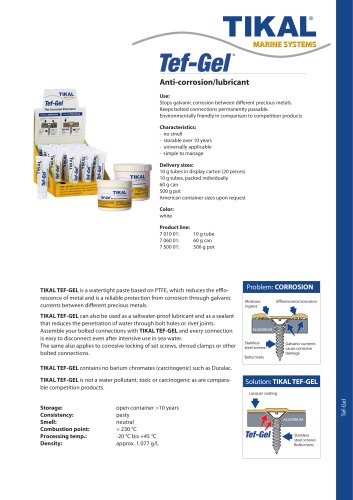 Tef Gel - Anti-Corrosion
1 Page
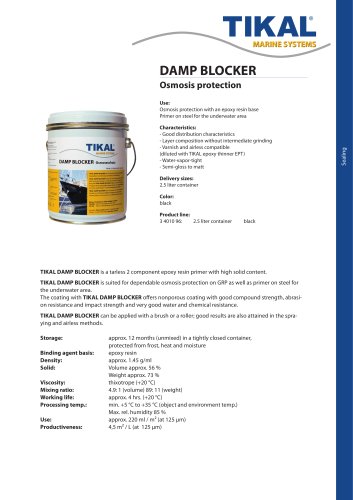 TIKAL DAMP BLOCKER
1 Page
 TIKAL WOODCOAT
1 Page
 TIKALFLEX primer P
1 Page
 TIKALFLEX flatcontact 22
1 Page
 TIKAL FAST PATCH
1 Page