
- Catalogs
- Teignbridge
- The Advantages Temet 25 Shaft Material


- Products
- Catalogs
- News & Trends
- Exhibitions
The Advantages Temet 25 Shaft Material

The Advantages Temet 25 Shaft Material
Temet 25 is a high-strength duplex stainless steel alloy known for its exceptional corrosion resistance in seawater, making it ideal for pleasure boat shafts.
Developed in the late 1980s by Teignbridge, Temet 25 was created to meet the demand for a material combining toughness, strength, and corrosion resistance, particularly for high-powered diesel motor yachts and workboats. It was introduced to the market as a cost-effective alternative to materials like Monel K500 and Aquamet 22.
Studies conducted by Lloyds Register of Shipping and Exeter University tested Temet 25 against other stainless steels (Aquamet 22, Type 316, Type 304, and Type 17-4PH) using a 5% ferric chloride solution. Temet 25 showed only trace pitting, outperforming the other materials in reducing crevice corrosion.
Corrosion fatigue tests were conducted to validate Temet 25's superiority. Samples were subjected to rotating bending loads in synthetic salt water. Temet 25 demonstrated significantly better performance, with a fatigue loading at 108 cycles recorded at 320 N/mm2, compared to lower values for Aquamet 17, Aquamet 22, and Type 316 SS.
Temet 25 offers improved corrosion and fatigue resistance, suggesting potential for reduced shaft diameters or increased longevity when used at the same diameter as other materials.
Catalog excerpts
The Advantages Temet 25 Shaft Material 1. 2. IMPROVED CORROSION RESISTANCE IMPROVED FATIGUE RESISTANCE What is Temet 25 ? Temet 25 is a special high strength duplex stainless steel alloy. It has outstanding resistance to corrosion in seawater which makes it an ideal material for pleasure boat shafts. History & Technical Advantages Temet 25 was developed in the late 1980’s, when the Teignbridge Technical Department was challenged to find a stainless steel that had a combination of toughness, strength and resistance to corrosion. With more high powered diesels being fitted to motor yachts and workboats alike, the objective was to develop a product superior to other materials used for boat shafting. Not only did Teignbridge achieve this goal in the production of Temet 25, a High Performance Duplex Steel, but we successfully introduced Temet 25 into the market at highly competitive price compared to materials such as Monel K500 and Aquamet 22. Once its development was complete, Teignbridge Propellers contracted Lloyds Register of Shipping (Lloyds) and Exeter University to undertake two studies with respect to the suitability of Temet 25 in the marine environment. The first part of the study investigated the corrosion resistance of the material and the second part of the study was a fatigue test of the material. In each test a representative sample of shafting materials were presented. The samples included Temet 25, Aquamet 22, Type 316, Type 304 and Type 17-4PH stainless steels. In the corrosion test the samples were stamped with an identification code and were fitted with a series of tight fitting ‘O’ rings. The specimens were then exposed to 5% ferric chloride solution at room temperature over a period of 48 hours. The ‘O’ rings were removed at time intervals of 1, 2, 4, 8, 24 and 48 hours. This test was carried out under the supervision of a Lloyd’s Register of Shipping (LRS) surveyor. The results show that the Temet 25 sample had only a trace amount of pitting, followed by Aquamet 22, Type 316, Type 304 and finally Type 17-4PH, making Temet 25 material clearly superior in reducing the premature failure due to crevice corrosion.
Open the catalog to page 1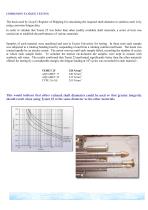
CORROSION FATIQUE TESTING The basis used by Lloyd’s Register of Shipping for calculating the required shaft diameter in stainless steel is by using corrosion fatigue data. In order to validate that Temet 25 was better than other readily available shaft materials, a series of tests was carried out to establish the performance of various materials. Samples of each material were machined and sent to Exeter University for testing. In these tests each sample was subjected to a rotating bending load by suspending a load from a rotating cantilevered beam. The beam was rotated rapidly by an electric...
Open the catalog to page 2Archived catalogs
 TPL.Brochure
4 Pages
- Fixed-pitch propeller
- Shaft drive propeller
- Nautical boat propeller
- 4-blade propeller
- 3-blade propeller
- Mechanical coupling
- Bronze propeller
- 5-blade propeller
- Boat mechanical coupling
- Aluminum propeller
- Shaft mechanical coupling
- Nautical ship propeller
- Rigid mechanical coupling
- Yacht propeller
- Custom-made propeller
- Nickel propeller
- 6-blade propeller