

- Company
- Products
- Catalogs
- News & Trends
- Exhibitions
Data-sheet

Data-sheet
The "marinaSCAN" IoT sensor system is designed to provide real-time data on berth occupancy using optical and acoustic sensors. Data is transmitted to a central database via LoRa-WAN or NB IoT.
- Energy self-sufficient with solar panel power generation.
- No moving parts and easy replacement of electronics.
- LEDs with independent brightness control.
- Constructed with UV and saltwater-resistant materials.
- Aluminum housing and injection-molded plastic electronics.
- Tread-resistant solar cell.
- Weight: Approximately 2.7 kg (±100g).
- Dimensions: 377 x 281 x 36 mm (l,b,h ±2mm).
- Operating temperature: -20°C to 50°C.
- Humidity range: 0% to 85%.
- Guarantee: 2 years.
- Wireless data transmission.
- Protocols: LoRa Wan, NFC, QR, Bluetooth, NB IoT.
- Optical sensors: 1 x ToF, 1 x brightness sensor.
- Acoustic sensors: 2 x ultrasound in/out.
- Distance measurement: 20 – 500 cm (Ultrasound), 20 – 200 cm (ToF).
- Internal sensor: 1 x acceleration sensor.
- Base plate: Aluminum, UV and saltwater resistant.
- Electronic unit: Injection molding, UV and saltwater resistant.
- Viewing window: Acrylic glass, UV and saltwater resistant.
- Mounting material: Stainless steel screws.
- 16 x RGB front LEDs, 2 x RGB rear LEDs.
- Automatic brightness control.
- Available in various RGB colors.
- Battery: 2 x LiPo, each 2200mA.
- Maximum performance: 4.2 V.
- Charging: Solar modules, energy self-sufficient.
- Solar panel dimensions: 200 x 350 x 2.5 mm.
- Maximum performance: 6.7 V.
Catalog excerpts

Data sheet: IoT sensor technology 2024 "marinaSCAN" Generate live data from the berth and control availability. The marinaSCAN sensor system was developed to determine information on the occupancy status of a berth in real time. The information is recorded using optical and acoustic sensors. All information is transmitted to a central database either via Lora-WAN or NB IoT. Overview: - The module is energy self-sufficient and generates its power via a solar panel - No moving parts - Revisable electronics inlay for easy replacement of defective electronics - Independent, brightness-dependent control of the LEDs - UV-resistant materials - Saltwater-resistant materials - Basic housing made of aluminum, electronic unit made of injection-molded plastic - Tread-resistant solar cell
Open the catalog to page 1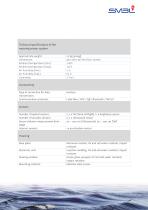
Technical specifications of the mooring sensor system
Open the catalog to page 2