- Products
- Catalogs
- News & Trends
- Exhibitions
General Catalogue
General Catalogue
Kongsberg Discovery, part of the Kongsberg Group, specializes in advanced technology solutions for sectors such as fishery, subsea, and offshore applications. Their expertise includes hydroacoustics, robotics, and communication technologies, supporting sustainable practices in fisheries.
SIMRAD, a Kongsberg brand, focuses on sustainable fisheries through technology. Their products, like echosounders and gear monitoring instruments, enhance fishing efficiency by targeting specific fish sizes and species, reducing by-catch, and minimizing environmental impact.
Founded in 1947, SIMRAD pioneered sonar and echosounder technology, introducing innovations like the first split beam echosounder in 1985 and multi-frequency transducers.
SIMRAD produces various transducers, including single beam, split beam, and wideband types, using ceramic and composite materials to enhance efficiency and accuracy.
The TU40 synchronizes multiple acoustic devices on fishing vessels to prevent interference, ensuring clear echograms for accurate fish detection. It is compatible with various commercial acoustic equipment.
Kongsberg Discovery, through SIMRAD, continues to innovate in fishery technology, promoting sustainable practices and enhancing fishing operations' efficiency and profitability.
The TU40 manages trigger sequences for acoustic equipment, operating independently of software applications once configured, ensuring optimal performance through an intelligent algorithm.
This unit provides real-time compensation of vessel motion, offering accurate roll, pitch, and heave data to fishery sonars and echosounders, with features like high data output rate and low power consumption.
Designed for fishery applications, FishNet facilitates real-time data transfer between vessels, enhancing operational efficiency and safety, supporting remote operations for pair trawling and purse seining.
An IMO type-approved gyro compass offering high reliability and accuracy, functioning as both an inertial navigation system and a gyro compass.
These sensors integrate with navigation systems without external displays, promoting a streamlined bridge environment and reducing response times for navigators.
Kongsberg Discovery manufactures scientific echosounder systems crucial for marine research and fishery management, with the EK80 systems offering high-quality measurements across various frequencies.
The NVC-series vessels are optimized for performance and fuel efficiency, minimizing underwater noise and enhancing propulsion interaction.
Details on various sonar models, including the ST90, SU90, SX90, and MF90, each offering features like high resolution, long-range detection, and advanced signal processing to improve fishing efficiency and sustainability.
Designed for coastal fleets, offering features like full beam stabilization, dual view, and FM transmissions, with a compact design simplifying installation.
The first matrix sonar in the market, ideal for trawlers with a 120° swath and tiltable beams, capable of detecting fish close to the bottom with high resolution.
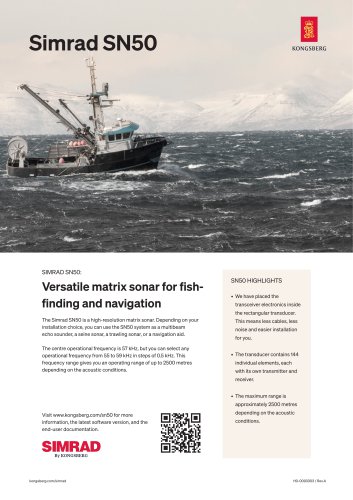
Based on SY50 technology, offering easy installation and low noise operation, with matrix sonar design providing focused coverage.
Details on processing units, transceiver units, and hull units for different sonar models, including voltage requirements, consumption, operating frequencies, and beam coverage.
Explains factors affecting sonar performance such as temperature, ship noise, and installation differences, illustrating how environmental conditions can alter sonar range and effectiveness.
SIMRAD's range of echosounders offers models with frequencies from 18 kHz to 200 kHz, with advanced receiver technology ensuring clear depiction of seabed and fish.
Designed for high-performance applications, featuring four 500 W channels, supporting a frequency range from 10 kHz to 500 kHz, and operating in narrowband or wideband mode.
Offers high resolution across all ranges with a dynamic range of 140 dB, capable of detecting echoes from plankton to whales, using split beam technology for accurate fish size estimation.
A cost-effective system integrating with existing setups, measuring up to five layers of current, providing speed and direction data.
SIMRAD's gear monitoring solutions provide vital information for efficient and safe fishing operations, with the PX sensor family offering various configurations for measuring depth, speed, and position.
Allows quick switching between predefined views using function keys, with a recording function for data replay or export, and a built-in spectrum analyzer for stable sensor data readings.
Provide real-time data on trawl operations, integrating with a third wire system for enhanced control and efficiency.
A next-generation trawl monitoring system offering real-time video and data streaming, supporting various deployment options.
Provides instant images of net openings and fish entry, using multibeam technology to improve detection near the seabed.
Contact information for Kongsberg Discovery's main service centers and distributors worldwide is listed for customer support.
Catalog excerpts

General Catalogue Fishery Products
Open the catalog to page 1
Kongsberg Discovery Protechting people and planet
Open the catalog to page 2
Kongsberg Discovery has a long history of providing products, systems, and solutions for commercial and non-commercial customers in the broader Ocean Space, encompassing subsea, offshore, merchant, fishery, naval, onshore and space applications. We are constantly working alongside industry, authorities, institutes, and other key stakeholders to understand the evolving nature of their requirements and needs. With decades of in-house competence and experience, we are a trusted technology partner for our customers. Our strong technology backbone within hydroacoustics, robotics, inertial navigation,...
Open the catalog to page 3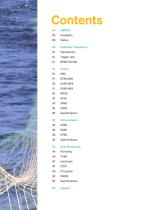
08 Fishfinder Transducers 10 Transducers 12 Trigger Unit 14 BR90 FishNet
Open the catalog to page 5
KONGSBERG DISCOVERY | Innovation
Open the catalog to page 6
SIMRAD More than 75 years of innovation SIMRAD's slogan is “Technology for sustainable fisheries” and we live by this slogan every day. SIMRAD believes that a sustainable fishery worldwide is the only right way to survive. By sustainable we mean a healthy take out of the world fish stocks as well as an efficient and profitable fishery for the fisherman. SIMRAD believes that technology is an important factor to achieve this. Products that we believe have contributed to a sustainable fishery are Echosounders with a split beam technology: this makes it possible to catch the right size fish. Gear...
Open the catalog to page 7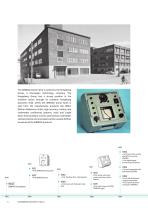
The SIMRAD brand name is owned by the Kongsberg Group, a Norwegian technology company. The Kongsberg Group has a strong position in the maritime sector through its company Kongsberg Discovery (KD), where the SIMRAD brand name is sold from. KD manufactures products like MRUs (Motion Reference Units), high accuracy surface and underwater positioning systems, multi and single beam echosounders, sonars, autonomous underwater vehicles (AUVs) and uncrewed surface vessels (USVs), as well as all the SIMRAD products. • First TrawlEye (FH, cable based) ll 1968 • First sonar with hydraulic hoist (SU) •...
Open the catalog to page 8
History SIMRAD was founded in 1947 by Mr. Willy Simonsen. The name SIMRAD derives from “SIMonsen RADio” and, as the name indicates, it all started with radios. But this shortly developed into echosounders and sonars. Today, SIMRAD is recognised all over the world for premium performance products, manufacturing sonars, echosounders and Gear Monitoring equipment. • First composite sonar (SC90) 1992 • First Trawl Sonar (FS3300) • First multi frequency sonar (SP270) 2002 • First composite transducer • Fishery sonar with Hyperbolic FM technology (SX90) 2017 • First matrix sonar for trawlers • CS90...
Open the catalog to page 9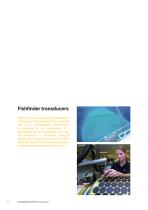
SIMRAD is one of the very few producers of transducers. The transducer is an important part of an echosounder's performance. A transducer is the combination of a microphone and a loudspeaker, all in one. The transducer is converting electrical energy into sound waves and vice versa. What you see on the echosounder screen is actually echoes from transmitted sound. 8 KONGSBERG DISCOVERY | Transducers
Open the catalog to page 10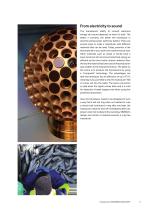
From electricity to sound The transducers' ability to convert electrical energy into sound depends on how it is built. The better it converts, the better the transducer is (and the echosounder performs better). There are several ways to make a transducer with different materials that can be used. Today, ceramics is the best material to use, seen from a performance view. Other materials such as nickel or ferrite have a lower price but will not convert electrical energy as efficient as the more costly ceramic material. Also, the way the material has been used in the production also matters to the...
Open the catalog to page 11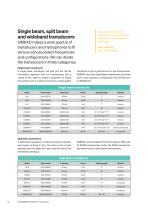
SIMRAD makes a wide spectre of transducers and hydrophones to fit various echosounders frequencies and configurations. We can divide the transducers in three categories: A single beam transducer will give you the normal information expected from an echosounder, like a school of fish, depth to bottom, separation of target from bottom, etc. It is still a must to have a high quality “We are at the forefront of performance through innovative design and a unique production technology.” Value Chain Manager transducer to get a good picture on the echosounder. SIMRAD has many single beam transducers...
Open the catalog to page 12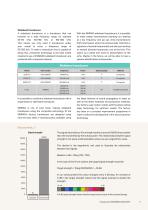
A wideband transducer is a transducer that can transmit on a wide frequency range, for example 50-110 kHz, 100-160 kHz or 160-300 kHz. This means you only need 3 transducers under your vessel to cover a frequency range of 50-300 kHz. To make a transducer that is capable of doing this, composite technology is the best suited material to use. All SIMRAD wideband transducers are produced with composite material. With the SIMRAD wideband transducers, it is possible to make sweep transmissions (sending out starting at a low frequency and go up), chirp transmissions (FM transmission where the echosounder...
Open the catalog to page 13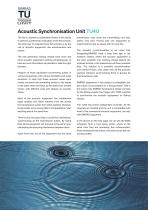
Acoustic Synchronisation Unit TU40 The key to achieve a sustainable fishery is the ability to perform a preliminary evaluation of the fish schools. The best way to evaluate those fish schools is by the use of acoustic equipment, like echosounders and sonars. The new generation fishing vessels have more and more acoustic equipment working simultaneously to have as much information as possible to take the right decision. Imagine all those equipment transmitting pulses in various frequencies, with various strengths and pulse durations. In case that these acoustic waves were visible, we would see...
Open the catalog to page 14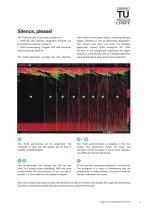
Silence, please! which allows monitoring of status, modifying settings, trigger schedule as well as performing diagnostics. The Trigger Unit does not need the software application running. Once configured, the TU40 will work in the background, organising the trigger sequence automatically, with an intelligent algorithm assuring the fastest ping rate for each equipment. The TU40 consists of two main components: • TU40 top side software application (typically run from existing computer onboard). • TU40 synchronising (Trigger) Unit that interfaces with the acoustic systems. The TU40 application...
Open the catalog to page 15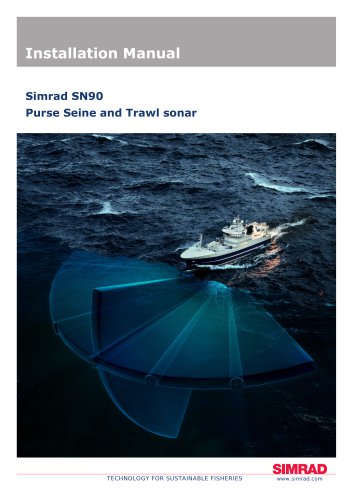
Archived catalogs
 General Catalog
84 Pages
 Single beam systems
12 Pages
 Catch Monitoring Systems
16 Pages
 Sonars
12 Pages
 Multibeam systems
12 Pages
 Product catalogue
84 Pages
 Echosounders
8 Pages
 Simrad main product catalogue
43 Pages
 Simrad scientific systems
8 Pages
 Simrad SH90
4 Pages
 ES200-7C
2 Pages
 ES70-18CD
4 Pages
 Software release note
2 Pages
 SIMRAD CATALOGUE
36 Pages
 FS70 Trawl Sonar
2 Pages
 SIMRAD Catlogue
36 Pages
 Sonar brochures
22 Pages
 Echo sounder brochures
36 Pages
 Catch monitoring brochures
68 Pages