
Vessel Mooring System

Vessel Mooring System
This document serves as a comprehensive guide for selecting and maintaining mooring systems, emphasizing the importance of choosing appropriate components for safe and efficient operations. It highlights the Samson Advantage, which provides exceptional service and support for mooring systems.
Choosing the correct mooring line is critical and involves considering factors such as rope construction, abrasion resistance, and installation procedures. The document emphasizes that mooring systems should be customized to specific needs rather than adopting a one-size-fits-all approach.
Samson offers a unique service package that includes pre- and post-sale services, crew training, and ongoing support, ensuring safety and long-term operational benefits.
The document addresses misconceptions about jacketed mooring lines and advocates for non-jacketed lines with specialized chafe protection as a superior option. Non-jacketed lines are easier to inspect and repair, offering long-term strength and cost savings.
Abrasion is a major cause of line damage. The document explains the types of abrasion and the importance of chafe protection. Proper maintenance of deck equipment and the use of chafe protection can significantly extend the service life of mooring lines.
Proper installation techniques are crucial to prevent damage and extend the life of mooring lines. Recommendations include end-for-ending and rotating lines to distribute wear evenly and maximize service life.
Regular inspections are essential to identify wear and damage. The document provides guidelines for inspecting ropes made with Dyneema® fiber and offers criteria for deciding whether to repair or retire a rope.
- Compression and Pulled Strand: Compression occurs under radial load, often on winch drums. Corrective action involves flexing the rope. Pulled strands result from snagging and can be worked back into the rope.
- Abrasion: Broken filaments and yarns are caused by abrasion and sharp edges. Evaluation is based on the most damaged section, with consultation or retirement recommended for significant strength loss.
- Melted or Glazed Fiber: Caused by excessive heat or shock load, requiring removal and re-splicing or retirement.
- Discoloration/Degradation: Resulting from chemical contamination, requiring similar corrective actions as melted fibers.
- Inconsistent Diameter: Caused by shock loading and broken strands, requiring removal and re-splicing or retirement.
Samson provides tools for inspecting and repairing mooring lines, including posters, pocket guides, and an app. They offer residual strength testing to help establish retirement criteria.
The document provides detailed specifications for various rope diameters, weights, and ISO strength ratings, highlighting the benefits of ropes made with Dyneema® fiber.
Designed to reduce dynamic loads on primary mooring lines, the document outlines the importance of choosing pendants with adequate elongation and provides guidelines for retirement and residual strength.
Products like Saturn Dynalene and DC Moor-Gard offer enhanced abrasion resistance and easy inspection, made with Dyneema® fiber and coated for durability.
Samson Rope Technologies, in collaboration with DSM Dyneema, offers high-performance synthetic ropes for maritime applications, designed to maximize service life, enhance safety, and reduce maintenance costs.
Samson's chafe protection products, made with 100% Dyneema® fiber, are durable, lightweight, flexible, and cut-resistant, designed to extend the service life of high-performance lines.
The ETS is a comprehensive emergency towing kit compliant with the 1994 Solas Convention, including AmSteel®-Blue towlines and other components, designed for easy deployment and reduced injury risk.
The Vulcan ETOP is a synthetic alternative to traditional wire ropes, made with Technora® fiber and a fire-resistant coating, designed to meet OCIMF standards and reduce hand injuries and maintenance costs.
Samson and DSM Dyneema have a long-standing partnership, resulting in innovative rope solutions like AmSteel®-Blue, widely used in the LNG market.
Samson provides detailed product information, technical bulletins, and splicing instructions on their website, along with a mobile app for inspection and retirement criteria.
Samson Rope Technologies, Inc.
2090 Thornton Street, Ferndale, Washington 98248 USA
Tel: +1.360.384.4669
Website: samsonrope.com
Catalog excerpts
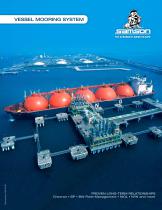
Photo courtesy of GOLAR LNG VESSEL MOORING SYSTEM PROVEN LONG-TERM RELATIONSHIPS Chevron • BP • BW Fleet Management • MOL • NYK and
Open the catalog to page 1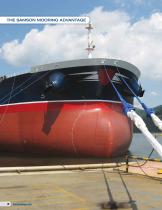
THE SAMSON MOORING ADVANTAGE
Open the catalog to page 2
MOORING LINE SELECTION Not an off-the-shelf decision For owner/operators in today’s shipping industry, safe working conditions, maximizing service life, and mitigating unnecessary failure of mooring lines are top priorities. Through proper vessel evaluation and selection of high modulus polyethylene (HMPE) ropes, Samson will show you how to achieve all three. We used to talk about mooring lines. However, with the advances in fiber and coating technology, and the innovations in chafe protection, we now talk about mooring systems. Selecting the right mooring system is not a “one-size-fits-all”...
Open the catalog to page 3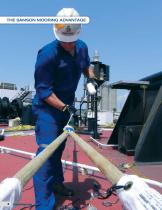
THE SAMSON MOORING ADVANTAGE
Open the catalog to page 4
THE SAMSON MOORING ADVANTAGE You won’t get this anywhere else Beyond selecting the right line for each component of your mooring system, Samson also provides an unparalleled service package we call The Samson Advantage. The Samson Mooring Advantage is designed for both new builds and retrofits, and adds value with critical pre- and post-sale services and an ongoing partnership program. This approach is driven by safety and is a proven model that cannot be duplicated by any other rope manufacturer. Whether it is vessel inspections prior to the sale, crew training for proper rope handling and splicing,...
Open the catalog to page 5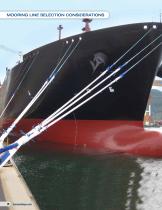
MOORING LINE SELECTION CONSIDERATIONS
Open the catalog to page 6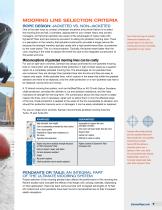
MOORING LINE SELECTION CRITERIA Rope Design: Jacketed vs. Non-Jacketed One of the best ways to combat unforeseen situations and prevent failure is to select the mooring line and tail, or pendant, appropriate for your vessel. Many ship owners, managers, and terminal operators are aware of the advantages of ropes made with Dyneema® fiber and have become accustom to asking for jacketed mooring lines. There is a perception in the industry that jacketed construction provides a longer service life because the strength member, typically made with a high-performance fiber, is protected by the outer jacket....
Open the catalog to page 7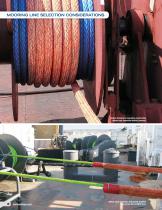
MOORING LINE SELECTION CONSIDERATIONS Saturn Dynalene’s innovative construction allows easy inspection without removal. Adding chafe protection will greatly lengthen the service life of HMPE lines.
Open the catalog to page 8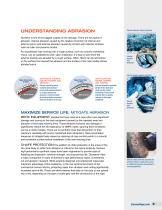
UNDERSTANDING ABRASION External abrasion without protection Abrasion is one of the biggest culprits of line damage. There are two types of abrasion: internal abrasion caused by the relative movement of internal and external yarns; and external abrasion caused by contact with external surfaces, such as roller and panama chocks. An unprotected rope moving over a rough surface, such as a poorly maintained chock, can be subjected to both. Upon inspection, it’s easy to see when the external strands are abraded by a rough surface. Often, fibers can be left behind on the surface that caused the abrasion...
Open the catalog to page 9
Samson field support technicians frequently assist with wire rope mooring line replacements while vessels are underway, complete with crew training in splicing, inspection, maintenance and proper rope-handling techniques.
Open the catalog to page 10
INSTALLATION After surfaces have been prepped, the working line should be installed on the winch with significant back tension. The device used to create the tension should have a smooth and consistent surface, and the installation speed or tension applied should not generate excessive heat build-up in the rope. As the line is wound onto the winch, it should be closely packed to minimize areas where the rope may “dive” or bury into the layers of the winch. Install each layer in the valleys of the previous layers or crossed over each other to support each subsequent layer. Never stack the layers...
Open the catalog to page 11
Inspection Guidelines and Residual Strength Testing Regular inspections and repair as needed will extend the working life of highperformance mooring lines. Any rope that has been in use for a period of time will show normal wear and tear. Some characteristics of a used rope will not reduce strength while others will. Below we have defined normal conditions that should be inspected on a regular basis. The following criteria should be considered when inspecting 12-strand ropes made with Dyneema® fiber: If upon inspection you find any of these conditions, you must consider the following before deciding...
Open the catalog to page 12
INSPECTION Tools and Reference Materials In addition to performing on-site inspections, Samson offers several tools to assist crews in inspecting and repairing mooring lines. From posters to display on the vessel, to pocket reference guides and online tools to a handy app for iPhone & iPad — Samson puts years of knowledge at your fingertips. Samson offers a range of tools to assist in inspecting high-performance synthetic lines. Residual Test Program Samson offers residual strength testing to aid operators/owners in establishing retirement criteria. Samson is home to the most robust research...
Open the catalog to page 13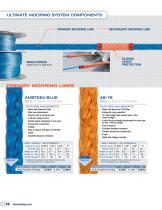
ULTIMATE MOORING SYSTEM COMPONENTS PRIMARY MOORING LINE SECONDARY MOORING LINE SLIDING CHAFE PROTECTION Single drum or split drum PRIMARY MOORING LINES ® AMSTEEL-BLUE > Made with Dyneema® fiber > Wire rope replacement > Size-for-size as strong as wire > 1/7th the weight of wire > Similar elastic elongation to wire rope > Torque-free construction > Flexible > Easy to inspect and splice in the field > Floats > Excellent abrasion resistance > Made with Dyneema® SK78 fiber > Enhanced creep properties > 30–40% lighter than aramid ropes of the same strength > A size-for-size strength replacement for...
Open the catalog to page 14
DOCK SIDE CHAFE PROTECTION PENDANT (TAIL) CONNECTION MOORING PENDANT (TAIL) {864} Class II DOUBLE BRAID {861} Class II DOUBLE BRAID > Made with Dyneema® SK78 core and cover > Enhanced creep properties when under static load and at elevated temperatures > 1/7th the weight of wire > Abrasion resistant > Firm construction > Excellent drum spooling capabilities > Easy to handle > Retains shape with use > Excellent cut resistance > Durable > Made with Dyneema® fiber > 1/7th the weight of wire > Abrasion resistant > Firm construction > Excellent drum spooling capabilities > Easy to handle > Retains...
Open the catalog to page 15All Samson catalogs and brochures
 Offshore Sling Brochure
6 Pages
 Chafe Gear Brochure
12 Pages
 Saturn-12 Brochure
4 Pages
 AGILE™ Lifting System
8 Pages
 The Ultimate Towing System
24 Pages
 Recreational Marine Catalog
38 Pages
 Tug Brochure
8 Pages
 Mooring Brochure
4 Pages
 AmSteel-Blue
2 Pages
 Recreational Running Rigging
38 Pages
 Commercial Marine
88 Pages


