

- Products
- Catalogs
- News & Trends
- Exhibitions
25_30HP

25_30HP
This manual provides essential information for the operation, maintenance, and care of the Titan outboard motor, emphasizing safety and proper understanding of instructions.
Highlights critical safety alerts, warnings, and cautions to prevent injury or damage. Recommends consulting a Titan dealer for operational or maintenance questions.
Includes identification numbers for the outboard motor and key, crucial for ordering spare parts or in case of theft.
Users must read the entire manual and any accompanying boat manuals. Key safety points include avoiding overpowering the boat, modifications, operating under the influence, and ensuring proper operation of controls.
Gasoline is highly flammable and explosive. Refuel in well-ventilated areas, avoid overfilling, and use clean gasoline.
Specifies battery capacity requirements for electric start models to avoid system damage.
Outlines periodic maintenance tasks, including lubrication, battery care, and cleaning. Provides a maintenance chart and instructions for checking and replacing parts.
Guidance on troubleshooting common issues and temporary actions in emergencies, such as impact damage or starter failure.
Models without a rectifier cannot connect to a battery. Installation of an optional rectifier regulator is necessary for battery use.
Propeller choice affects performance. Smaller-pitch propellers suit greater loads, while larger-pitch propellers suit smaller loads.
Specifies minimum cold cranking amps and rated capacity for different models.
Powertec motors have a device allowing the engine to start only in neutral.
Descriptions of the fuel tank, fuel joint, fuel gauge, and other components, detailing their functions and operational instructions.
Overheat warning systems prevent engine damage by reducing speed and lighting indicators.
Proper mounting is crucial for safety and performance. Instructions for secure attachment are provided.
Use an engine restraint cable or chain to secure the engine to the boat. Secure the clamp bracket to the transom using provided bolts.
Outlines a step-by-step break-in procedure to ensure engine longevity.
Ensure sufficient fuel and oil, check for leaks, and verify control operations before use.
Instructions for mixing oil and gasoline for portable and built-in tanks.
Instructions for manual, electric, and remote control start models.
Allow engine to idle for 3 minutes to warm up and ensure proper cooling.
Instructions for shifting gears safely, ensuring no obstacles are nearby.
Ensure tilt lock lever is locked before moving the remote control lever.
Allow the engine to cool at idle before stopping and follow proper shutdown procedures.
Adjust trim angle to optimize performance and fuel economy.
Tilt the motor up when stopped for extended periods or in shallow waters.
Use the shallow water cruising system at low speeds.
Flush the cooling system with fresh water after saltwater use.
Provides detailed dimensions, weight, performance, and engine specifications.
Follow procedures for flushing, lubricating, and storing the outboard motor to prevent damage.
Inspect oil for water presence and replace seals if necessary.
Handle battery electrolytic fluid with care and follow safety precautions.
Wash the motor exterior and flush the cooling system with fresh water.
Key tasks include anode inspection, battery charging, and fuel system checks.
Inspect and replace spark plugs as needed.
Regularly check for fuel leaks and inspect fuel lines and connectors.
Inspect propeller for damage and change gear oil regularly.
Clean the fuel tank outdoors, away from ignition sources.
Inspect and clean anodes to prevent corrosion.
Follow safety precautions for handling battery electrolytic fluid and hydrogen gas.
Instructions for safely connecting and disconnecting the battery.
Ensure top cowling is secure and keep the boat bottom clean.
Guidance on addressing starter issues, engine starting problems, and other common issues.
Instructions for handling impact damage, fuse replacement, and submerged motor treatment.
Catalog excerpts

OWNER’S MANUAL
Open the catalog to page 1
Read this owner’s manual carefully before operating your outboard motor.
Open the catalog to page 2
To the owner Thank you for choosing a Titan outboard motor. This Owners Manual contains information needed for proper operation, maintenance and care. A thorough understanding of these simple instructions will help you obtain maximum enjoyment from your new Titan. If you have any question about the operation or maintenance of your outboard motor, please consult a Titan dealer. In this OwnerOs Manual particularly important information is distinguished in the following ways. ds The Safety Alert Symbol means ATTENTION! BECOME ALERT! YOUR SAFETY IS INVOLVED! Failure to follow WARNING instructions...
Open the catalog to page 3
25A,30 OWNER’S MANUAL ©2008 by Powertec Motor Co., Ltd. 1st Edition, March 2008 All rights reserved. Any reprinting or unauthorized use without the written permission of Powertec Motor Co., Ltd. is expressly prohibited. Printed in China
Open the catalog to page 4
General information reference in case you need a new key. Outboard motor serial number The outboard motor serial number is stamped on the label attached to the port side of the clamp bracket or the upper part of the swivel bracket. Record your outboard motor serial number in the spaces provided to assist you in ordering spare parts from your Powertec dealer or for reference in case your outboard motor is stolen. Key number If a main key switch is equipped with the motor, the key identification number is stamped on your key as shown in the illustration. Record this number in the space provided...
Open the catalog to page 7
Consult your dealer for correct use. • Never operate after drinking alcohol or taking drugs. About 50% of all boating fatalities involve intoxication. • Have an approved personal flotation device (PFD) on board for every occupant. It is a good idea to wear a PFD whenever boating. At a minimum, children and nonswimmers should always wear PFDs, and everyone should wear PFDs when there are potentially hazardous boating conditions. • Gasoline is highly flammable, and its vapors are flammable and explosive. Handle and store gasoline carefully. Make sure there are no gas fumes or leaking fuel before...
Open the catalog to page 8
General information • Be sure shift control is in neutral before starting engine. (except 2HP) • Do not touch or remove electrical parts when starting or during operation. • Keep hands, hair, and clothes away from flywheel and other rotating parts while engine is running. • This engine is equipped with a neutral starting device. • The engine will not start unless the shift control is in neutral position. GASOLINE AND ITS VAPORS ARE HIGHLY FLAMMABLE AND EXPLOSIVE! • Do not smoke when refueling, and keep away from sparks, flames, or other sources of ignition. • Stop engine before refueling. • Refuel...
Open the catalog to page 9
General information NMMA-certified TC-W3 rating may be used. Battery requirement CAUTION: Do not use a battery that does not meet the specified capacity. If a battery which does not meet specifications is used, the electric system could perform poorly or be overloaded, causing electric system damage. For electric start models, choose a battery which meets the following specifications. Battery specifications Minimum cold cranking amps (CCA/EN): 25A 347.0 A 30A 347.0 A 30A 347.0 A Minimum rated capacity (20HR/IEC): 25A 40.0 Ah 30A 40.0 Ah 30A 40.0 Ah Without a rectifier or Rectifier Regulator CAUTION:...
Open the catalog to page 10
General information NOTE: Select a propeller which will allow the engine to reach the middle or upper half of the operating range at full throttle with the maximum boat load. If operating conditions such as light boat loads then allow the engine r/min to rise above the maximum recommended range, reduce the throttle setting to maintain the engine in the proper operating range. For instructions on propeller removal and installation, see page 47. Start-in-gear protection Powertec outboard motors or Powertec-ap-proved remote control units are equipped with start-in-gear protection device(s). This...
Open the catalog to page 11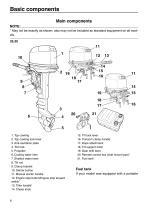
Basic components Main components * May not be exactly as shown; also may not be included as standard equipment on all models. 25,30 5 1. Top cowling 2. Top cowling lock lever 3. Anti-cavitation plate 4. Trim tab 5. Propeller 6. Cooling water inlet 7. Shallow water lever 8. Tilt rod 9. Clamp bracket 10. Starter button 11. Manual starter handle 12. Engine stop button/Engine stop lanyard switch* 13. Tiller handle* 14. Choke knob 6 15. Tilt lock lever 16. Transom clamp handle 17. Rope attachment 18. Tilt support knob 19. Gear shift lever 20. Remote control box (side mount type)* 21. Fuel tank* Fuel...
Open the catalog to page 12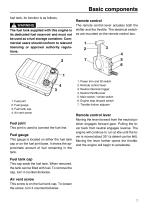
Basic components fuel tank, its function is as follows. Remote control The fuel tank supplied with this engine is its dedicated fuel reservoir and must not be used as a fuel storage container. Commercial users should conform to relevant licensing or approval authority regulations. The remote control lever actuates both the shifter and the throttle. The electrical switches are mounted on the remote control box. 1. Fuel joint 2. Fuel gauge 3. Fuel tank cap 4. Air vent screw Fuel joint This joint is used to connect the fuel line. Fuel gauge This gauge is located on either the fuel tank cap or on...
Open the catalog to page 13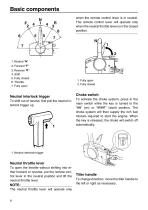
Basic components when the remote control lever is in neutral. The remote control lever will operate only when the neutral throttle lever is in the closed position. 3. Reverse “ ” 4. Shift 5. Fully closed 6. Throttle 7. Fully open Neutral interlock trigger To shift out of neutral, first pull the neutral interlock trigger up. 1. Fully open 2. Fully closed Choke switch To activate the choke system, press in the main switch while the key is turned to the “ ” (on) or “ ” (start) position. The choke system will then supply the rich fuel mixture required to start the engine. When the key is released,...
Open the catalog to page 14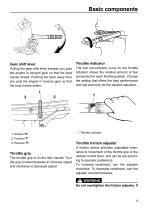
Basic components Gear shift lever Pulling the gear shift lever towards you puts the engine in forward gear so that the boat moves ahead. Pushing the lever away from you puts the engine in reverse gear so that the boat moves astern. Throttle grip The throttle grip is on the tiller handle. Turn the grip counterclockwise to increase speed and clockwise to decrease speed. Throttle indicator The fuel consumption curve on the throttle indicator shows the relative amount of fuel consumed for each throttle position. Choose the setting that offers the best performance and fuel economy for the desired...
Open the catalog to page 15

- Nautical motor-boat
- Inflatable boat
- Outboard inflatable boat
- Inboard engine
- Outboard engine
- 4-stroke engine
- Electric engine
- Gasoline engine
- Boat generator set
- Radome antenna
- Ship antenna
- Aluminum floor inflatable boat
- Boat filter
- GPS antenna
- Water filter
- 2-stroke engine
- Nautical jet-ski
- Boat air conditioner
- Boat heater
- Three-seater jet-ski