
- Catalogs
- Oceanic Systems
- deck filler

deck filler

deck filler
Catalog excerpts

• Displays Tank Level at the Deck Filler and at the existing • Prevents fuel spills during • Maximise Range from Full Tanks • Available for "FUEL", "DIESEL", • Blue LED Level Display • Robust Stainless Steel with Laser Etched designator Registered Design International Patents Pending Deck Filler Gauge The 3210 NMEA2000® Deck Filler Gauge displays the tank level right at the tank's deck filler. This enables the user to see the exact tank level at the point of filling. This allows the tanks to be filled to the top without the risk of spills or wastage. The tank level is displayed on a blue LED display set into the deck filler surround. This provides a clear indication of the level of the liquid in the tank at all times. The LED varies in brightness to compensate for ambient light levels, brighter in sunlight and dimmer at The deck filler cap has a standard octagonal opening key with a heavy duty O ring seal to keep sea water out of the tank. The deck filler and it's cap are pro- duced in mirror polished stainless steel to provide a rugged and attractive finish. It is constructed to the IEC60945 Maritime Naviga- tional and Radiocommunications Equipment Standard to ensure high reliability and trouble free operation for many years. work using a single plug. No other wiring is needed.
Open the catalog to page 1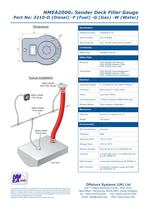
NMEA2000® Sender Deck Filler Gauge Part No: 3210-D (Diesel) -F (Fuel) -G (Gas) -W (Water) Typical Installation Deck Filler Gauge C^^, Fuel Tank The inclusion of vessels in any picture does not infer that their manufacturer endorses this product. Our policy is one of continuous product improvement so product specifications are subject to change without notice. Our products are designed to be accurate and reliable, however, they should only be used as aids to the safe management of the boat and not as a replacement for traditional aids or techniques. Copyright © 2009 Offshore Systems (UK) Ltd....
Open the catalog to page 2All Oceanic Systems catalogs and brochures
 NMEA2000® to Modbus Gateway
2 Pages
 NMEA2000® AC Monitor
2 Pages
 multitank display
2 Pages
 mutlifunction display 3340
2 Pages
 gauge driver 3135
2 Pages


Archived catalogs
 water senders
2 Pages
 Volumetric
2 Pages
- Boat indicator
- Analog indicator
- Boat monitoring and control panel
- Boat display
- Digital display
- Digital indicator
- Multi-function display
- Motor indicator
- Tank indicator
- Rudder angle indicator
- Pressure indicator
- Boat alarm system
- NMEA 2000® indicator
- Fuel tank indicator
- Network gateway
- Sailboat display
- Boat charge controller
- LED indicator
- Water tank indicator