
- Catalogs
- Observator GmbH
- OMC-150 /158-2 Intrinsically safe wind system

OMC-150 /158-2 Intrinsically safe wind system

OMC-150 /158-2 Intrinsically safe wind system
- OMC-150 Anemometer: Utilizes a cup and vane principle for wind measurement. It is made from stainless steel and features a high accuracy sensor compliant with W.M.O. standards. It operates within a temperature range of -25 to +70°C and measures wind speeds from 0 to 75 m/s with an accuracy better than 2%.
- OMC-158-2 Interface Module: Provides NMEA0183 output and supports RS422 communication at 4800 or 9600 baud. It is DIN rail mounted and operates within the same temperature range as the anemometer.
- High accuracy and compliance with international safety standards.
- Robust construction with stainless steel and polycarbonate materials.
- Flexible installation with a pole-mounting bracket and U-bolts.
- Comprehensive output options including NMEA0183 and RS422.
Catalog excerpts

OMC-150 Anemometer with OMC-158-2 Interface Applications Offshore and Industry OMC-150 /158-2 Intrinsically safe wind system The OMC-150 is an Intrinsically Safe combined wind speed and direction sensor, based on the cup and vane principle. • OMC-150 Wind sensor: • High accuracy sensor according W.M.O. To complete the Intrinsically safe wind system the OMC158-2 is available. A DIN rail mounted Zener barrier and • Meets ATEX Directive 2014/34/EU; IEC 60079-0 : 2012, IEC 60079-11 : 2012 and ISO 80079-36:2016 interface module. Further an Eex junction box is available • Equipment category II 2 G • Certificate number DEKRA 13ATEX0119, IECEx DEK Using a sin/cos potentiometer wind direction is measured without a dead-band, while speed is measured using a • OMC-158-2 Wind Sensor Interface Module: proximately switch and a code cap. The wind sensor is • Cable length between sensor 1 km made from stainless steel and comes with a mounting arm • Certificate numbers: KIWA 17ATEX0015 and IECEx which can be clamped to a mast using two U-Bolts. KIWA 17.0005 • Output NMEA0183, RS422 on 4800 or 9600 Baud The Zener barrier and interface module is provided with a • Wind measurement on 4 Hz (standard) or 1 Hz R422, NMEA output which can be set as 4800 or 9600 baud • Compensation (linear wind speed and bracket and can include a VER message as well. correction) may be set on or off • VER message can be included The Observator range is in continuous development and so specifications may be subject to chang
Open the catalog to page 1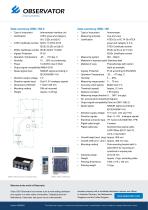
Direction supply voltage Direction signals input Dimensions (HxWxD) Mounting method Weight Measuring system Polycarbonate with carbon black as antistatic IP-x6 according to EN-60529 -25 . +70 deg. C 5 ... 90% 0 ... 75 m/s Better than 2 % Approx. 0.3 m/s 1.68 meters 10 V nom. (-5V and +5V) Dual -5..+5V analogue signals ITT Canon CA3102E16S-1 PB 5 meters Screened blue signal cable, Data summary OMC-158-2 Type of instrument Anemometer interface unit Certification ATEX group and category II(1) G [Ex ia Ga] IIC ATEX Certificate number KIWA 17 ATEX 0015 IECEx 02 [Ex ia Ga] IIC IEXEx Certificate number...
Open the catalog to page 2All Observator GmbH catalogs and brochures
 Visi-Plus Cassette (CS/CL)
2 Pages
 Visi-Plus Light Extra
2 Pages
 Visi-Plus Light
2 Pages
 OMC-115 WindSonic
2 Pages
 OMC-4XX Temperature Sensors
2 Pages
 OMC-210-2 Rain Gauge
2 Pages
 Brochure MET-LINK
2 Pages
 Brochure OMC-140
4 Pages
 Brochure OMC-160-3
2 Pages


