

- Products
- Catalogs
- News & Trends
- Exhibitions
3DR

3DR
3DL sails are crafted using various combinations of yarns, layouts, and films, tailored to meet specific performance needs and budgets. They are available with North TF taffeta films for enhanced resistance to chafe, tear, and UV exposure.
- Aramid: Utilizes Twaron 49, a top-grade aramid fiber, commonly used in racing sails.
- 100% Carbon: Designed for superyachts over 80 feet, featuring a special yarn layout to handle full batten loads.
- IACC Carbon Fiber: Developed for AC sails, offering maximum strength and lightness.
- Marathon: Designed for cruising yachts with double-sided taffeta film for longevity.
- Carbon/Aramid: Combines aramid and carbon fibers for durability and low stretch, ideal for fleet racing.
The manufacturing process involves several key steps:
- Designing a custom 3D shape using North Sails software and fluid-dynamics simulation.
- Applying structural yarns with a 6-axis fiber head under uniform tension.
- Using vacuum pressure and heat to bond films and yarns, ensuring a precise 3D shape.
- Finalizing the sail with corner reinforcements and protective patches.
The 3DL laminate is bonded using a multiphase polymer, enhancing endurance and flexibility. The 3D molding process ensures that fibers assume the designed shape instantly under wind pressure, distributing loads evenly.
3DL sails are built as a unitary membrane on full-sized 3D molds, offering:
- Continuous yarn paths for efficient load distribution.
- Thermo-molded construction with no seams, enhancing structural efficiency.
- Long-lasting performance with a wider wind range, reducing the need for frequent sail changes.
The 3DL RM (Rotary Molded) technology uses a cylindrical structure for small boat sails, allowing for quick production cycles and maintaining high-quality standards.
Catalog excerpts

>> HOW IS 3DL MADE? >> MODELS >> 1. 3DL sails are available in many different combinations of yarn, yarn layout and film. Your North Sails representative is prepared to help you determine which style of 3DL performance is the right choice for your boat and your budget. >> 2. >> 3. >> 4. All styles are also available with North TF ta f f e ta films for added chafe, tear and UV resistance on one or both sides. ARAMID North Sails Virtual Wind Tunnel simulates the force that hits the sail while sailing. >> 3. A 3DL sails begins with a custom 3-dimensional design file created with the exclusive North Sails software. The sail-designer precisely defines the sail's 3dimensional "flying shape" using fluid-dynamics computer simulation. >> 5. Vacuum pressure applied to the laminate. Vacuum pressure is applied to the laminate at approximately 2400 kg. per square meter. The mold is shaped with an hydraulic system. A mechanical comb keeps the yarns separate and parallel as they are applied to the mold. A sophisticated computer program reads the designer files, then instructs an articulating mold to assume the designed 3D shape. The mold is shaped with an hydraulic system. A pair of lasers scans the mould surface to ensure the accuracy of the shape within imperceptible tolerances. Than a base layer of mylar film is tensioned over the mould. A 6-axis fiber head suspended from an overhead gantry applies structural yarn onto the surface of the film. The fiber head "draws" the pattern in yarn that matches anticipated loads in sail. All structural yarns are applied under uniform tension and adhere to the surface of the film. >> 6. Film and yarns are bonded by heating. A carbon element heat "blanket" cures the pressurized laminate. 4.<< >> 7. Sails finishing. The sail is cured further for five days in order to lock in the shape. 100% CARBON Aramid fibers are the most commonly used fiber for racing sails. We use Twaron 49 which is the best aramid fiber available. Sails derived from the AC. The fact that the sail is entirely built of Carbon fiber requires expert sail trimmers and handlers. CARBON/ARAMID North Gatorback is tensioned on the base film. 100% CARBON SUPERYACHT LA OUT Y A second film, North Gatorback, is tensioned on the top of the base film and yarn to handle incidental loads off primary loads lines. These sails have a combination of aramid and carbon fiber. The 2 fibers give both low stretch as well as long sailing life. These sails are forgiving of the breakdown due to the frequent tacking in fleet racing. >> 8. In the loft: the manufacturing phase. The sail is shipped to the loft where corner reinforcements and protective patches are applied by sailmakers. This special yarn layout is appropriate for yachts longer than 80 feet. The material is 100% Carbon Fiber and includes special yarn passes to oppose the loads encountered in full batten in boom furling systems. IACC CARBON FIBER MARATHON This is a special grade of carbon fiber developed for AC sails. These sails represent the maximum strength and lightness possible today. These are the 3DL sails studied especially for cruising yachts. They feature a double sided taffeta film which gives extraordinary longevity to these sails. The 3DL Marathon product is for cruisers who want the maximum performance even though they may not race.
Open the catalog to page 1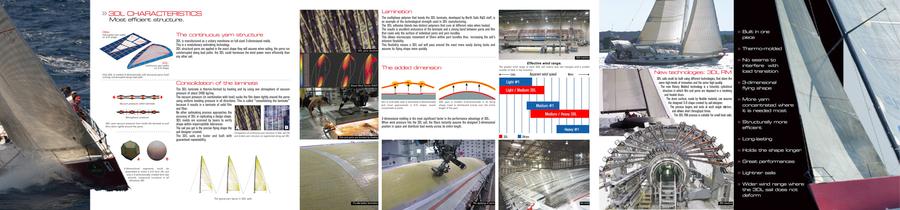
>> 3DL CHARACTERISTICS Lamination Most efficient structure. Other: The continuous yarn structure interrupted yarn paths on 2-D shape 3DL is manufactured as a unitary membrane on full-sized 3-dimensional molds. This is a revolutionary sailmaking technology. 3DL structural yarns are applied in the exact shape they will assume when sailing, the yarns run uninterrupted along load paths: the 3DL could harnesses the wind power more efficiently than any other sail. 3DL yarns structure The multiphase polymer that bonds the 3DL laminate, developed by North Sails R&D staff, is an example of the technological...
Open the catalog to page 2All North Sails Sailmaking catalogs and brochures


Archived catalogs
 Premier Spectra
1 Page
 Gradient Series™
1 Page
 G-Series Gennakers
1 Page

- North Sails sailboat sail
- North Sails mainsail
- North Sails headsail
- North Sails long-sleeve jacket
- North Sails cruising sailboat sail
- Sailing jacket
- North Sails hooded jacket
- North Sails polyester sail
- North Sails waterproof jacket
- Symmetric spinnaker
- North Sails sailing dinghy sail
- North Sails jib
- North Sails racing sailboat sail
- Downwind sail
- Cross-cut sail
- Spray top
- Men's jacket
- Long-sleeve spray top
- Black jacket