
- Catalogs
- Navis Engineering Oy
- Autopilot


Autopilot

Autopilot
Navis Engineering, established in 1992, specializes in ship automation systems and dynamic positioning technology. The company focuses on creating user-friendly systems while maintaining high quality and reliability. The NavAP Heading Control System is a modern autopilot designed to reduce operator workload, enhance vessel efficiency, and improve safety. It features a high-resolution display suitable for outdoor installations and is type approved by DNV.
System Overview
The NavAP is adaptive, using a single 'Sensitivity' parameter for tuning. It includes a 'Heading Monitor System' for continuous data monitoring from multiple sources. The 'Auto Tune' algorithm adjusts performance based on vessel parameters, making it suitable for various vessel types. It supports multiple operating modes and is compatible with modern steering systems and integrated bridge systems.
Operation Modes
The NavAP offers several modes: Track (controls motion between track points), Follow-up (manual control), Wind Vane (for sailing boats), River Pilot (manual Rate of Turn control), and Auto (maintains heading at various speeds). It supports course keeping (CTS Pilot) and is compatible with thrusters for low-speed operations.
System Configuration
The NavAP can be configured with up to five control panels and various steering controls. It supports multiple input and output signals, including NMEA telegrams for communication with other systems. The system is designed to meet various international standards and operates within specified temperature ranges.
Technical Specifications
The NavAP operates on a 24 VDC supply with power consumption depending on configuration. It supports various signal inputs and outputs for integration with other systems. The enclosure and components meet specific IP ratings for protection, and the system complies with international standards such as ISO and IEC.
Contact Information
Navis Engineering's headquarters are located in Vantaa, Finland, with an R&D center in Saint Petersburg, Russia. Contact details and further information are available on their website.
Catalog excerpts

NAVIS NavAP Heading Control System
Open the catalog to page 1
Introduction Navis Engineering, established in 1992, is a recognized expert in ship automation systems and one of the few world experts in dynamic positioning technology. After more than 25 years of scrupulous research and development, we have cultivated a profound understanding of every customer’s needs, as well as of market trends in shipbuilding. Our company’s mission is to keep our systems as simple and user-friendly as possible, and, at the same time, to preserve the high level of quality and reliability. Navis Engineering manufactures the new generation of autopilots – NavAP Heading Control...
Open the catalog to page 2
System overview The NavAP is fully adaptive. The use of only one ‘Sensitivity’ parameter for fine-tuning system performance covers all known yawing, steering and counter rudder settings of the autopilots of other brands. The NavAP has built-in ‘Heading Monitor System’(HMS) functionality, which makes it possible to receive and monitor the data coming from two heading data sources continuously (gyro+gyro, gyro+magnetic compass, atellite gyro etc.). Several speed sources can also be used during operation (GPS, waterspeed log or bottom tracking log). The NavAP fully self-adjusting ‘Auto Tune’ algorithm...
Open the catalog to page 3
Operation modes Auto The NavAP automatically keeps the set heading on high and low speeds. The low-speed heading mode can be used by means of 1 or 2 thrusters connected to the NavAP. Track The NavAP controls vessel motion on straight legs between track points set from chart system. FU Follow-up manual control of the steering systems using the rotary knob on the control panel or via an external FU lever/wheel. CTS Pilot The NavAP automatically keeps the set course (COG). River Pilot Manual Rate of Turn (ROT) control using the rotary knob on the control panel or via an external ROT tiller. Wind...
Open the catalog to page 4
System configuration MANDATORY SENSORS CONTROL PANEL CHART SYSTEM/ ECDIS NMEA 0183 OPTIONAL SENSORS SPEEDLOG MAIN ALARM SYSTEM (CAMS) VDR HEADING SENSOR 2 4...20mA 0...10 VDC -10...+10 VDC Bang-Bang Standard NavAP autopilot NavAP configuration can be extended: • Up to five control panels (central bridge,fly bridge, port/stbd wing, aft bridge); • With steering gear control levers and/or steering wheel. Technical specifications Electrical parameters Supply voltage Power consumption Approx.25 W (The total power consumption depends on the configuration.) Signal inputs Gyro compass Satellite compass...
Open the catalog to page 6
NMEA telegram APB, BWC/BWR, HTC, HSC, Propr Signal outputs VDR connection NMEA telegrams HTD, RSA, ROR, ALR, ALA,HMS, HMR NMEA telegrams ALF, ALC, ACN, ARC, HBT for communication with CAMS, BAM Control of steering gear/tunnel thruster 2 switching outputs 2 analog outputs +/- 10 V DC, 0…10 V, or 4 – 20 mA 2 analog outputs for 6…18 V Danfoss valves analog output for tunnel +/- 10 V DC, 0…10 V, max. 5 mA, or 4 – 20 mA thruster Actual rudder steering gear Status/alerts from 0…10V, 4-20mA, potentiometer – Off-heading – Heading monitor – Autopilot on – System alert – System failure –User activity –...
Open the catalog to page 7
Headoffice Navis Engineering Oy, Tuupakantie 3A, FI 01740 Vantaa, Finland Tel:+358 9 250 9011 Fax:+358 9 250 9012 R&D Center Navis Engineering OY Saint-Petersburg Branch, Detskaya str., 5a, 199106 Saint-Petersburg, Russia Tel:+7 812 322 67 15 Fax: +7 812 322 67 35 navisincontrol.com, [email protected]
Open the catalog to page 8All Navis Engineering Oy catalogs and brochures
 Heading Control System
6 Pages
 Joystick Control System
9 Pages
 Dynamic Positioning Systems
8 Pages
Archived catalogs
 NavDP4000
8 Pages
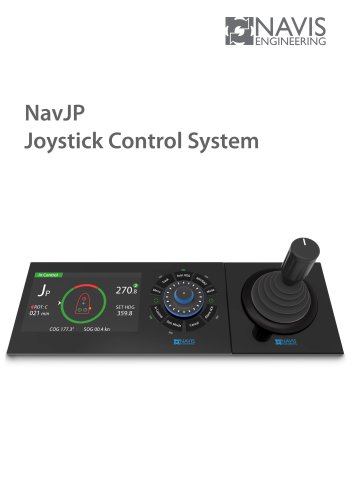 NavJP
NavJP8 Pages
 Steering Control System
4 Pages
 JP4000 Joystick Control System
12 Pages
 AP4000 Autopilot
8 Pages


