
- Catalogs
- Moog Components Group
- Model 129


Model 129

Model 129
The Model 129 slip ring is designed for power transmission in marine and industrial settings, known for its reliability in harsh environments. It supports up to 5000 volts and 150 amps per slip ring pass, ensuring efficient power transfer across rotating interfaces.
Features
- Stainless steel housing for durability
- Hazardous area certification available
- Integrated power and signal transfer
Benefits
- High-quality design, manufacturing, and testing
- Maintenance-free operation
- Long-lasting performance
- Compatible with fiber optic rotary joints and fluid rotary unions
Applications
- Industrial machinery
- FPSO swivel stacks
Specifications
Electrical
- Voltage: Maximum 5000 VAC
- Current: Maximum 150 A per pass
- Flashover Voltage: 24,000 VAC
- Insulation Resistance: Minimum 500 MΩ @ 1 kVDC
- Short Circuit Rating: 11 kA / 1s, 17 kA peak
Mechanical
- Rotation Speed: Maximum 50 rpm continuous
- Protection Class: IP 66
- Operating Temperature: -20 °C to +55 °C
- Housing: Stainless steel (304)
Options
- Hazardous Area Option: Model 129X with CSA and KEMA certifications
- Fiber Optics: Fiber Optic Rotary Joint or Optical Converter
- Fluid: Fluid Rotary Union
- Design Certification: ABS, DNV, BV, LRS
- Submersed Applications: Fluid filling fittings or pressure compensated
- Ingress Protection: IP 68
- Extended Temperature Range
Electrical Signal Performance
- Contact Resistance: 20 mΩ nominal
- Insertion Loss: 1.5 dB maximum up to 30 MHz
- Crosstalk: -15 dB maximum up to 30 MHz
Terminations
- Standard: Loose wire pigtails, 10 ft in length
- Flange & Cable Covers: Various entry threads and orientations
- Cabled Pigtails: Tinned copper braid and heat shrink over loose wire pigtails
- Special: Supply and installation of connectors, terminals, conduit, cable, glands, junction boxes
Catalog excerpts
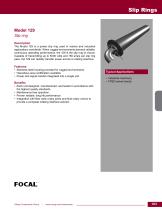
Slip Rings Model 129 Slip ring The Model 129 is a power slip ring used in marine and industrial applications worldwide. When rugged environments demand reliable, continuous operating performance, the 129 is the slip ring of choice. Capable of transmitting up to 5000 volts and 150 amps per slip ring pass, the 129 can reliably transfer power across a rotating interface. • Stainless steel housing provided for rugged environments • Hazardous area certification available • Power and signal transfer integrated into a single unit Typical Applications • Industrial machinery • FPSO swivel stacks • Each unit designed, manufactured, and tested in accordance with the highest quality standards • Maintenance free operation • Proven reliable, long life performance • Integration with fiber optic rotary joints and fluid rotary unions to provide a complete rotating interface solution Moog Components Group
Open the catalog to page 1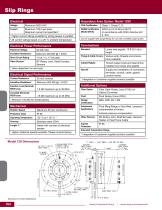
Slip Rings Electrical Hazardous Area Option: Model 129X Maximum 150 A per pass Maximum current not specified 2 1 Higher current ratings possible by wiring passes in parallel All current ratings based on a 20 °C ambient temperature Electrical Power Performance 24 000 VAC Flashover Voltage Insulation Resistance Short Circuit Rating RF Rotary Joint, Shaft Encoder, Sensors Value dependent on wire type KEMA Certification (Model 295-X) ATEX II 2 G EEx d IIB T5 (in accordance with ATEX directive 94 / 9 / EC) Can be supplied with purge fittings for use with a certified purge system Terminations Standard...
Open the catalog to page 2All Moog Components Group catalogs and brochures
 Space Sector
7 Pages
 Air Moving
4 Pages
 FO285 / FO286
2 Pages
 FO206
FO2062 Pages
 FO197S
2 Pages
 FO197
FO1972 Pages
 FO228
FO2282 Pages
 Model 907 Datasheet
2 Pages
 Model 180
2 Pages
 Model 176
2 Pages
 Model 159
2 Pages
 Marine product guide
12 Pages


