

The Loft - Trim Guide 2008
The Loft - Trim Guide 2008
This document serves as a comprehensive guide on windsurfing rig trim, focusing on optimizing performance through various adjustments. It covers specifications, procedures, and recommendations for rigging and trimming windsurfing sails.
Windsurfing rigs are dynamic, with performance influenced by sail design, mast characteristics, and trim settings. Key trim variables include downhaul and outhaul tensions, which directly affect the sail's aerodynamic form and performance.
Increased downhaul tension is beneficial for high wind conditions, making the sail easier to handle and increasing speed. Conversely, less tension is suitable for low wind, providing more power.
Outhaul tension affects sail depth and handling. Reduced tension increases power for light winds, while greater tension flattens the sail for easier handling in stronger winds.
Beyond downhaul and outhaul, factors like boom height, harness line position, and mast type also impact performance. Adjustments in these areas can enhance control and speed.
Board performance is influenced by footstrap position, fin size, and mastfoot placement. Adjustments in these areas can optimize control and speed based on wind conditions.
For high winds, adjust the mast and boom to recommended lengths, lower the boom, and move the mastfoot forward. For low winds, reduce downhaul, raise the boom, and move the mastfoot back.
Common issues like feeling overpowered or difficulty in planing can be addressed by adjusting downhaul, outhaul, mastfoot position, and other trim settings.
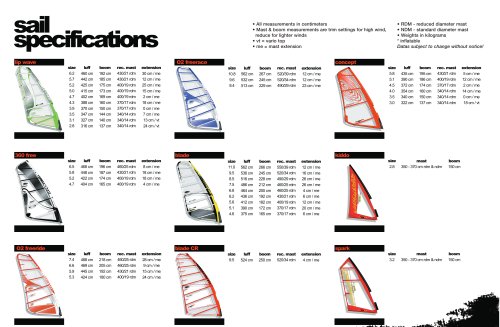
The guide provides detailed specifications for various sail models, including recommended mast and boom lengths, batten configurations, and compatible mast types.
The document lists various sail sizes, mast lengths, boom lengths, and compatible masts. It distinguishes between reduced diameter masts (rdm) and standard diameter masts (sdm), and provides weight specifications in kilograms.
- O2 Freerace: Available in sizes 10.8, 9.6, and 8.4. Uses standard diameter mast (sdm) with fixed and vario options.
- 360Free: Sizes range from 6.5 to 4.7. Compatible with reduced diameter mast (rdm) and features both fixed and vario options.
- Blade: Sizes from 11.8 to 5.1, all with 4 cams. Primarily uses sdm, with some rdm options.
- Concept: Sizes from 6.5 to 3.0, all using rdm with vario top.
- Spark and Kiddo: Smaller sizes for specific use cases, with rdm and vario top configurations.
- Mast Types: Standard Diameter Mast (sdm) and Reduced Diameter Mast (rdm).
- Mast Extension (me): Indicates the required extension for each sail size.
- Weight: Provided in kilograms, highlighting the lightweight nature of certain models.
Specifications are subject to change without notice. The document is dated January 2008 and is sourced from The Loft, with more information available at www.loftsails.com.
Catalog excerpts

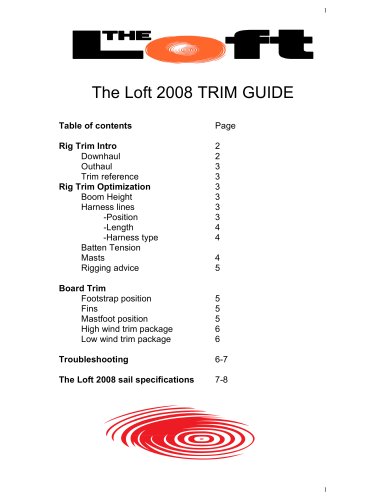
The Loft 2008 TRIM GUIDE Table of contents Page Batten Tension Board Trim High wind trim package 6 Low wind trim package 6 The Loft 2008 sail specifications 7-8
Open the catalog to page 1
Windsurfing rigs have by nature an elastic, living character... the aerodynamic form your rig presents to the wind depends primarily on three elements: -sail design (the mast and seam curves cut into the sail) -mast stiffness & flex character -the trim you set into your rig (downhaul & outhaul tension as well mast-foot position and boom-height among other trim settings). Trim sensitivity = Performance & wind range expansion Rig trim is critical to rig performance. Loftsails are exceptionally trim Trim begins with noting the boom length, mast length and the recommended mast for your sail which...
Open the catalog to page 2
Extreme low wind trim will increase light wind power and also make the rig feel stiff and more back hand oriented, especially should the wind rise. Greater outhaul tension flattens the sail profile making the sail much easier to handle and faster in medium and strong winds. Flatter outhaul trim allows the sail to pass more easily through the wind. For a given sail size the range between ideal strong and light wind trim may be up to An easy trim reference (cam-free sails) is the position of the forward end of the batten just above the boom. If this forward batten end passes the mast without touching...
Open the catalog to page 3
Narrow harness lines (12cm and less) transfer power to the sailor more directly, more critically. As the harness lines are placed closer together on the boom they make rig trim more critical relative to the power center. Racers tend to set narrow harness line placement, often no space -Harness line length also influences performance. For average size windsurfers 24 to 26 cm from the line center to the boom is an average harness line length. Short lines limit speed potential... bodyweight is the power generator. Bodyweight too close to the rig and maximum power is unavailable. Overly short lines...
Open the catalog to page 4
mast pocket, the sail head arrives all the way to the mast top before pulling the sail all the way down onto the mast. A fold will occur at the boomhole, which relieves pressure between the mast pocket and the mast top- avoiding damage to the mast pocket. -It is also very important that the mast parts do not slide apart during the rigging process. If your mast has a loose fit, check the joint before downhauling by feeling the middle of the mast with your hand- if you can feel a gap between the mast parts- STOP!... and re-fit your mast! Taping your mast together around the middle seam will ensure...
Open the catalog to page 5
High wind trim package If you feel overpowered set the mast and boom length to the recommended high-wind lengths and trim accordingly. Also try the boom lower by 2-4 cm and set the mastfoot further forward 1 -3cm. Hi wind trim will require the harness lines to move forward by 2-4cm compared to Low wind trim package To trim for power free the downhaul and the boom 2-4cm. Raise the boom a few centimeters and move the mastfoot back 2-3 cm. Low wind trim will require the harness lines to move back by 2-4cm compared to high wind trim. Experience the new sensations resulting from trim alternatives,...
Open the catalog to page 6
©Try more downhaul, more outhaul, straps further forward, bigger fin, mastfoot further back, softer mast. ©Difficulty closing the sail down onto the board. ©Try more outhaul, more downhaul, mastfoot further forward, smaller fin, softer mast, footstraps farther back, harness lines farther back, lower harness hook, smaller sail. ©The board bounces in chop and when starting to gibe. ©Try the mastfoot farther forward, boom lower, more downhaul, more outhaul, smaller fin, footstraps farther forward, smaller sail. Optimizing trim for high performance windsurfing is a process that has no limits! Improvements...
Open the catalog to page 7
Blade all sizes 4 cams sdm= "standard diameter mast" rdm= "reduced diameter mast" vt= vario top me= mast extension weights in kilograms Inflatable Specifications subject to change without notice
Open the catalog to page 8
The Loft 2008 TRIM GUIDE Table of contents Page Batten Tension Board Trim High wind trim package 6 Low wind trim package 6 The Loft 2008 sail specifications 7-8
Open the catalog to page 9
Windsurfing rigs have by nature an elastic, living character... the aerodynamic form your rig presents to the wind depends primarily on three elements: -sail design (the mast and seam curves cut into the sail) -mast stiffness & flex character -the trim you set into your rig (downhaul & outhaul tension as well mast-foot position and boom-height among other trim settings). Trim sensitivity = Performance & wind range expansion Rig trim is critical to rig performance. Loftsails are exceptionally trim Trim begins with noting the boom length, mast length and the recommended mast for your sail which...
Open the catalog to page 10
Extreme low wind trim will increase light wind power and also make the rig feel stiff and more back hand oriented, especially should the wind rise. Greater outhaul tension flattens the sail profile making the sail much easier to handle and faster in medium and strong winds. Flatter outhaul trim allows the sail to pass more easily through the wind. For a given sail size the range between ideal strong and light wind trim may be up to An easy trim reference (cam-free sails) is the position of the forward end of the batten just above the boom. If this forward batten end passes the mast without touching...
Open the catalog to page 11
Narrow harness lines (12cm and less) transfer power to the sailor more directly, more critically. As the harness lines are placed closer together on the boom they make rig trim more critical relative to the power center. Racers tend to set narrow harness line placement, often no space -Harness line length also influences performance. For average size windsurfers 24 to 26 cm from the line center to the boom is an average harness line length. Short lines limit speed potential... bodyweight is the power generator. Bodyweight too close to the rig and maximum power is unavailable. Overly short lines...
Open the catalog to page 12All Loftsails catalogs and brochures
 catalog 2012
2 Pages
 THE LOFTSAILS
15 Pages
 Loft Sails 2009 brochure pt4
6 Pages
 Loft Sails 2009 brochure pt3
8 Pages
 Loft Sails 2009 brochure pt2
4 Pages
 Loft Sails 2009 brochure pt1
6 Pages
Archived catalogs
 The Loft - Catalog 2008
20 Pages
 The Loft - Masts 2008
4 Pages
 The Loft - Booms 2008
11 Pages
- Windsurf sail
- Carbon mast
- Watersports harness
- Wave windsurf sail
- 4-batten windsurf sail
- Windsurf mast
- Freeride windsurf sail
- 7-batten windsurf sail
- 5-batten windsurf sail
- 6-batten windsurf sail
- Windsurfing harness
- Slalom windsurf sail
- SDM windsurf sail
- Race windsurf sail
- Windsurf boom
- Speed windsurf sail
- Seat harness
- Freerace windsurf sail
- Carbon windsurf boom