
- Catalogs
- International Marine
- Hydroblasting Standards


Hydroblasting Standards

Hydroblasting Standards
The document emphasizes the significance of proper procedures for surface preparation and paint application to ensure optimal performance of cargo tank coatings. It serves as a guide for ship operators, shipyards, and contractors to achieve high standards in these processes.
Prior to abrasive blasting, tanks must be clean, dry, and ready for coating application. Essential requirements include cleaning tanks, removing blisters, heavy scale, grease, oil, and completing all hot work. Freshwater washing is crucial.
Adherence to surface preparation standards like ISO 8501-1 (1988) - Sa21/2 and Sa3 is vital. Sa21/2 is the optimal standard, while Sa3 is less feasible. Clean, oil-free, and dry compressed air is necessary for blasting, and abrasives must be contaminant-free.
Staging should facilitate thorough cleaning and access, with tubular scaffolding recommended. It should not obscure surfaces to be coated and must be designed to prevent grit ingress.
The document details four common procedures for grit blasting and coating application, highlighting their advantages and disadvantages. Continuous blasting and meticulous cleaning are emphasized.
Coatings must be applied according to International Paint's guidelines using airless spray equipment. Environmental conditions must be controlled, with dehumidification and temperature management being critical.
Ventilation must prevent solvent vapor concentration from exceeding safety limits. Heating should use a heat exchange system, and lighting must be explosion-proof.
After curing, tanks should undergo seawater testing to identify defects. Any issues found should be repaired following International Paint's recommendations.
Stripe coating is essential for areas like stiffeners, welds, and difficult access points. Application should be by brush or roller, with airless spray used only in specific cases.
Repair procedures depend on the extent of damage. Major repairs follow full procedures, while minor repairs focus on cleaning, degreasing, and corrosion removal.
- Use a disc sander or grinder for cleaning.
- Abrade the coated area around the repair for better adhesion.
- Apply the paint system as per the agreed specification. Multiple coats may be needed for small areas.
- Follow the advice on product labels, Technical Data Sheets, and Material Safety Data Sheets.
- Consult International Paint for minimum cure times before cargo loading or service entry.
- Cargo tank coatings contain volatile, flammable solvents that can form explosive mixtures.
- Use personal protection equipment to prevent health hazards.
- Ensure tanks and surrounding areas are flame and spark-free.
- Provide adequate ventilation and suitable breathing equipment.
- Prevent skin irritation and protect skin, eyes, and ears.
- Have rescue equipment like an independent air supply available for emergencies.
- Use coatings specifically formulated for cargo tanks.
- Consult International Paint for detailed Health and Safety advice.
- Statements in the brochure are advisory and not specific recommendations or warranties.
- Liability for loss or damage from use of the information is limited.
- Products and advice are subject to the Conditions of Sale.
- Product Data Sheets and Material Safety Data Sheets are available on request or from the website.
- International Paint Ltd is part of Akzo Nobel, a Netherlands-based company.
- Akzo Nobel serves customers worldwide with healthcare products, coatings, and chemicals.
- Consolidated sales for 2003 were EUR 13 billion, with approximately 64,300 employees in over 80 countries.
Catalog excerpts

Marine Coatings Cargo Tank Coatings Recommended Working Procedures AKZO NOBEL
Open the catalog to page 1
Introduction Successful in service performance of cargo tank coating systems depends not only on the correct choice of coating but also on the procedures adopted for surface preparation and paint application. This document is designed to assist ship operators, shipyar ds and contractors achieve the optimum preparation and application standards so maximising the performance of cargo tank coatings. Tank Condition - Pre Contract Prior to the commencement of abrasive blasting, it is essential that the tanks are clean, dry and in a condition suitable for the surface preparation and application of...
Open the catalog to page 2
“Successful in service Heating coils should be masked during blasting and coating. performance of cargo tank coating systems depends not only on the correct choice of coating but also on the procedures adopted for surface preparation and paint application.” Steelwork Preparation In order to provide surfaces which will ensure optimum coating performance, the following minimum steelwork preparation should Surface Preparation be carried out: Two main universal standards of surface preparation are normally specified for cargo tank coatings – ISO Standar d ISO 8501-1 (1988) - Item Sharp Edges Sa21/2...
Open the catalog to page 3
Scaffolding (Staging) Type Cargo Lines Staging should be designed to allow thor ough cleaning and acceptable The internal areas of cargo pipe lines should be coated, if r equired, substrate access. International Paint recommend that staging should prior to fitting on the vessel. The exter nal areas of cargo pipe lines be the ‘turn over’ type, when local safety r egulations permit. Tubular should be blasted and coated at the same time as the lowermost scaffolding should not mask surfaces to be coated. Wher e contact with 2 metres (6.5 feet) of the tank. surfaces is necessary, spade ends should...
Open the catalog to page 4
When preparing surfaces by other means, all traces of debris should also be removed by appropriate methods. Before application of the coating, the amount of r esidual salt on the prepared steel surface should be measured by the Bresle patch method (ISO 8502-6: 1995) or similar. If the salt contamination level is “For optimum performance of cargo tank coatings, close control of dry film thickness above the maximum that is permissible for the particular pr oduct being used,† further fresh water washing, blasting and cleaning will be required. is essential.” Coatings Application All products must...
Open the catalog to page 5
Stripe Coats Stripe coating is an essential part of good painting practice in cargo Key areas for stripe coat application. tanks. Typical areas where stripe coats should be applied include: • backs of stiffeners • cut outs i.e. scallops, etc • welds • areas of difficult access (corners etc) • ladders and hand rails • areas of properly prepared pitting In general, stripe coats should be applied by brush or r oller depending on the items concer ned. In exceptional circumstances it may be acceptable to apply a stripe coat to the backs of stif feners by narrow-angle airless spray. The use of spray...
Open the catalog to page 6
Repairs These procedures are recommended for the repair of damages either at the initial coating stage or during cargo tank maintenance. The procedure recommended will depend upon the type and extent of r epair involved. Major Repairs Inspection of cargo tank following full coating refurbishment. Where major repairs are required, work should be carried out in accor dance with all the previous sections of these working procedures. Minor Repairs These are repairs to areas damaged, either at the initial coating stage, (e.g. by destaging) or during the in service period (e.g. cargo-induced damages,...
Open the catalog to page 7
November 2004 International Paint Ltd is part of Akzo Nobel, the Netherlands based company serving customers thr oughout the world with healthcare products, coatings and chemicals. Consolidated sales for 2003 totalled EUR 13 billion. Akzo Nobel currently employs approximately 64,300 people in more than 80 countries. Argentina Australia Bahrain Belgium Brazil Bulgaria Canada Chile Colombia Croatia Cuba Cyprus Denmark Ecuador Egypt Estonia Fiji Finland France Germany Greece Hong Kong Iceland India Indonesia Iran Italy Japan Kuwait Latvia Lithuania Luxembourg Malaysia Malta Mexico Netherlands New...
Open the catalog to page 8All International Marine catalogs and brochures
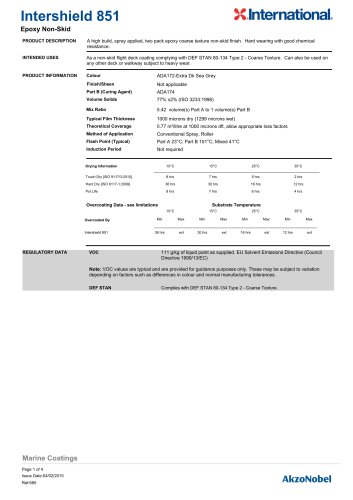 Intershield 851
4 Pages
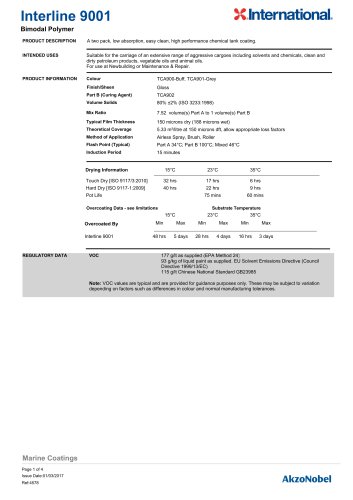 Interline 9001
4 Pages
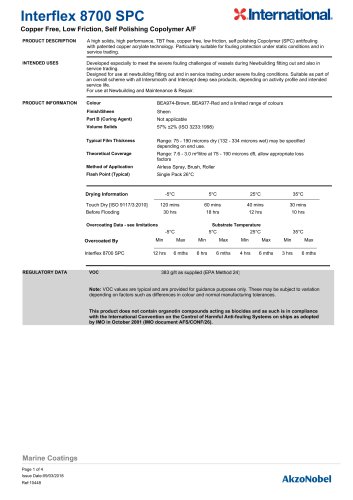 Interflex 8700 SPC
4 Pages
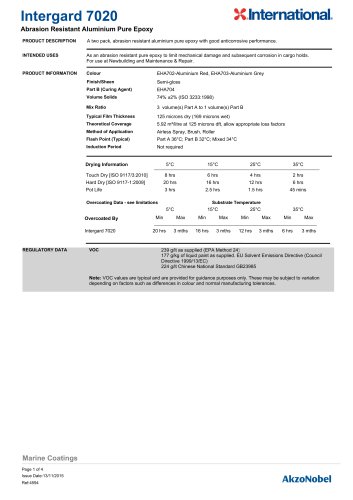 Intergard 7020
4 Pages
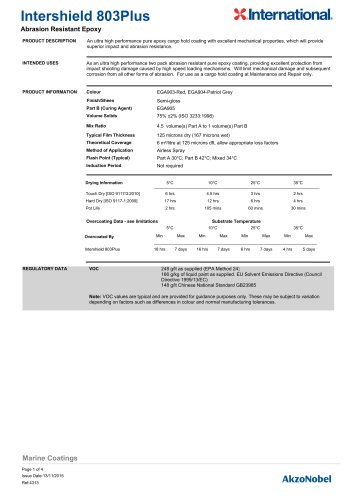 Intershield 803Plus
4 Pages
Archived catalogs
 Formula 150 (MIL-DTL-24441)
4 Pages
 Intergard 5000
4 Pages
 Interline 975P
4 Pages
 Interline 994LT
4 Pages
 Interline 644
4 Pages
 Intersmooth 7670 SPC
4 Pages
 Interspeed 5617
4 Pages
 Interflex 8700 SPC
4 Pages
 Intertherm 50
4 Pages
 Interplate Zero
4 Pages
 Intergard 269
4 Pages
 Interline 850
4 Pages
 Intershield 6GV
2 Pages
 Intersleek 1100SR
4 Pages
 Interswift 6800HS
2 Pages
 Intercept 8500LPP PIC
2 Pages
 INTERPRIME 198
4 Pages
 INTERTHANE 990
4 Pages
 INTERLAC 678
4 Pages
 Intertuf 362
4 Pages
 Intergard 821
4 Pages
 Intershield 803Plus
4 Pages
 Intershield 852
4 Pages
 Intershield 851
4 Pages
 Intershield 456
4 Pages
 Interfine 878
4 Pages
 Intersleek 717
4 Pages
 Intersleek 737
4 Pages
 Intersmooth 7465HS SPC
4 Pages
 Intersmooth 7465Si SPC
4 Pages
 Fisheries
2 Pages
 Interflex 8700 PIC
2 Pages
 Interline 9001
6 Pages
 Intershield 300
8 Pages
 Intershield 5150LWT
2 Pages
 Intersleek 1000
6 Pages
 Intersleek 7180 Linkcoat
6 Pages
 Intertrac Vision
4 Pages
 Silyl acrylate antifoulings
2 Pages
 Integard 5555 PIC
2 Pages
 Interbond 808
2 Pages
 Intercept 7000
1 Page
 Keeping your fleet protected
6 Pages
 Cargo Hold Coatings
7 Pages
 Antifouling coatings range
8 Pages
 Cargo Tank Coatings
7 Pages
 Intersleek
6 Pages
 Universal Primer Range
2 Pages
 Intergard 403
4 Pages
 INTERTHERM 891 DATA SHEET
4 Pages
 Intershield 300V
4 Pages
 INTERSHIELD 803 DATA SHEET
4 Pages
 Interspeed-5640
2 Pages
 Intergard 5400 PIC
2 Pages
 Interswift 6600
2 Pages
 Intersleek 700
2 Pages
 Intershield One-2-One
1 Page
 Interline 904
2 Pages
 Maintenance and Repair
19 Pages
 Hydroblasting Standards
15 Pages
 Intersleek7180Brochure
2 Pages
 Interplate® Zero
11 Pages
 Interline®9001
5 Pages
 Intergard 5600 / 5620
2 Pages
 Intergard 7020
2 Pages
 Intergard 7500
2 Pages
 Interswift 6900Si
4 Pages
 INTERBOND 501
4 Pages
 INTERGARD 400
4 Pages
 Interline 104
4 Pages
 Intercept 8000 LPP
4 Pages
 Intershield_163_Inerta
9 Pages
 Interswift 455FB
4 Pages
 Intersmooth 365 SPC
4 Pages
 Intershield 163 Inerta 160
4 Pages
 Interswift 655
4 Pages
 Interspeed 6400
4 Pages
 Intersmooth 7460HS SPC
4 Pages
 Intersmooth 360 SPC
4 Pages
 Intersleek 970
4 Pages
 Intersleek 386
4 Pages
 Interprime 65
4 Pages
 Colour Card
2 Pages
 Abrasive Sweep Standards
12 Pages
 Cargo Hold
8 Pages
 Slurryblasting Standards
14 Pages
 INTERTUF 203 DATA SHEET
4 Pages
 INTERZINC 22HS DATA SHEET
4 Pages
 INTERZONE 1000 DATA SHEET
4 Pages
 INTERFINE 629HS
4 Pages
 BALLAST TANK BROCHURE
13 Pages
 INTERLAC 665 DATA SHEET
4 Pages
 INTERSHEEN 579 DATA SHEET
4 Pages
 INTERGARD 5600 DATA SHEET
4 Pages
 INTERSHIELD 300 DATA SHEET
4 Pages
 INTERTUF 262 DATA SHEET
4 Pages
 INTERGARD 7600 DATA SHEET
4 Pages
 INTERZINC 22 DATA SHEET
4 Pages
 Intergard 343
9 Pages


- International antifouling
- Self-polishing antifouling coating
- International epoxy primer
- International multi-use antifouling
- International multi-use primer
- International ship coating
- International anti-corrosion primer
- Two-component primer
- International professional vessel coating
- Epoxy filler
- Steel primer
- Two-component filler
- Repair filler
- International two-component coating
- International epoxy coating
- High-gloss varnish
- Single-component primer
- Single-component coating
- International merchant ship primer