
- Catalogs
- International Marine
- Hydroblasting Standards


Hydroblasting Standards

Hydroblasting Standards
Hydroblasting is a cleaning technique using water pressure to clean surfaces without abrasives, eliminating dust pollution and abrasive disposal issues. It operates at high (10,000-25,000 psi) and ultra-high pressures (above 25,000 psi). The standard applies to various hydroblasting pressures and aims to guide on acceptable flash rusting levels before applying coatings.
Format
The standard includes color photographs showing steel surfaces before and after hydroblasting, with varying flash rusting degrees.
Explanatory Text
Initial Rust Grades: Grades C and D are defined, with C having slight pitting and D having visible pitting.
Blast Standards: HB2 and HB21/2 cleanliness levels are comparable to Sa2 and Sa21/2 standards, with HB21/2 being more thorough.
Degrees of Flash Rusting: Light (L), Moderate (M), and Heavy (H) flash rusting are defined by the visibility and adherence of rust.
Procedure for Using the Standard
1. Select the rust grade photograph matching the steel to be cleaned.
2. Choose the specified cleaning degree photograph.
3. Compare the prepared surface with the photograph before flash rusting.
4. Compare the flash rusted surface with flash rusting photographs.
5. Ensure the paint product is suitable for the flash rusting degree.
Notes
Definitions clarify hydroblasting terms and differentiate from water washing. Special attention is needed for difficult access areas and temperature rise during hydroblasting. Chemical corrosion inhibitors are not recommended due to potential adhesion issues. Flash rusting can be reduced by brushing or high-pressure washing.
References
Standards referenced include SSPC-VIS 1-89 and ISO 8501-1:1988 for surface cleanliness.
Visual Standards
Photographs depict rust grades C and D, with preparation standards HB2 and HB21/2, and degrees of flash rusting (L, M, H).
Catalog excerpts

Hydroblasting Standards www.international-marine.com
Open the catalog to page 1
Hydroblasting Standards Contents 1. 2. 3. 4. Introduction Format Explanatory Text Procedure For Using The Standards 5. Notes 6. References 7. Visual Standards 1 Introduction Hydroblasting is a technique for cleaning surfaces, which relies entirely on the energy of water striking a surface to achieve its cleaning effect. Abrasives are NOT used in hydroblasting systems. Consequently the problems caused by dust pollution and by the disposal of spent abrasives are eliminated. Two different hydroblasting operating pressures are commonly encountered. • High pressure hydroblasting, operating at pressures...
Open the catalog to page 2
The definitions are: Rust Grade C: Steel surface completely covered with rust but with little or slight pitting under normal vision. Rust Grade D: Steel surface completely covered with rust on which general pitting is visible under normal vision. 3.2 Blast Standards The standard illustrates grade C and D surfaces prepared by hydroblasting to two different degrees of cleanliness. These are designated HB2 and HB21/2 and are comparable to Sa2 and Sa21/2 described in the ISO 8501-1:1988 surface preparation standard and to SSPC-SP6 and SSPC-SP10 of the Steel Structures Painting Council surface preparation...
Open the catalog to page 3
4.3 Compare the prepared surface with the photograph selected immediately after hydroblasting but before the surface has flash rusted to evaluate the degree of cleaning, see note 5.3. 4.4 Prior to painting compare the flash rusted surface with the flash rusting photographs. For example, D HB2 L, D HB2 M, D HB2 H to evaluate the degree of flash rusting that has occurred. 4.5 Check that the paint product specified is suitable for overcoating the degree of flash rusting that has occurred. See note 5.7. 5 Notes 5.1 Definition of Terms The terms hydroblasting, hydrojetting and water jetting essentially...
Open the catalog to page 4
5.6 Chemical Corrosion Inhibition Flash rusting can be prevented by the use of water soluble chemical corrosion inhibitors. These inhibitors may leave a crystalline layer on the steel surface as the water evaporates which can then lead to a loss of adhesion and osmotic blistering if coatings are applied over this type of surface. International Paint do not recommend the use of corrosion inhibitors to hold wet blasted surfaces. If inhibitors are used, they must be thoroughly washed off with fresh water before International Paint products are applied. 5.7 Removal of Flash Rusting When flash rusting...
Open the catalog to page 5
7 Visual Standards Rust Grade Standards Rust grade C Rust grade D
Open the catalog to page 6
Preparation Standard C HB2 Rust grade C C HB2 Rust grade C Hydroblasted to an Sa2 equivalent
Open the catalog to page 7
Degree of Flash Rusting C HB2 L. Light flash rusting C HB2 M. Moderate flash rusting C HB2 H. Heavy flash rusting
Open the catalog to page 8
Preparation Standard C HB2 1/2 Rust grade C C HB21/2 Rust grade C Hydroblasted to an Sa21/2 equivalent
Open the catalog to page 9
Degree of Flash Rusting C HB21/2 L. Light flash rusting C HB21/2 M. Moderate flash rusting C HB21/2 H. Heavy flash rusting
Open the catalog to page 10
Preparation Standard D HB2 Rust grade D D HB2 Rust grade D Hydroblasted to an Sa2 equivalent
Open the catalog to page 11
Degree of Flash Rusting D HB2 L. Light flash rusting D HB2 M. Moderate flash rusting D HB2 H. Heavy flash rusting
Open the catalog to page 12
Preparation Standard D HB2 1/2 Rust grade D D HB21/2 Rust grade D Hydroblasted to an Sa21/2 equivalent
Open the catalog to page 13
Degree of Flash Rusting D HB21/2 L. Light flash rusting D HB21/2 M. Moderate flash rusting D HB21/2 H. Heavy flash rusting
Open the catalog to page 14
September 2004 Argentina Australia Bahrain Belgium Brazil Bulgaria Canada Chile Colombia Croatia Cuba Cyprus Denmark Ecuador Egypt Estonia Fiji Finland France Germany Greece Hong Kong Iceland India Indonesia Iran Italy Japan Kuwait Latvia Lithuania Luxembourg Malaysia Malta Mexico Netherlands New Zealand Northern Ireland Norway Pakistan Panama Papua New Guinea Peoples Republic of China Peru Philippines Poland Portugal Qatar Republic of Ireland Romania Russia Saudi Arabia Singapore Slovenia South Africa South Korea Spain Sri Lanka Sweden Taiwan Thailand Turkey U.S.A. Ukraine United Arab Emirates...
Open the catalog to page 15All International Marine catalogs and brochures
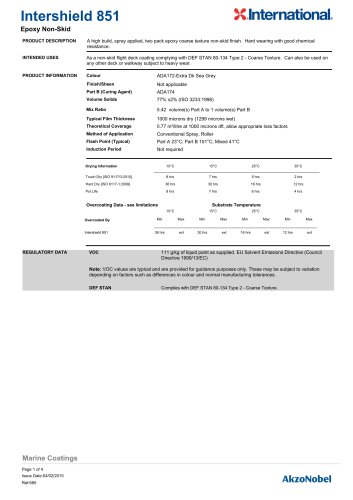 Intershield 851
4 Pages
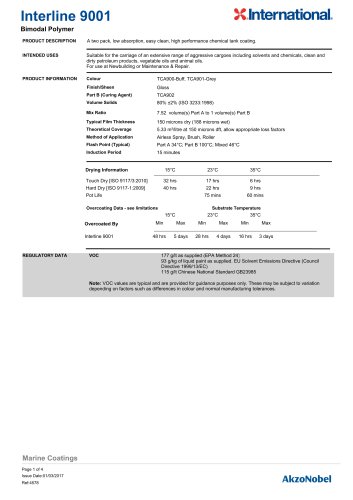 Interline 9001
4 Pages
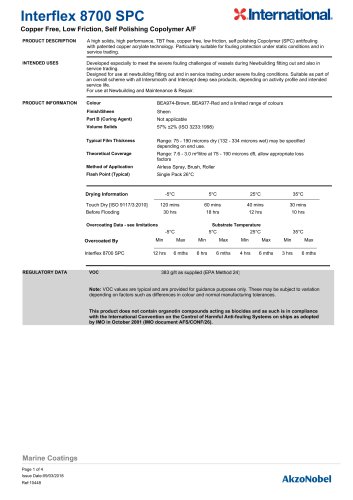 Interflex 8700 SPC
4 Pages
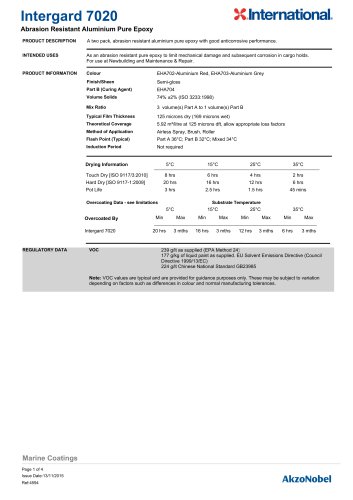 Intergard 7020
4 Pages
 Intershield 803Plus
4 Pages
Archived catalogs
 Formula 150 (MIL-DTL-24441)
4 Pages
 Intergard 5000
4 Pages
 Interline 975P
4 Pages
 Interline 994LT
4 Pages
 Interline 644
4 Pages
 Intersmooth 7670 SPC
4 Pages
 Interspeed 5617
4 Pages
 Interflex 8700 SPC
4 Pages
 Intertherm 50
4 Pages
 Interplate Zero
4 Pages
 Intergard 269
4 Pages
 Interline 850
4 Pages
 Intershield 6GV
2 Pages
 Intersleek 1100SR
4 Pages
 Interswift 6800HS
2 Pages
 Intercept 8500LPP PIC
2 Pages
 INTERPRIME 198
4 Pages
 INTERTHANE 990
4 Pages
 INTERLAC 678
4 Pages
 Intertuf 362
4 Pages
 Intergard 821
4 Pages
 Intershield 803Plus
4 Pages
 Intershield 852
4 Pages
 Intershield 851
4 Pages
 Intershield 456
4 Pages
 Interfine 878
4 Pages
 Intersleek 717
4 Pages
 Intersleek 737
4 Pages
 Intersmooth 7465HS SPC
4 Pages
 Intersmooth 7465Si SPC
4 Pages
 Fisheries
2 Pages
 Interflex 8700 PIC
2 Pages
 Interline 9001
6 Pages
 Intershield 300
8 Pages
 Intershield 5150LWT
2 Pages
 Intersleek 1000
6 Pages
 Intersleek 7180 Linkcoat
6 Pages
 Intertrac Vision
4 Pages
 Silyl acrylate antifoulings
2 Pages
 Integard 5555 PIC
2 Pages
 Interbond 808
2 Pages
 Intercept 7000
1 Page
 Keeping your fleet protected
6 Pages
 Cargo Hold Coatings
7 Pages
 Antifouling coatings range
8 Pages
 Cargo Tank Coatings
7 Pages
 Intersleek
6 Pages
 Universal Primer Range
2 Pages
 Intergard 403
4 Pages
 INTERTHERM 891 DATA SHEET
4 Pages
 Intershield 300V
4 Pages
 INTERSHIELD 803 DATA SHEET
4 Pages
 Interspeed-5640
2 Pages
 Intergard 5400 PIC
2 Pages
 Interswift 6600
2 Pages
 Intersleek 700
2 Pages
 Intershield One-2-One
1 Page
 Interline 904
2 Pages
 Maintenance and Repair
19 Pages
 Hydroblasting Standards
8 Pages
 Intersleek7180Brochure
2 Pages
 Interplate® Zero
11 Pages
 Interline®9001
5 Pages
 Intergard 5600 / 5620
2 Pages
 Intergard 7020
2 Pages
 Intergard 7500
2 Pages
 Interswift 6900Si
4 Pages
 INTERBOND 501
4 Pages
 INTERGARD 400
4 Pages
 Interline 104
4 Pages
 Intercept 8000 LPP
4 Pages
 Intershield_163_Inerta
9 Pages
 Interswift 455FB
4 Pages
 Intersmooth 365 SPC
4 Pages
 Intershield 163 Inerta 160
4 Pages
 Interswift 655
4 Pages
 Interspeed 6400
4 Pages
 Intersmooth 7460HS SPC
4 Pages
 Intersmooth 360 SPC
4 Pages
 Intersleek 970
4 Pages
 Intersleek 386
4 Pages
 Interprime 65
4 Pages
 Colour Card
2 Pages
 Abrasive Sweep Standards
12 Pages
 Cargo Hold
8 Pages
 Slurryblasting Standards
14 Pages
 INTERTUF 203 DATA SHEET
4 Pages
 INTERZINC 22HS DATA SHEET
4 Pages
 INTERZONE 1000 DATA SHEET
4 Pages
 INTERFINE 629HS
4 Pages
 BALLAST TANK BROCHURE
13 Pages
 INTERLAC 665 DATA SHEET
4 Pages
 INTERSHEEN 579 DATA SHEET
4 Pages
 INTERGARD 5600 DATA SHEET
4 Pages
 INTERSHIELD 300 DATA SHEET
4 Pages
 INTERTUF 262 DATA SHEET
4 Pages
 INTERGARD 7600 DATA SHEET
4 Pages
 INTERZINC 22 DATA SHEET
4 Pages
 Intergard 343
9 Pages


- International antifouling
- Self-polishing antifouling coating
- International epoxy primer
- International multi-use antifouling
- International multi-use primer
- International ship coating
- International anti-corrosion primer
- Two-component primer
- International professional vessel coating
- Epoxy filler
- Steel primer
- Two-component filler
- Repair filler
- International two-component coating
- International epoxy coating
- High-gloss varnish
- Single-component primer
- Single-component coating
- International merchant ship primer