
- Catalogs
- International Lashing Systems
- ILS Catalogue

- Company
- Products
- Catalogs
- News & Trends
- Exhibitions
ILS Catalogue
1 /100Pages

ILS Catalogue
1 /100Pages
Catalog excerpts

INTERNATIONAL LASHING SYSTEMS
Open the catalog to page 1
Email [email protected] Website www.ils.be
Open the catalog to page 2
A world player specialized in cargo securing technology.
Open the catalog to page 3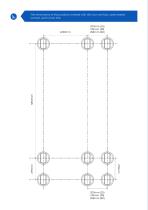
The dimensions of the products marked with this icon are fully customisable. Contact us for more info.
Open the catalog to page 4
mission statement everything you need to run a tight ship As a professional in the marine and offshore industry, we know you’re not just going to hit any port in a storm. Well, you’ve come to the right place. We’ve got decades of experience in the design and manufacturing of lashing products. Our warehouse is stocked to the brim with the best products on the market. Literally everything you need to run a tight ship. And at ILS, we take pride in getting it all over to you ahead of ti
Open the catalog to page 5
we’ve known the twistlocks since 1974
Open the catalog to page 6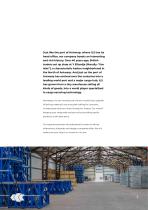
Just like the port of Antwerp, where ILS has its head office, our company boasts an interesting and rich history. Over 40 years ago, British traders set up shop at ‘t Eilandje (literally: “the Islet”), a characteristic harbor neighborhood in the North of Antwerp. And just as the port of Antwerp has evolved over the centuries into a leading world port and a major cargo hub, ILS has grown from a tiny warehouse selling all kinds of goods, into a world player specialized in cargo securing technology. Nowadays, we can honestly say we are a world-class supplier of lashing materials, ensuring plain...
Open the catalog to page 7
your preferred partner
Open the catalog to page 8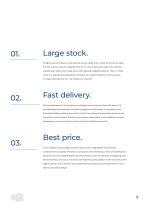
Large stock. Imagine everything you may need to secure cargo onto a ship. All kinds of cargo, for that matter. Hard to imagine? Not for us. We’ve got it all under one roof. Our warehouse holds a very large stock of all lashing-related products. That is, if they meet our high quality standards. Whether you need twistlocks, chains, levers, D-rings, lashing bars, etc.: we’ve got you covered. Fast delivery. Our commitment to a fast delivery will keep you on course. Over the years, ILS has developed an extensive network of agents and stockists in all major ports and shipbuilding nations around the...
Open the catalog to page 9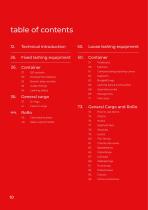
26. Fixed lashing equipment 27 ISO sockets 30 Dovetail foundations 32 Breech base sockets 37 D-rings 41 Flush D-rings 48 Steel cups for RoRo 61 Compensating stacking cones 65 Lashing bars & turnbuckles
Open the catalog to page 10
technical introduction what you need to know about container lashing
Open the catalog to page 12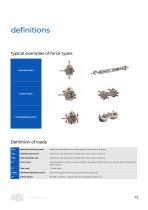
definitions Typical examples of force types TENSION FORCE SHEAR FORCE COMPRESSION FORCE Maximum Securing Load Maximum load allowed on a lashing item when used in practice Working Load Limit Maximum load allowed on a lifting item when used in practice Safe Working Load Maximum load allowed on a lifting item when used in practice Proof Load Load applied on an item in test conditions. No plastic deformation may remain after this load has been applied. Test Load (Minimum) Breaking Load Minimum load an item has to sustain before breaking Safety Factor BL/MSL or BL/WLL. Typical value for most lashing...
Open the catalog to page 13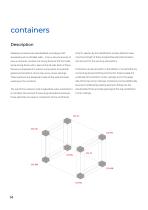
containers Description Shipping containers are standardised according to ISO Only for special, by the classification society defined, cases standards such as ISO 668, 1496, … From a structural point of may the strength of these longitudinal elements be taken view, a container consists of a strong frame at the front side into account for the securing calculations. and a strong frame with a door at the aft side. Each of these frames is composed of 2 vertical corner posts, 2 horizontal Containers can be secured to a foundation or to eachother by girders at the bottom and on top, and 4 corner castings....
Open the catalog to page 14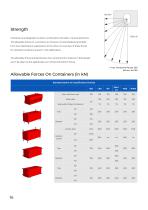
Containers are designed to sustain combinations of loads in various directions. The allowable forces on a container are however not standardised and defer from one classification organization to the other. An overview of these forces for standard containers is given in the table below. The allowable forces acting between two containers (for instance in buttresses) are to be taken as the appropriate sum of top and bottom forces. Allowable Forces On Containers (in kN)Standartization of Classification SocietyISO LRS BV ABS RINA
Open the catalog to page 16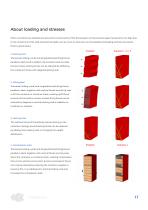
About loading and stresses When containers are stacked and secured on board, some of the forces given on the previous page may become too high due to the movement of the ship and external loads such as wind. An overview on the possible overloading and how to prevent them is given below. Problem 1. Racking load Transversal (rolling, wind) and longitudinal (pitching) forces parallel to deck tend to deform the container end and side frames. Excess racking forces can be reduced by stiffening the container frames with diagonal lashing rods. 2. Lifting load Tranversal (rolling, wind) and longitudinal...
Open the catalog to page 17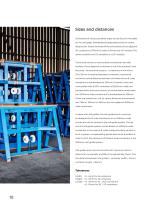
Sizes and distances Dimensions of various container types can be found in the table on the next page. Standardised longitudinal centre-to-centre distance be- tween the holes of the end sockets of two adjacent 20’ containers is 279mm in order to fit into one 40’ module. (The same is valid for two 10’ containers in a 20’ module) Transversal centre-to-centre distance between the side sockets of two adjacent containers is not fully standard- ised. Because – for practical reasons – a clearance of minimum 20 to 35mm is required between containers, transversal centre-to-centre distance between the holes...
Open the catalog to page 18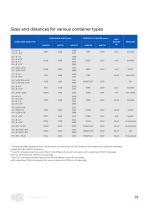
1 Transverse offset (distance from centre point to centre point of ISO holes) of all containers is 2259mm standard, except for ‘SEALAND' containers. 2 Two 20' containers behind each other fit the offsets of one 40' container with a spacing of 76mm between the two containers (or 279mm c/c spacing). 3 Two 24,5' containers behind each other fit the offsets of one 49' container with a spacing of 51mm between the two containers (or 279mm c/c spacing).
Open the catalog to page 19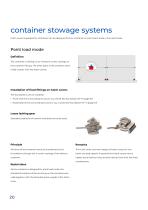
container stowage systems Hatch covers equipped for containers can be designed to stow containers in point load mode or line load mode. Point load mode Definition The container is resting on its 4 bottom corner castings on the container fittings. The other parts of the container don’t make contact with the hatch covers. Installation of fixed fittings on hatch covers The foundations can be installed: • Flush with the surrounding structure, e.g. a flush ISO foundation DF-71 (page 27) • Raised above the surrounding structure, e.g. a raised ISO foundation DF-41 (page 27) Loose lashing gear Standard...
Open the catalog to page 20- Nautical shackle
- Turnbuckle with toggle
- Open-body turnbuckle
- Ship chain
- Nautical D-shackle
- Fork turnbuckle
- Container lashing twist lock
- Crimp turnbuckle
- Ship hook
- Single hook
- Lashing strap
- Ro-Ro ship strap
- Fixed lashing point
- Hook for boat
- Container lashing point
- Container lashing stacking cone
- Transport strap
- Long-link chain