
- Catalogs
- Hobie Cat USA
- HOBIES CTALOGUE

- Products
- Catalogs
- News & Trends
- Exhibitions
HOBIES CTALOGUE

HOBIES CTALOGUE
- Balancing: Sit on the upwind side, use the hiking strap for balance, and manage the mainsheet and tiller with respective hands.
- Steering: Push the tiller to turn towards the wind and pull to turn away, minimizing movement to avoid over-steering.
- Sail Power: Adjust the sail to prevent luffing and use tell tails for optimal performance. Avoid sailing directly into the wind.
- Turning: For tacking, push the tiller slowly and switch sides. For jibing, turn away from the wind and control the sail's movement.
- Launching: Launch into the wind for control, and manage rudder positions based on water depth.
- Righting: If capsized, use the righting line and lean back to bring the boat upright.
- Docking/Landing: Approach docks and beaches into the wind for controlled stops.
- Adjust rudder rake for steering feel, using a 3/16" Allen wrench for adjustments. Check breakaway tension after changes.
- Loading: Ensure weight distribution to avoid towing issues.
- Towing: Be cautious of the wide load and ensure proper mirror setup for visibility.
- Launching/Retrieving: Prepare at the top of the ramp, avoid dunking wheel bearings, and ensure secure vehicle parking.
- Maintenance: Use waterproof lights and maintain electrical connections to prevent corrosion.
- Always wear a life jacket and be aware of wind conditions and boat handling techniques.
- Avoid overhead power lines when rigging or sailing.
- Sail within your experience level and wear life jackets.
- Learn right-of-way rules and give way when in doubt.
- Adhere to car roof rack weight limitations and secure the boat when car-topping.
- Securely tie the boat and loose parts to the trailer and check tie downs frequently.
- Avoid leaving the boat on a mooring to prevent accelerated wear and inspect rigging often.
Catalog excerpts
Sailing and Trailering Guide Sailing Your Hobie Cat Page 2-4 Balancing Steering Sail Power Turning Launching Righting Docking / Landing Rudder Tuning Trailering Page 4-5 Page 5 Loading Towing Launching / Retrieving Maintenence Safety Tips Page 6
Open the catalog to page 1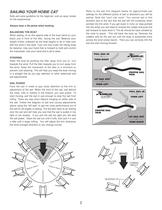
Refer to the sail trim diagram below for approximate sail settings for the different points of sail or directions you will be sailing. Note the "can't sail zone". You cannot sail in this direction due to the fact that the sail will luff constantly when pointed into the wind. If you get stuck in irons (or stop pointed into the wind) you will need to reverse the rudder and push the sail forward to back-wind it. The jib should be back winded by the crew to assist. This will back the boat up. Reverse the rudders and let the sail out until the boat is positioned more across the wind (close reach)....
Open the catalog to page 2
into the wind. Drift backwards with the rudders in the up position and your weigh towards the front of the boat. Stay forward as the boat drifts into deeper water.You can hold the sail out to catch wind backwards to increase reverse speed. Then move to the rear and lower the rudders. It will be easiest to lower only one rudder while moving backwards. Then lower the other when the boat begins to move forward again. Be aware of the intended direction you wish to sail when lowering the rudder and steer the boat as the rudder drops into the water. There will be a lot of force on the rudder to turn...
Open the catalog to page 3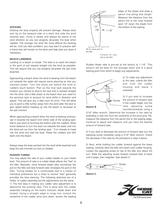
edge of the blade and draw a pencil line along that length. Measure the distance from the pencil line to the most forward spot 12" down the blade from the bottom of the casting.. 12" DOCKING Docking the boat properly will prevent damage. Always dock and rig on the leeward side of a dock (the side the wind reaches last). Come in slowly and always be aware of the wind direction so you can properly de-power the boat when needed. The stronger the wind the more difficult the docking will be. Until you feel confident, you may want to practice with a friend who will remain on the dock and help slow...
Open the catalog to page 4
The mast support on a trailer is subject to a lot of side-to-side motion and consequently may fatigue where it is welded to the trailer. All this can be reduced by tying a line from each bow to the mast support. This will stiffen the rig up and prolong the life of the trailer. 6) Hobie Cat rudder blades are preset to break away from the locked down position at 17-26 pounds by testing with a line around the rudder blade seven inches above the lowest tip of the blade. Once the rake is changed, the breakaway tension should be rechecked. The tension may be adjusted by turning the 3/4" internal screw...
Open the catalog to page 5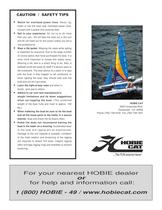
CAUTION / SAFETY TIPS • Watch for overhead power lines. Never rig, trailer or sail the boat near overhead power lines. Contact with a power line could be fatal. • Sail to your experience. Do not try to do more than you can. Do not take the boat out in the surf and do not head out for the ocean unless you are a real professional. • Wear a life jacket. Wearing life vests while sailing is important for everyone. Due to the large number of novice sailors that have purchased the boat, it is even more important to review this safety issue. Wearing a life vest is a smart thing to do. Also, a sailboat...
Open the catalog to page 6All Hobie Cat USA catalogs and brochures
 SAILING PARTS & ACCESSORIES
37 Pages
 2017 Stand Up Paddle Collection
12 Pages
 DuraCruz
1 Page
 Hobie All-Products Quad-Fold
2 Pages
 HCE sailing collection 2017
36 Pages
 HCE SAILING COLLECTION 2016 GB
36 Pages


Archived catalogs
 STAND UP PADDLE COLLECTION
32 Pages
 HOBIE Parts & Accessories
40 Pages
 HOBIE Kayaking Collection 2009
31 Pages
 HOBIE Sailing Collection 2009
20 Pages

