
- Catalogs
- Hexcel Composites
- Wind_Turbine_Blades

Wind_Turbine_Blades

Wind_Turbine_Blades
Hexcel is a prominent supplier of advanced composite materials for the wind energy sector, having supplied over 100 million square meters of composites for wind turbine blades over the past 25 years. Their technologies have facilitated the production of blades exceeding 80 meters in length, contributing significantly to global wind power expansion.
- Prepreg Materials: These materials are optimized for faster curing at lower temperatures, enhancing production efficiency.
- Fibre-Reinforced Matrix Solutions: Designed for rapid and cost-effective processing.
- Unidirectional Carbon Prepregs: Utilized in critically loaded structures for enhanced performance.
- Materials for Root Ends and Polyurethane Solutions: Enable cost-efficient manufacturing of nacelle housings.
- HexPly® M9G and M79: Epoxy resins tailored for low-pressure molding and faster curing at reduced temperatures.
- HexPly® SuperCap™ and SuperFIT™: Heavy UD epoxy prepregs and partially impregnated reinforcements designed for thick laminates.
- Polyspeed® Laminates: Pre-cured laminates that optimize structural integrity and reduce exotherm during curing.
- Spar/Shear Web: Critical for blade stiffness, utilizing UD reinforced carbon and glass materials.
- Shell Construction: Provides aerodynamic shape and environmental resistance, often employing sandwich construction for added strength.
- Nacelle Construction: Houses the main technical components of the turbine, typically using fiberglass and foam core materials.
- Blade Root: A critical area requiring high-quality laminates for secure connection to the hub.
- Modipur® Polyurethane Core Foams: Used in nacelle, shell, and mold applications.
- HexWeb® Honeycombs: Non-metallic honeycombs providing structural support.
- HexForce® Reinforcements: Biaxial and triaxial reinforcements in glass and carbon fiber.
- Redux® Adhesives: Hot melt film adhesives for bonding and structural integrity.
Hexcel's extensive range of composite materials and solutions supports the efficient and cost-effective manufacturing of wind turbine blades, advancing wind energy technology.
Hexcel is a global leader in producing prepregs and composites, particularly for wind turbine blades. The company focuses on integrating materials into customer processes, emphasizing innovative solutions for the wind energy industry.
Due to the large scale of components like wind blades, manual manufacturing processes are no longer feasible. Hexcel is committed to integrating automated technologies into manufacturing processes to address these challenges.
Hexcel has established strong partnerships with various companies, institutes, and universities to develop, demonstrate, and validate novel materials and concepts. Their material testing facilities have received GL accreditation, ensuring high standards in testing and quality assurance.
All information provided is believed to be accurate but is given without liability. Users should assess the suitability of products for their specific needs. All sales are subject to Hexcel's standard terms, which include limitations on liability.
Catalog excerpts

Harnessing nature’s power Hexcel’s composite materials, processes and solutions for wind turbine blades
Open the catalog to page 1
Harnessing nature’s power Hexcel is a leading global supplier of advanced composite materials to the wind energy market and has supplied more than 100 million square metres of composites to wind turbine blade manufacturers over the last 25 years. Our composite technologies have enabled blade lengths to increase to over 80 metres, supporting the growth of wind power around the world. We work closely with our customers to develop products and processes that are tailored to their specific requirements. This approach has enabled us to develop technologies such as: • repreg materials and process solutions...
Open the catalog to page 2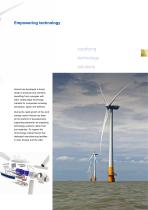
Empowering technology Hexcel has developed a broad range of products and solutions benefiting from synergies with other cutting edge technology markets for composites including aerospace, space and defense. During the rapid growth of the wind energy market Hexcel has been at the forefront of developments supporting expansion by supplying technology solutions rather than just materials. To support the wind energy market Hexcel has dedicated manufacturing facilities in Asia, Europe and the USA.
Open the catalog to page 3
A wind blade is a component for a machine designed to direct and concentrate energy from the air into a wire that connects the turbine generator to an electrical grid. The cost of such energy depends on advanced and cost-effective solutions to manufacture very large composite structures like wind blades. Prepreg is a glass or carbon fibre reinforcement that is impregnated with a resin (e.g. epoxy). Prepreg is supplied in roll form and cured by applying heat and pressure to produce high quality laminates with superior stiffness and strength - at low weights. Prepreg is an ideal economical technology...
Open the catalog to page 4
Benefits of HexPly® M9-family prepregs: • optimised structural design • consistent fibre volume ratio • lower and consistent blade weight • pure UD materials with optimised performance/ cost ratio • high strength and fatigue properties • short total processing and cure cycle • clean working environment • low exothermic properties -enabling curing and co-curing of multi-ply laminates, e.g. carbon with glass • minimise stresses caused by differences in thermal expansion
Open the catalog to page 5
A wind blade is a structural beam that throughout its operating life is subjected to considerable lift forces on its aerodynamic profile. Stiffening of the blade is therefore essential to resist bending. Sometimes two strips of reinforcing materials are used to provide local stiffening - one on the upwind face and one on the downwind face. However, to provide the essential shear strength these two strips need to be structurally joined by a construction called a shear web. There are different ways of designing a spar/shear web - either as a girder-structure connected by one or two shear-webs or...
Open the catalog to page 6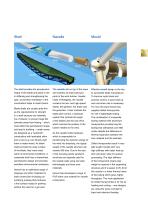
The shell provides the aerodynamic shape of the blade and plays a role in stiffening and strengthening the spar, as the fibre orientation in the construction helps to resist torsion. Blade shells are usually quite thin as the requirements for strength in a shell structure are relatively low. However, to prevent large flat laminate areas from flexing - which could affect the aerodynamic shape and lead to buckling - certain areas are designed as a “sandwich” construction with laminated skins and a core (e.g. low density rigid foam or balsa wood). As blade shells provide the outer surface of the...
Open the catalog to page 7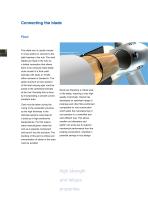
The blade root is usually circular in cross section to connect to the pitch bearing in the hub. The wind blades are fixed to the hub via a bolted connection that allows them to be removed. Most blade roots consist of a thick solid laminate with studs or T-bolts either screwed or bonded in. The girder structure (or box section) of the load carrying spar must be joined to the cylindrical laminate at the root. Normally this is done by incorporating a smooth curved transition area. Care must be taken during the curing of the composite structure as the high thickness in the laminate sections could...
Open the catalog to page 8
Polyspeed® pre-cured glass/ carbon/epoxy laminates are used in conjunction with prepreg in a vacuum bag lay-up to improve the quality and optimise the structure of cured stacks. Polyspeed® pre-cured laminates are available in woven or unidirectional constructions fully supporting the mechanical performance of vacuum bag cured structures. As the materials are already cured when introduced in the lay-up the final exotherm upon curing can be reduced, additionally buckling, waviness of long lay-ups can be avoided completely thus providing optimised fibre orientation in large scale unidirectional...
Open the catalog to page 9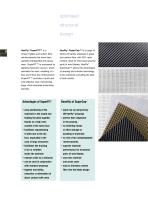
HexPly® SuperFIT™ is a range of glass and carbon fibre reinforcements that have been partially impregnated with epoxy resin. SuperFIT™ is processed by applying heat and vacuum, which activates the resin, enabling it to flow and infuse the reinforcement. SuperFIT™ provides a quick and cost-effective way of producing large, thick laminates minimising porosity. HexPly® SuperCap™ is a range of heavy UD epoxy prepregs in glass and carbon fibre, with 32% resin content, ideal for thick load-carrying parts in wind blades. HexPly® SuperCap™ allows the advantages of prepreg and infusion technology to be...
Open the catalog to page 10
Hexcel formulates a range of Modipur® Polyurethane (PU) core foams for wind energy applications and has access to a wealth of history and experience in PU technology built up over 30 years. PU foams are recommended for nacelle, shell and mould applications. Hexcel offers a wide range of industrial non-metallic Honeycombs (HexWeb® HRH78 and A10) in a variety of cell configurations and densities to support wind energy applications. Hexcel produces a range of HexForce® biaxial and triaxial reinforcements in glass and carbon fibre that are ideally suited for wind blade manufacturing. HexForce® Fabrics...
Open the catalog to page 11All Hexcel Composites catalogs and brochures
 Rail
Rail5 Pages
 Automotive Product Focus
4 Pages
 Winter_Sports_Brochure
6 Pages


Archived catalogs
 HexTow® Chopped Fiber
2 Pages
 HexPly® M47
4 Pages
 HexPly ® M78.1
4 Pages
 HexMC®-i / C / 2000 / M77
2 Pages
 HexMC®-i / C / 2000 / M81
2 Pages
 HexPly® M81
4 Pages
 Redux ® 100 series
4 Pages
 HexPly® M10R
4 Pages
 HexForce_Technical_Fabrics_Handbook
116 Pages
 HexPly® M77
3 Pages
 HexPly® M49
4 Pages
 HexPly M9M10
4 Pages
 CarbonFiber_SelectorGuide_us
4 Pages
 HexPly® M34
4 Pages
 HexForce? Aramid Fabric
1 Page
 HexWeb_Acousti-Cap
4 Pages
 Redux epoxy film adhesive
4 Pages
 HexForce
12 Pages
 HexMC
HexMC6 Pages
 A1 & A10
4 Pages
 MARKET BROCHURES-Rail
5 Pages
 Honeycomb
40 Pages


