
- Catalogs
- Hexcel Composites
- Honeycomb

Honeycomb

Honeycomb
Hexcel has developed over 700 varieties of honeycomb materials designed to enhance structural stiffness without significantly increasing weight. These materials are available in various configurations and materials.
Honeycomb is primarily manufactured using the expansion method, with the corrugated process used for high-density materials. The expansion process involves stacking adhesive-printed sheets, curing them to form a block, and expanding the block to form honeycomb structures.
Standard hexagonal honeycomb is the most common configuration. Other configurations include OX-Core for curving, Flex-Core for tight radii, Double-Flex for high formability, and Tube-Core for energy absorption.
Materials include aluminum, fiberglass, aramid fiber, Nomex®, Kevlar®, and KOREX®, each suited for different applications.
Selection criteria include mechanical properties, density, and thickness. Tables provide mechanical properties and test methods.
Properties include acoustics, air/fluid directionalization, pressure drop, bending, thermal expansion, dielectric properties, energy absorption, moisture absorption, radio frequency shielding, and thermal conductivity.
Honeycomb materials are used in aerospace, automotive, and other industrial applications due to their lightweight and high-strength characteristics.
Aluminum honeycomb materials are available with CR III chromate-based and CR-PAA™ phosphoric acid anodized coatings, offering different levels of corrosion resistance.
Four alloys are available: aerospace grades 5052 and 5056, and commercial grades 3104 and 3003, with 5056 offering greater strength.
These honeycombs are reinforced with fiberglass or aramid fibers, offering properties like enhanced shear modulus and fire resistance.
Includes HFT-G, TPU®, Micro-Cell™, and Acousti-Core®, each offering unique properties like energy redirection and sound absorption.
Properties are tested based on MIL-STD-401 and ASTM Standards. Key tests include density, compressive properties, crush strength, and shear properties.
Includes Beam-Flexure and Flatwise Tensile tests to evaluate mechanical properties like shear strength and tensile strength.
Properties are classified as Preliminary, Typical, or Minimum based on testing data.
Shear strength varies with core thickness, with correction factors provided for different thicknesses.
Tables provide detailed mechanical properties for various honeycomb core types, categorized by nominal density and cell size.
This guide serves as a reference for understanding the mechanical properties and testing methods of honeycomb core materials.
Lists honeycomb designations, detailing material composition, cell size, density, and mechanical properties.
Comparison table shows relative cost, temperature resistance, flammability, and other properties of various honeycomb materials.
Graphs illustrate the impact of temperature exposure on honeycomb strength.
Discusses acoustical properties, air and fluid flow directionalization, and pressure drop across honeycomb structures.
Honeycomb structures have minimal pressure drop in fluid streams, with flow resistance mainly due to friction drag on cell walls.
Honeycomb exhibits anticlastic curvature when bent, with Poisson’s ratio varying between configurations.
Honeycomb dimensions change with temperature, with coefficients provided for various materials.
Nonmetallic honeycomb is used in radomes due to low dielectric constant and loss tangent.
Honeycomb absorbs energy by crushing under load, with aluminum honeycomb designed for reliable absorption.
Tests show moisture pickup in honeycomb samples exposed to high humidity.
Thermal conductivity is influenced by cell size and core density.
Honeycomb offers advantages over foam and wood-based cores, including higher strength-to-weight ratios.
Honeycomb is used in aerospace, automotive, rail, marine, and other industries for energy absorption and structural integrity.
Lists brochures and data sheets related to honeycomb products and applications.
Catalog excerpts
Hexcel honeycomb HEXCELS^ Composites
Open the catalog to page 1
99HXDH1679 Rv. HW HC Guide v.2 11/24/99 2:37 PM Page 3 HexWeb Honeycomb Attributes and Properties Contents Introduction . . . . . . . . . . . . . . . . . . . . . . . . . . . . . . . . . . . . . . . . . . . . . . . . . . . . . . . . . . . . . . . . . . . . . . . . . . . . . . . . . . . . . . . . . . . . .2 How Honeycomb Is Manufactured . . . . . . . . . . . . . . . . . . . . . . . . . . . . . . . . . . . . . . . . . . . . . . . . . . . . . . . . . . . . . . . . . . . . . . . . . 3 Honeycomb Cell Configurations . . . . . . . . . . . . . . . . . . . . . . . . . . . . . . . . . . . . . . . . . ....
Open the catalog to page 2
99HXDH1679 Rv. HW HC Guide v.2 Contents 11/24/99 2:37 PM Page 4 cont. Comparison of Typical Mechanical Properties and Other Design Considerations . . . . . . . . . . . . . . . . . . . . . . . . . . . . . . . . . 23 Additional Properties of Honeycomb . . . . . . . . . . . . . . . . . . . . . . . . . . . . . . . . . . . . . . . . . . . . . . . . . . . . . . . . . . . . . . . . . . . . . . 28 Acoustical . . . . . . . . . . . . . . . . . . . . . . . . . . . . . . . . . . . . . . . . . . . . . . . . . . . . . . . . . . . . . . . . . . . . . . . . . . . . . . . . . . . . . . . . . . .28 Air/Fluid Directionalization...
Open the catalog to page 3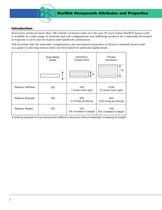
HexWeb Honeycomb Attributes and Properties Hexcel has produced more than 700 varieties of honeycomb over the past 50 years.Today, HexWeb honeycomb is available in a wide range of materials and cell configurations, and additional products are continually developed in response to new uses for honeycomb sandwich construction. This brochure lists the materials, configurations, and mechanical properties of Hexcel's standard honeycomb as a guide to selecting honeycomb core best suited for particular applications. Solid Metal Relative Stiffness 7 times more rigid 37 times more rigid! Relative Strength...
Open the catalog to page 4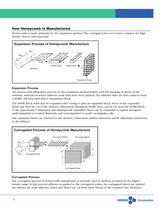
99HXDH1679 Rv. HW HC Guide v.2 11/24/99 2:37 PM Page 6 How Honeycomb Is Manufactured Honeycomb is made primarily by the expansion method.The corrugated process is most common for high density honeycomb materials. Expansion Process of Honeycomb Manufacture Roll Web Sheet HOBE Block HOBE Slice Adhesive Expanded Sheet Expansion Process The honeycomb fabrication process by the expansion method begins with the stacking of sheets of the substrate material on which adhesive node lines have been printed.The adhesive lines are then cured to form a HOBE® (HOneycomb Before Expansion) block. The HOBE block...
Open the catalog to page 5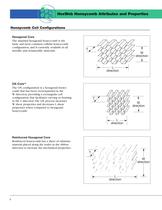
HexWeb Honeycomb Attributes and Properties Honeycomb Cell Configurations Hexagonal Core The standard hexagonal honeycomb is the basic and most common cellular honeycomb configuration, and is currently available in all metallic and nonmetallic materials. The OX configuration is a hexagonal honey- comb that has been overexpanded in the W direction, providing a rectangular cell configuration that facilitates curving or forming in the L direction. The OX process increases W shear properties and decreases L shear properties when compared to hexagonal Reinforced Hexagonal Core Reinforced honeycomb...
Open the catalog to page 6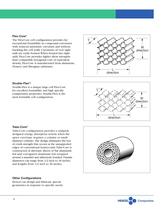
The Flex-Core cell configuration provides for exceptional formability in compound curvatures with reduced anticlastic curvature and without buckling the cell walls. Curvatures of very tight radii are easily formed. When formed into tight radii, Flex-Core provides higher shear strengths than comparable hexagonal core of equivalent density. Flex-Core is manufactured from aluminum, Nomext and fiberglass substrates. Double-Flex is a unique large cell Flex-Core for excellent formability and high specific compression properties. Double-Flex is the most formable cell configuration. Tube-Core configuration...
Open the catalog to page 7
HexWeb Honeycomb Attributes and Properties Honeycomb Materials Aluminum Honeycomb Hexcel aluminum honeycombs are designated as Material - Cell Size - Alloy - Foil Thickness - Density ' - signifies the honeycomb is treated with a corrosion-resistant coating - is the cell size in fractions of an inch is the aluminum alloy used is the nominal reference foil thickness in - indicates the cell walls are nonperforated - is the density in pounds per cubic foot Corrosion-Resistant Coatings Corrosion-resistant coatings consist of a base layer underlying a primer layer. Aluminum honeycomb is available with...
Open the catalog to page 8
Fiberglass Reinforced Honeycomb Hexcel fiberglass reinforced honeycombs are Material - Cell Size - Density HRP® - refers to the type of material 3/16 - is the cell size in fractions of an inch 4.0 - is the nominal density in pounds HRP is a fiberglass fabric reinforced honeycomb dipped in a heat-resistant phenolic resin to achieve the final density. This product was developed for use at service temperatures up to 350°E However, it is also well suited for short exposures at higher temperatures. The HRP-series honeycomb is available in the standard hexagonal configuration, as well as in the two...
Open the catalog to page 9
HexWeb Honeycomb Attributes and Properties KOREX honeycomb is made from KOREX aramid paper dipped in a heat-resistant phenolic resin to achieve the final density. KOREX honeycomb offers improved strength-to-weight ratios and/or lower moisture absorp- tion than Nomex honeycomb of a similar configuration. Special Honeycomb_ HFT-G is a bias weave carbon fabric reinforced honeycomb dipped in either a heat-resistant phenolic resin or a polyimide resin to achieve the final density. This product was developed for use at service tempera- tures up to 500°E However, it is well suited for short exposures...
Open the catalog to page 10
Specifying Honeycomb_ When honeycomb is specified, the following informa- tion needs to be provided: • Cell configuration (hexagonal, OX-Core, Flex-Core, etc.) • Cell size • Alloy and foil gauge (aluminum honeycomb only) Cell sizes range from 1/16" to 1", with 1/8", 3/16", 1/4", and 3/8" being the most common. Honeycomb densi- ties range from 1.0 lb/ft3 to 55 lb/ft3. Guide to Determining Which Type Determining which type of honeycomb to specify requires that the relevant possible attributes be defined for the application. The attributes that help determine the most appropriate honeycomb type...
Open the catalog to page 11All Hexcel Composites catalogs and brochures
 Rail
Rail5 Pages
 Wind_Turbine_Blades
12 Pages
 Automotive Product Focus
4 Pages
 Winter_Sports_Brochure
6 Pages


Archived catalogs
 HexTow® Chopped Fiber
2 Pages
 HexPly® M47
4 Pages
 HexPly ® M78.1
4 Pages
 HexMC®-i / C / 2000 / M77
2 Pages
 HexMC®-i / C / 2000 / M81
2 Pages
 HexPly® M81
4 Pages
 Redux ® 100 series
4 Pages
 HexPly® M10R
4 Pages
 HexForce_Technical_Fabrics_Handbook
116 Pages
 HexPly® M77
3 Pages
 HexPly® M49
4 Pages
 HexPly M9M10
4 Pages
 CarbonFiber_SelectorGuide_us
4 Pages
 HexPly® M34
4 Pages
 HexForce? Aramid Fabric
1 Page
 HexWeb_Acousti-Cap
4 Pages
 Redux epoxy film adhesive
4 Pages
 HexForce
12 Pages
 HexMC
HexMC6 Pages
 A1 & A10
4 Pages
 MARKET BROCHURES-Rail
5 Pages


