
- Catalogs
- Hemisphere GPS
- A21? ANTENNA


A21? ANTENNA

A21? ANTENNA
The document provides technical specifications for the A21™ and A31™ antennas designed by Hemisphere GNSS. These antennas are engineered to maintain tracking of GPS and differential correction signals in challenging environments, offering superior noise rejection and multi-path mitigation.
A21™ Antenna Specifications
- Design: Metal base, lower profile, improved multi-path mitigation.
- GNSS Reception: GPS L1, SBAS, and L-band.
- Frequency: 1.525 to 1.585 GHz.
- LNA Gain: 30 dB.
- Power Input: 3.3 to 12 VDC, 24 mA typical.
- Mechanical: Aluminum base with ASA plastic cap, dimensions 7.0 H x 13.0 D (cm), weight 0.38 kg.
- Environmental: Operating temperature -40°C to +70°C, IP69K rating.
A31™ Antenna Specifications
- Design: Improved multi-path mitigation, superior noise rejection.
- GNSS Reception: GPS, SBAS, L-band, and Beacon.
- Frequency: 1.575 GHz (L1) for GNSS, 283.5 - 325 KHz for Beacon.
- LNA Gain: 30 dB for both GNSS and Beacon.
- Power Input: 5 to 12 VDC, 50 - 60 mA.
- Mechanical: Lexan enclosure, dimensions 10.4 H x 14.5 D (cm), weight 0.73 kg.
- Environmental: Operating temperature -30°C to +70°C, IP69K rating, 95% non-condensing humidity.
Applications
Both antennas are designed for use with Hemisphere GNSS Crescent® and Crescent Vector™ II receivers, ensuring reliable performance in environments with electrical noise and challenging conditions.
Catalog excerpts

GPS, SBAS and L-band Antenna GPS, SBAS, L-band and Beacon Antenna GNSS Sensor GNSS Sensor GNSS Reception: GNSS Frequency: LNA Gain: LNA Noise: GPS L1, SBAS, and L-band 1.525 to 1.585 GHz 30 dB 2.0 dB, typical Aluminum base with ASA plastic cap 7.0 H x 13.0 D (cm) 2.9 H x 5.1 D (in) .38 kg (.84 lbs) 5/8 inch female thread TNC (straight) Environmental Storage Temperature: Operating Temperature: Enclosure Rating: Shock and Vibration: Beacon Frequency: Beacon LNA Gain: Power Input Mechanical Enclosure: Dimensions: Weight: Mount: RF Connector: L-Band Frequency: L-Band LNA Gain: Beacon Sensor Power Input Input Voltage: Input Current: GPS, SBAS, L-band and Beacon 1.575 GHz (L1) 30 dB < 2.0 dB L-Band Sensor L-Band Sensor L-Band Frequency: L-Band LNA Gain: GNSS Reception: GNSS Frequency: LNA Gain: LNA Noise: The A21™ antenna is designed to help maintain tracking of GPS and differential correction signals in challenging environments. Sometimes keeping the antenna level and away from electrical noise is just not possible. With a metal base, lower profile, improved multi-path mitigation, and ability to filter out an additional 30 decibels of radio band frequencies, A21 offers superior noise rejection. The A21 is designed for use with Hemisphere GNSS Crescent® and Crescent Vector™ II receivers. Input Voltage: Input Current: Mechanical Enclosure: Dimensions: Weight: Mount: RF Connector: Lexan 10.4 H x 14.5 D (cm) 4.1 H x 5.7 D (in) .73 kg (1.62 lbs) 1” coarse thread (5/8” adapter vailable) a TNC Environmental Storage Temperature: -40°C to +85°C (-40°F to +185°F) Operating Temperature: -30°C to +70°C (-22°F to +158°F) Enclosure Rating: IP69K Shock and Vibration: EP455 Humidity: 95% non-condensing The A31™ antenna is designed to help maintain tracking of GPS, Beacon and differential correction signals in challenging environments. Sometimes keeping the antenna level and away from electrical noise is just not possible. With improved multi-path mitigation and ability to filter out an additional 30 decibels of radio band frequencies, A31 offers superior noise rejection. The A31 is designed for use with Hemisphere GNSS Crescent and Crescent Vector II receivers. [email protected] www.hemispheregnss.com
Open the catalog to page 1All Hemisphere GPS catalogs and brochures
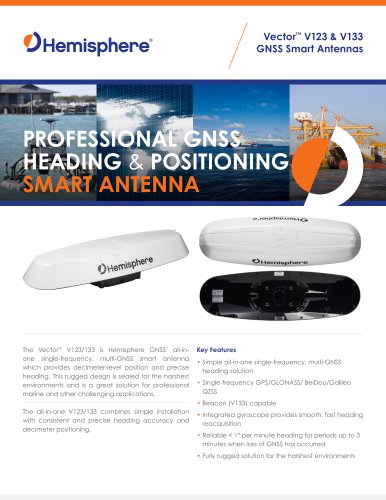 Vector™ V123 & V133
2 Pages
 VS1000
2 Pages
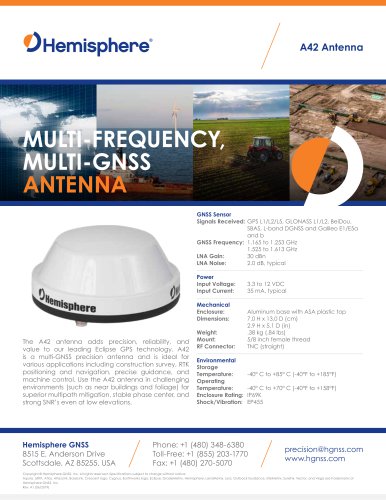 A42
A421 Page
 A43
A431 Page
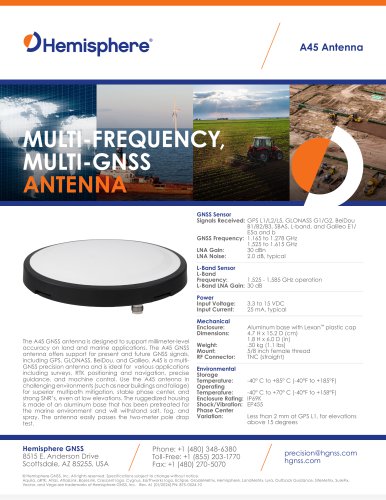 A45
A451 Page
Archived catalogs
 R330? GNSS RECEIVER
2 Pages
 S321
S3212 Pages
 Atlas Brochure
6 Pages
 HemisphereGNSS AtlasLink
2 Pages
 GNSS OEM Modules Brochure
2 Pages
 HemisphereGNSS V320
2 Pages
 S320? GNSS SURVEY RECEIVER
2 Pages
 HemisphereGNSS XF3
2 Pages
 A325™ GNSS Smart Antenna
2 Pages
 S321+ GNSS SMART ANTENNA
2 Pages
 A222™ Smart Antenna
29 Pages
 CRESCENT P102/P103 OEM BOARDS
50 Pages
 IRONVIEW CW400 DATA COLLECTOR
55 Pages
 A101 Smart Antenna
34 Pages
 A325
A32533 Pages
 POCKETMAX4
43 Pages
 S320 Product Brochure
6 Pages


- Boat antenna
- Radome antenna
- Ship antenna
- GPS antenna
- Inertial navigation system
- WiFi antenna
- Ship inertial navigation system
- Boat receiver
- Professional antenna
- IMU inertial navigation system
- GNSS antenna
- GNSS inertial navigation system
- IP66 antenna
- IP69K antenna
- GPS receiver
- High-accuracy inertial navigation system
- UHF antenna
- IP67 antenna
- Boat inertial navigation system
- GNSS receiver