
- Catalogs
- Hellohasea
- BOLLARD CATALOGUE

BOLLARD CATALOGUE

BOLLARD CATALOGUE
The primary function of mooring bollards and cleats is to secure vessels to a berth using mooring lines. The load rating required for these bollards and cleats is determined by factors such as current, wind, and wake, and should be assessed by a qualified engineer following a mooring analysis.
Bollards and cleats are manufactured from cast steel, ductile cast iron, or gray cast iron, each with specific standards and properties:
- Cast Steel: High strength, impact resistance, and ductility, but more expensive and requires corrosion protection.
- Ductile Cast Iron: High strength and corrosion resistance, less expensive than cast steel, but lower ductility and impact resistance.
- Gray Cast Iron: Least expensive, good corrosion resistance, but low strength and impact resistance.
All cast bollards and cleats must undergo heat treatment to meet ASTM or BS standards, ensuring the mechanical properties conform to requirements.
Bollards and cleats come in various shapes, sizes, and capacities, including Single Bit, Double Bit, T Head, and Cleats. Specifications such as height, head size, and load capacities should be specified.
To protect against corrosion, bollards and cleats are coated with epoxy, polyurethane, hot dip galvanizing, or bitumastic coatings. A rust preventative primer is applied initially, with the final coating applied post-installation.
Post heat-treatment, bollards undergo chemical analysis and mechanical properties testing to ensure quality.
The catalogue lists various bollard types with their capacities, materials, and coating systems:
- Single Bit Bollards: 20MT to 225MT, Cast Steel.
- Double Bit Bollards: 10MT to 200MT, Cast Steel.
- T Head Bollards: 30MT to 150MT, Cast Steel.
- Cleats: 10MT to 50MT, Cast Steel.
- Bolted Pillar-Bollards: 10MT to 100MT, Gray Cast Iron.
- Twin Horn Bollards: 10MT to 150MT, Gray Cast Iron.
- Tee-Head Bollards: 10MT to 200MT, Gray Cast Iron.
Products are packed using wooden or steel pallets.
The document outlines the sand casting process, which includes obtaining casting geometry, pattern making, core making, molding, melting and pouring, cleaning, and additional processes before delivery.
Catalog excerpts

MOORING BOLLARDS M AN SURE WELL IMPORT & EXPORT CO., LTD.
Open the catalog to page 1
XI’AN SURE WELL IMP. & EXP. CO., LTD. Brief Introduction Hellohasea is a manufacturer and international working company providing series products to port construction, shipping and maritime industries. As a special company with senior knowledge and experience in design, technology, quality assurance, production control and marketing, we supply quality products to shipping and maritime industry in all aspects; Our Mooring bollard, Marine fender, Pneumatic fender and Foam filled fender products are popular all over the world with high quality, competitive price, fast delivery and efficient service....
Open the catalog to page 2
XI’AN SURE WELL IMP. & EXP. CO., LTD. ◇ Requires maintenance of corrosion protection. Cast steel bollards must be properly maintained and coated to prevent corrosion. The thinner section can be damaged over time if maintenance is neglected. ●Ductile Cast iron: Advantage: ◇ High strength ◇ Less expensive per unit weight than cast steel ◇ Good corrosion resistance ◇ Wide availability Disadvantage: ◇ Low ductility ◇ Requires higher factor of safety due to low elongation than cast steel ◇ Note resistant to impact ●Gray Cast iron: Advantage: ◇ Less expensive per unit weight than ductile cast iron...
Open the catalog to page 3
XI'AN SURE WELL IMP. & EXP. CO., LTD. \JjL • Polyurethane coatirtQ •Bitumastic coating When bollards and cleats supply from manufacturer, the bollards and cleats should with a rust preventative primer at least, perfectly compatible with expected top coating, to protect them from corrosion until final coating can be done at the jobsite. Since the installation of most bollards includes filling the core with concrete and filling the anchor bolt counter bores with non shrink grout, it is recommended that the top coat of the coating system be applied after installation. All our bollards are tested...
Open the catalog to page 4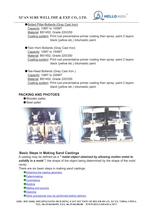
XI'AN SURE WELL IMP. & EXP. CO., LTD. J^^HELLOHASEA • Bolted Pillar-Bollards (Gray Cast Iron) Coating system: Print rust preventative primer coating then spray- paint 2 layers black (yellow etc.) bitumastic paint. •Twin Horn Bollards (Gray Cast Iron) Coating system: Print rust preventative primer coating then spray- paint 2 layers black (yellow etc.) bitumastic paint. •Tee-Head Bollards (Gray Cast Iron ) Coating system: Print rust preventative primer coating then spray- paint 2 layers black (yellow etc.) bitumastic paint. •Wooden pallet, • Steel pallet Basic Steps in Making Sand Castings A casting...
Open the catalog to page 5
XI'AN SURE WELL IMP. & EXP. CO., LTD. j^fljj HELLOHASEA The various steps in the production of castings are briefly summarized for the benefit of those who may be unfamiliar with foundries and the casting process. Obtaining the casting geometry The traditional method of obtaining the casting geometry is by sending blueprint drawings to the foundry. This is usually done during the request for quotation process. However, more and more customers and foundries are exchanging part geometry via the exchange of computer aided design files. Pattern making The pattern is a physical model of the casting...
Open the catalog to page 6All Hellohasea catalogs and brochures
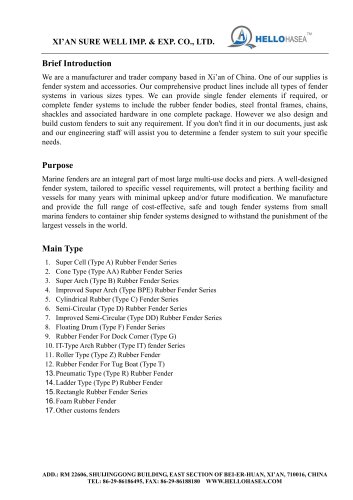 MARINE FENDER CATALOGUE
38 Pages