
- Catalogs
- GME electrophones
- plb_epirb

- Products
- Catalogs
- News & Trends
- Exhibitions
plb_epirb

plb_epirb
Emergency Position Indicating Radio Beacons (EPIRBs) and Personal Locator Beacons (PLBs) are critical devices used in emergency situations to transmit distress signals. Since the COSPAS SARSAT system's inception in 1982, these devices have saved thousands of lives globally.
Technological Advancements
The integration of GPS technology into EPIRBs and PLBs, alongside geostationary satellites (GEOs) introduced in 1998, marked a significant advancement in search and rescue operations. GPS-equipped beacons offer faster detection and more precise location data, reducing the search area from a 5 km radius to 100 meters.
Benefits of GPS-Equipped Beacons
GPS-equipped beacons provide rapid alerting and precise location information, crucial in emergencies involving injuries or adverse weather conditions. This technology significantly enhances the chances of a successful rescue.
Specifications and Features
EPIRBs and PLBs come with various features, including:
- 16 to 50 channel GPS receivers
- Top-mounted Quad Helix GPS antennas
- 6 to 7-year battery life with warranties
- Automatic water activation and rugged design
- Compliance with international standards and COSPAS-SARSAT operation
Product Variants
Different models cater to various needs, such as manually activated or auto-release EPIRBs, and standard or GPS-equipped PLBs. Notable models include MT406G, MT403G, and MT410G.
Legal Requirements and Recommendations
In Australia, carrying an EPIRB is mandatory for recreational vessels operating more than 2 nautical miles from the coast. PLBs are suitable for multi-environment use but are not substitutes for EPIRBs under Australian law.
Registration and Compliance
Registration of 406 MHz EPIRBs and PLBs is mandatory and free. Compliance with international standards ensures these devices are effective and reliable.
Case Studies
Several real-world rescues highlight the effectiveness of GME's EPIRBs and PLBs, including incidents in the Banda Sea, Aegean Sea, and Patagonian mountains.
Conclusion
EPIRBs and PLBs are essential safety devices for marine, aviation, and land applications. The integration of GPS technology has significantly improved their effectiveness, making them indispensable for ensuring quick and focused search and rescue efforts.
Catalog excerpts

GPIRBs & PLBs Emergency Position Indicating Radio Beacons & Personal Locator Beacons EMERGENCY BEACONS
Open the catalog to page 1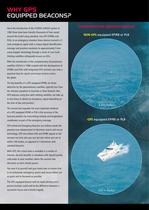
WHY GPS EQUIPPED BEACONS? Since the introduction of the COSPAS SARSAT system in 1982 there have been literally thousands of lives saved around the world using standard, non GPS EPIRBs and COMPARATIVE SEARCH AREAS NON GPS equipped EPIRB or PLB PLBs. In an emergency situation these devices transmit a 5 watt emergency signal with a unique digital identification message and position resolution to approximately 5 kms using Doppler technology through a series of Low Earth Orbiting satellites colloquially known as LEOs. With the introduction of the complimentary Geostationary satellites (GEOs) in 1998...
Open the catalog to page 2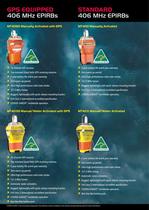
GPS EQUIPPED 406 MHz EPIRBs STANDARD 406 MHz EPIRBs MT406G Manually Activated with GPS MT400 Manually Activated channel GPS receiver. 16 year battery life and 6 year warranty. 6 mounted Quad Helix GPS receiving antenna. Top Zero warm up period. year battery life and 6 year warranty. 6 Ultra high performance solid state strobe. Zero warm up period. 121.5 MHz homer. Ultra high performance solid state strobe. ugged, lightweight,with quick release mounting bracket. R 121.5 MHz homer. Class 2 international accredited specification. Full ugged, lightweight,with quick release mounting bracket. R OSPAS-SARSAT*...
Open the catalog to page 3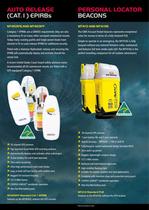
AUTO RELEASE (CAT.1) EPIRBs PERSONAL LOCATOR BEACONS MT403FG AND MT403FF MT410 AND MT410G Category 1 EPIRBs are a GMDSS requirement; they are also a mandatory fit on many other surveyed commercial vessels. Today many cruising yachts and larger power boats have elected to fit an auto-release EPIRB for additional security. The GME Accusat Pocket beacons represents exceptional value for money in terms of a fully featured PLB. Fitted with a Hammar Hydrostatic release unit ensuring the EPIRB will automatically deploy and activate should the vessel sink. Simple to operate in an emergency, the MT410G...
Open the catalog to page 4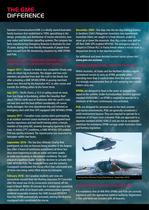
THE GME DIFFERENCE Standard Communications/GME is a wholly owned Australian family business first established in 1959, specialising in the design, production and distribution of marine electronics, twoway radios and television signalling systems. The company has been manufacturing Emergency Beacons in Australia for over 35 years, during this time literally thousands of people have been rescued from life threatening situations by GME EPIRBs and PLBs. GME ACCUSAT™ BEACONS SAVING LIVES IN AUSTRALIA AND AROUND THE WORLD August 2011 - Darwin to Ambon race competitor Shady Lady sinks on return leg...
Open the catalog to page 5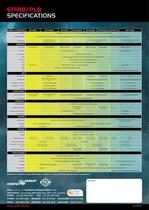
Specifications are subject to change without notice or obligation. 'For full list of international approvals see www.gme.net.au GME is a division of: Standard Communications PTY. LTD. ^saWiPRPWiw HEAD OFFICE: Locked Bag 2086 North Ryde, NSW 1670, Australia. IQLBBB
Open the catalog to page 6All GME electrophones catalogs and brochures
 GX850
GX8502 Pages
 GX800
GX8002 Pages
 mt600
mt6002 Pages
 sound safe
4 Pages
 GDEK
GDEK2 Pages
 marine_antenna_booklet
2 Pages
 AIS
AIS4 Pages
 g-series
6 Pages
 MT400 and MT406G EPIRBS
2 Pages
 MT400
MT4003 Pages
 Kingray Professional
6 Pages
 KINGARY
24 Pages
 ABL012
1 Page
 GP450X
2 Pages
 Marineradio_3
6 Pages
 GX600D
2 Pages
 Corporate Brochure
18 Pages
 MT410G
2 Pages
 Fact Epirbs
2 Pages
 Marine Entertainment
6 Pages
 GR200
GR2002 Pages

- Boat antenna
- Vertical antenna
- Radome antenna
- Nautical boat radio
- Nautical VHF radio
- Multi-purpose instrument
- Boat speaker
- Fixed multi-purpose instrument
- Boat remote control
- Boat combo
- Chart plotter multi-purpose instrument
- Color multi-purpose instrument
- Satellite multi-purpose instrument
- GPS multi-purpose instrument
- Audio amplifier
- Radio with DSC
- Boat amplifier
- Plastic speaker
- Cockpit speaker