
- Catalogs
- Gems Sensors
- Flow Sensors


Flow Sensors

Flow Sensors
RotorFlow sensors provide visual indication, continuous sensing, and accurate switching. They offer options for pulsed DC output or adjustable 1 amp switched output, with flow ranges from 0.1 GPM to 60.0 GPM. Available in compact inline housings made of high-performance plastic, brass, or stainless steel.
Materials include brass, 316 stainless steel, or polypropylene, with a ceramic rotor pin and a PPS composite rotor. Maximum pressure is 200 PSIG for brass or stainless steel bodies and 100 PSIG for polypropylene. Operating temperatures range from -20°F to 212°F for brass or stainless steel and up to 180°F for polypropylene. Input power required is 24 VDC or 115 VAC.
- Switch Types (RFS): Provide reliable flow setpoint switching with adjustable setpoints.
- Output Types (RFO): Offer pulsed DC voltage output proportional to flow rate, suitable for monitoring or metering.
- Indicator Types (RFI): Provide visual confirmation of flow with a bright, orange spinning rotor.
Used in semiconductor processing, lasers, medical equipment, X-ray tubes, and robotic welding to protect equipment from coolant flow failure.
Specify part number based on body material, port size, and input power rating. Detailed part numbers are provided for different configurations and flow ranges.
Switch set point calibration is facilitated by an LED signal. Special configurations are available for potable water and enhanced chemical capabilities. Stainless face plates are available for higher pressure/temperature ratings.
FS-600 Series sensors utilize thermal dispersion technology for flow rates from 0.1 GPM to 11 GPM, compatible with conductive and non-conductive fluids. Made with 303 and 316 stainless steel, they operate at a maximum pressure of 363 PSIG and temperatures between -14°F to 140°F.
The FS-600 flow switch operates on the calorimetric principle, using the cooling effect of a flowing fluid to monitor flow rate. It uses two transistors and a heater element to measure fluid velocity.
Proper installation enhances performance. Horizontal fluid lines are recommended, with appropriate thread sealant for leak-tight connections. 150 micron filtration is recommended. Low flow applications are supported with a low flow adapter.
Custom configurations are available for enhanced chemical compatibility, higher temperature and pressure capabilities, and alternate electrical terminations.
Rebuild kits are available for quick maintenance, including components like ceramic rotor pins and O-rings.
For further details, visit the manufacturer's website or contact customer service.
Catalog excerpts

Rotorflow INTRODUCTION RotorFlow® Sensors Provide Visual Indication, Continuous Sensing and Accurate Switching Bright, visual indication with choice of pulsed DC output, or adjustable 1 amp switched output Flow ranges from .1 GPM to 60.0 GPM RotorFlow Series Sensors are U.L. Recognized — File No. E45168. Compact inline housings Available in high performance plastic, brass, or stainless steel housings Determined to provide you with the most versatile line of flow sensors available, we’ve continued a non-stop refinement process for the entire RotorFlow® Series. GEMS new generation of RotorFlow® sensors, the RF-2500 Series, have been totally re-engineered with a one piece composite rotor, stronger unibody construction, ceramic shaft and better sealing. The results are greater durability with broader chemical, temperature and pressure capabilities. High Resolution or High Visibility Rotors. 7/16˝ Hex Hub Ceramic Shaft Heavy Duty, Buna N O-Rings Brass, Stainless Steel or High Performance, Polypropylene Bodies FLOW SENSORS – ELECTRONIC Today’s RotorFlow Series is state-of-the-art and offers more options, better performance and durability than ever before...all at an affordable price geared for high volume, OEM applications. Select the RotorFlow sensor that is right for your application by choosing one of our three distinct configurations. You’ll find details on each of these configurations inside. RotorFlow Switch Types For specific flow setpoint switching, RotorFlow RFS type switches are one of the most reliable flow switches available. Setpoints are fully adjustable over the specified flow range. The dynamic operation of the rotor guards against jamming and false actuation. RotorFlow Output Types For flow rate monitoring or metering applications. RotorFlow RFO Type sensors provide a pulsed DC voltage output that is proportional to the rate of flow. The operating range of 4.5 to 24 VDC pulsed output is easily integrated into most digital logic units. RFA Type RotorFlow sensors provide a continuous 0-10 VDC analog output. RotorFlow Indicator Types For those who want simple visual confirmation of flow, RotorFlow RFI indicators provide the durable, low-cost answer. A bright, orange spinning rotor provides visual flow confirmation at a glance. New wide-body senses flow up to 60 GPM. 3/4˝ and 1˝ line models. Visit www.GemsSensors.com for most current information.
Open the catalog to page 1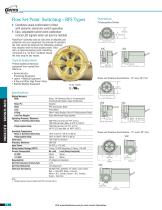
Flow Set Point Switching – RFS Types Combines visual confirmation of flow with dynamic, electronic switch operation Easy, adjustable switch point calibration: a local LED signals when set point is reached Dimensions Polypropylene Bodies 2.37˝ (60.2 mm) .64˝ (16.3 mm) RotorFlow® Switches build an extra level of reliability and protection into your equipment. By principle of operation, the rotor cannot be deceived into indicating a positive flow situation when no flow actually exists. Once set to a desired actuation point, RotorFlow will switch to a “no-flow” condition should the rotor stop for...
Open the catalog to page 2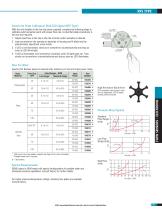
Switch Set Point Calibration With LED Signal (RFS Type) With the unit installed in the line and power supplied, complete the following steps to calibrate switch actuation point with proper flow rate. A small flat-blade screwdriver is the only tool required. 1. Adjust liquid flow in the line to the rate at which switch actuation is desired. 2. Insert screwdriver into opening on backside of housing and fit blade into the potentiometer adjustment screw inside. 3. If LED is not illuminated, slowly turn screwdriver counterclockwise and stop as soon as LED illuminates. 4. If LED is illuminated, turn...
Open the catalog to page 3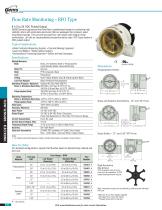
Flow Rate Monitoring – RFO Type 4.5 to 24 VDC Pulsed Output GEMS Sensors popularized the RotorFlow’s paddlewheel design by combining high visibility rotors with solid-state electronics that are packaged into compact, panel mounting housings. They provide accurate flow rate output with integral visual confirmation...all with an unprecedented price/performance ratio. RFO Types feature a VDC pulsed output. Typical Applications • Water Purification/Dispensing Systems • Chemical Metering Equipment • Lasers and Welders • Water Injection Systems • Semiconductor Processing Equipment • Chillers and Heat...
Open the catalog to page 4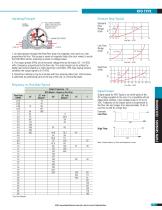
RFO TYPE Pressure Drop-Typical HALL EFFECT SENSOR SENDS A VOLTAGE PULSE WITH EACH PASS OF MAGNETIC FIELD Standard Flow Range Units 1. As liquid passes through the RotorFlow body, the magnetic rotor spins at a rate proportional to flow. This causes a series of magnetic fields (the rotor vanes) to excite the Hall Effect sensor, producing a series of voltage pulses. 2. The output pulses (RFO) are at the same voltage level as the input (4.5 - 24 VDC) with a frequency proportional to the flow rate. The output signal can be utilized by digital rate meters totalizers or other electronic controllers....
Open the catalog to page 5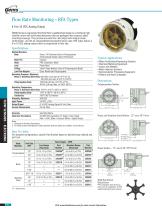
Flow Rate Monitoring – RFA Types 0 to 10 VDC Analog Output GEMS Sensors popularized the RotorFlow’s paddlewheel design by combining high visibility rotors with solid-state electronics that are packaged into compact, panel mounting housings. They provide accurate flow rate output with integral visual confirmation...all with an unprecedented price/performance ratio. RFA Types feature a 0 to 10 VDC analog output which is proportional to flow rate. FLOW SENSORS – ELECTRONIC Wetted Materials Body Brass, 316 Stainless Steel or Polypropylene (Hydrolytically Stable, Glass Reinforced) Rotor Pin Ceramic...
Open the catalog to page 6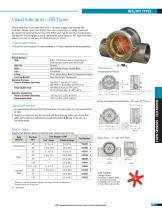
RFA/RFI TYPES Visual Indicators – RFI Types This is RotorFlow in its most basic form — a bright orange rotor turning with fluid flow. Simple, direct and reliable. Flow rate is estimated, or simply confirmed, by viewing the speed of the turning rotor. Either port may be used for incoming flow, and bayonet mounting lens is easily removed for quick cleanout. RFI Type RotorFlow sensors are easy to see, easy to install and easy to afford. Typical Applications • Visual flow confirmation on heat exchangers • Plastic injection molding equipment Specifications Brass, 316 Stainless Steel or Polypropylene...
Open the catalog to page 7All Gems Sensors catalogs and brochures
 D-Cryo Series Solenoid Valve
2 Pages
 B-Cryo Series Solenoid Valve
2 Pages
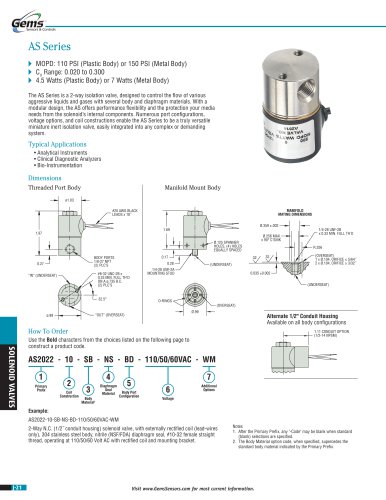 AS Series Solenoid Valve
2 Pages
 BS Series Solenoid Valve
2 Pages
 KM/KL Series Solenoid Valve
4 Pages
 KV/KW Series Solenoid Valve
2 Pages
 PM/PL Series
2 Pages
 Gems Master Catalog Product
406 Pages
 3600 Series
4 Pages
 3800 Series
2 Pages
 3500 Series
4 Pages
 F Series
4 Pages
 Appendix and Glossary
13 Pages
 Pressure Transducers
67 Pages
 Pressure Switches
30 Pages
 Flow Switches
26 Pages
 Warrick Conductivity Sensors
29 Pages
 Level Sensors Continuous
33 Pages
 Level Indicators Visual
27 Pages
 Level Switches Multi-Point
26 Pages
 Warrick_Conductivity_Sensors
29 Pages
 Level_Sensors_Continuous-
33 Pages
 Level_Indicators_Visual
27 Pages
 Level Switches Single Point
43 Pages
 Level_Switches_Mult-Point
26 Pages
 Solenoid Valves
40 Pages
 Electronic_Products-
13 Pages
 J-Valves_05-16-2011opt
40 Pages
 Proximity_Switches-
5 Pages
 Flow_Switches
24 Pages
 Pressure_Switches
28 Pages
 Pressure_Transducers-5-16-2011
44 Pages
 Gems_ProdOverview_2008_Opt_Print
12 Pages
 SemiconBroch
8 Pages
 FS-380P Series
2 Pages


