
- Catalogs
- Gems Sensors
- Electronic_Products-


Electronic_Products-

Electronic_Products-
GEMS Relays and Barriers are designed to ensure intrinsic safety by making non-voltage producing sensors or switches safe for use in explosive environments. These devices offer quick, arc-free response, solid-state reliability, and low-power switching capabilities, with encapsulation to resist dust, moisture, and tampering.
Intrinsic safety is defined as equipment that cannot release enough energy to ignite hazardous atmospheric mixtures. Certified intrinsically safe systems prevent explosions even with simultaneous failures, allowing for installations without explosion-proof enclosures.
SAFE-PAK relays enhance sensor load-handling capabilities in AC and DC applications, while Zener Barriers provide intrinsically safe DC outputs. These devices ensure the entire switching circuit remains intrinsically safe, minimizing shock hazards.
SAFE-PAK and Zener Barrier units are installed in safe areas and connected to sensors in hazardous locations without explosion-proof housings. Maintenance involves routine inspections to ensure grounding integrity and cleanliness.
Various models of SAFE-PAK and Zener Barriers are available, each with specific approvals for different hazardous locations, certified by organizations such as UL, FM, CSA, and MSHA.
SAFE-PAK relays are used in hazardous areas with wiring diagrams provided for installation guidance. Transient protection is recommended for AC loads using metal oxide varistors.
These relays offer programmable switching modes, including normally open, normally closed, or latching outputs with variable time delays, suitable for sensors monitoring flow, pressure, and level.
Part numbers are provided for various models based on relay style, operating voltage, and switch operation requirements.
- Programmable SAFE-PAK: Offers normally open and closed load operations, with specific terminal connections for each mode. Latching operations are detailed for refill control and pump-down applications.
- Zener Barriers: Designed to limit DC voltage and current in hazardous areas, ensuring intrinsic safety. Available in single and dual-channel configurations, with encapsulated construction to resist dust and moisture.
- Wiring Instructions: Detailed wiring diagrams are provided for various configurations, including typical applications with flow and level switches.
- Installation: Must comply with the National Electrical Code and GEMS installation bulletins. Recommendations include using varistors in high-noise environments.
- Use of varistors across terminals in high-noise systems to protect against electrical interference.
- Ensure latching functions are implemented on the sensor input side, not on the output power circuit side.
- Intrinsic Safety: Solid-state reliability with compact design, eliminating the need for explosion-proof enclosures.
- Load Handling: Non-intrinsically safe relays enhance sensor load handling capabilities, with options for AC and DC models.
- Specific ambient operating temperatures are required for all models (-40°F to +140°F).
- Correct polarity must be maintained to avoid damage to DC LOAD-PAK units.
The document provides comprehensive guidelines for the safe and effective use of GEMS Programmable SAFE-PAK and Zener Barriers in hazardous environments, emphasizing the importance of following specified wiring and installation procedures to maintain intrinsic safety.
This document provides technical specifications and operational guidelines for various LOAD-PAK models, including AC and DC versions, as well as SPDT-PAK and FLIP-PAK. It includes details on transient protection, wiring instructions, and ordering information.
- LOAD-PAK Models: Available in 5 AMP and 10 AMP AC, and 2 AMP DC versions. The DC model is certified intrinsically safe under MSHA Certification No. 1951 for Group D use.
- Operating Voltage Range: AC models operate between 24 to 260 VAC, while the DC model operates between 6 to 48 VDC.
- Voltage Loss and Sensor Current: AC models have a voltage loss of 2-3 VAC and a maximum sensor current of 20 mA. The DC model has a voltage loss of 2 VDC and a maximum sensor current of 35 mA.
- Operating Temperature: Ranges from 0°F to 120°F (-17.8°C to 48.9°C) for most models.
- Wiring Instructions: External sensor switches should not be placed in conduits with high voltage lines to prevent unintended activation of the solid-state triac.
- Transient Protection: AC and DC LOAD-PAKs include transient protection, but SPDT-PAK requires an external protective circuit or a metal oxide varistor.
- Ordering: Specify part numbers based on the tabulated specifications for accurate ordering.
- Surge Current Ratings: Non-repetitive surge current ratings are provided for LOAD-PAKs.
- FLIP-PAK: Provides solid-state control for motor starters or motors, with safety shutdown features. It can be configured for pump up/down control, ensuring operation within specified ratings.
Catalog excerpts
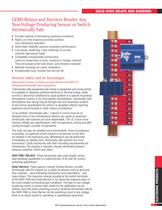
SOLID STATE RELAYS AND BARRIERS GEMS Relays and Barriers Render Any Non-Voltage Producing Sensor or Switch Intrinsically Safe ► Provide method of eliminating explosive conditions ► Rapid, arc-free response provides positive, non-mechanical operation ► Solid-state reliability assures consistent performance ► Low-power switching; a few milliamps of current controls high-power loads ► Completely encapsulated construction Units are impervious to dust, moisture or foreign material They are tamper-proof and shock- and vibration-resistant ► Modular housings for easier installation ► Exceptionally long, trouble-free service life Intrinsic Safety and its Advantages. Instrument Society of American Specification ISA-RP12.2 Defining Intrinsically Safe Equipment: "Intrinsically safe equipment and wiring is equipment and wiring which is incapable of releasing sufficient electrical or thermal energy under normal or abnormal conditions to cause ignition of a specific hazardous atmospheric mixture in its most ignited concentration. Intrinsically safe terminations and wiring may be brought into any hazardous location of any Group classification for which it is accepted without requiring explosion-proof housing or other means of protection." To be certified "intrinsically safe," a device or circuit must be so designed that no two simultaneous failures can cause an explosion. Intrinsically safe systems are more dependable. The I.S. circuit must function reliably per specifications, with no explosions, during and after cycling through a number of operations. The units can also be installed more conveniently. Since no explosion is possible, no explosion-proof conduit or enclosures of any kind are needed in the hazardous area. Maintenance can be performed immediately as needed. And, intrinsically safe systems are more economical. Costly enclosures with their mounting requirements are unnecessary. No purging is required, thereby eliminating blowers, pressure switches, timers and relays. SAFE-PAK® RELAYS: These intrinsically safe units amplify sensor load-handling capabilities in a wide diversity of AC and DC control switching applications. Zener Barriers: These passive, energy-limiting devices, provide intrinsically safe DC outputs for a variety of sensors such as level and flow switches.. .level indicating transducers and transmitters.. .and many others. The maximum energy possible at the switch terminals of the SAFE-PAK and Zener Barriers is far below the explosive point of the most volatile surrounding gas conditions. The type of non-voltage- producing switch or sensor best suited for the application can be utilized, since the entire switching circuit is rendered intrinsically safe by the SAFE-PAK or Zener Barrier. As the switching circuit is low voltage, there is no shock hazard to operating or maintenance personnel. Visit www.GemsSensors.com for most current information.
Open the catalog to page 1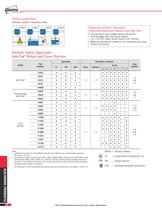
. Sensors & Controls Typical Applications Switches Located in Hazardous Areas Important points to remember when selecting Zener Barriers and Safe Pak® : • The maximum input voltage rating of the barrier must be higher than your power supply. (i.e., a 24 VDC supply would require a 30 V barrier.) • Make sure the barrier is rated for your hazardous area class, Intrinsic Safety Approvals - Safe-Pak® Relays and Zener Barriers 1. Certified intrinsically safe under MSHA certification No. 1662 for use on permissible equipment. 2. Zener Barrier models, Part Numbers 54801, 54803, 54805, 54806; Programmable...
Open the catalog to page 2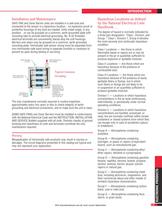
SAFE-PAK and Zener Barrier units are installed in a safe area and connected to the sensor in a hazardous location...no explosion-proof or protective housings of any kind are needed. Units install singly, in any position...or can be grouped on a common, earth-grounded plate with mounting tabs to provide electrical grounding. No. 6-32 threaded electrical terminals are conveniently placed atop the unit housings. Barriers and relays may be grouped on a common, earth-grounded mounting plate. Intrinsically safe sensor wiring must be separated from non-intrinsically-safe input wiring in separate conduits...
Open the catalog to page 3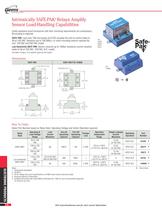
. Sensors & Controls Intrinsically SAFE-PAK® Relays Amplify Sensor Load-Handling Capabilities Costly explosion-proof enclosures with their mounting requirements are unnecessary. SAFE-PAK: Less than 100 microamps at 9 VDC actuates the unit to control loads to 5A at 120 VAC. Resistive (up to 100,000Q ) or short-circuiting sensors operate the Low Sensitivity SAFE-PAK: Sensor closures up to 1000Q resistance control resistive See table on Page L-2 for specific approval information Select Part Number based on Relay Style, Operating Voltage and Switch Operation required. 3. All AC voltage and current...
Open the catalog to page 4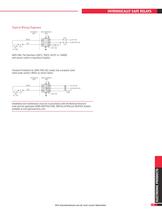
3 RED N.O. DRY OR N.C. DRY 2 1 RESISTOR (–) 3 BLACK 2 1 FUSE* DC POWER SUPPLY ANNUNC. (+) 2 CONDUCTOR CABLE intrinsically safe relays SIGNAL RETURN BARRIER Typical Wiring Diagrams HAZARDOUS AREA NON-HAZARDOUS AREA FUSE BLACK RED LOAD N.O. DRY OR N.C. DRY HOT VAC NEUTRAL VAC FUSE SAFE-PAK SAFE-PAK, Part Numbers 25872, 25873, 64101 or 144600 with sensor switch in hazardous location. Transient Protection for SAFE-PAK (AC Loads) Use a properly sized metal oxide varistor (MOV) as shown below. HAZARDOUS AREA NON-HAZARDOUS AREA BLACK HOT VAC NEUTRAL VAC RED N.O. DRY OR N.C. DRY SAFE-PAK LOAD ELECTRONIC...
Open the catalog to page 5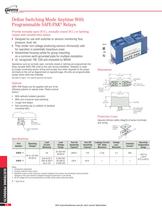
. Sensors & Controls Define Switching Mode Anytime With Programmable SAFE-PAK® Relays Provide normally open (N.O.), normally closed (N.C.) or latching output with variable time delays ► Designed for use with switches or sensors monitoring flow, ► They render non-voltage-producing sensors intrinsically safe for operation in potentially hazardous areas ► Streamlined housing suited for group-mounting on a common earth-grounded plate for multiple installation ► UL recognized, FM, CSA and evaluated by MSHA Operations such as normally open, normally closed or latching are programmed into these versatile...
Open the catalog to page 6All Gems Sensors catalogs and brochures
 D-Cryo Series Solenoid Valve
2 Pages
 B-Cryo Series Solenoid Valve
2 Pages
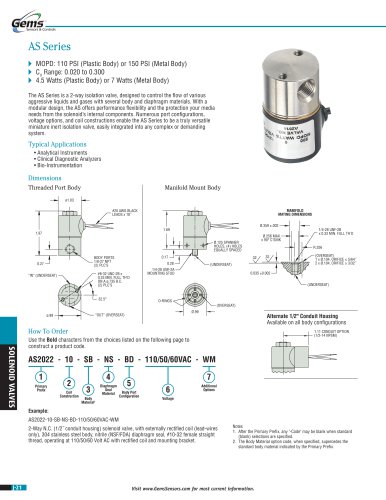 AS Series Solenoid Valve
2 Pages
 BS Series Solenoid Valve
2 Pages
 KM/KL Series Solenoid Valve
4 Pages
 KV/KW Series Solenoid Valve
2 Pages
 PM/PL Series
2 Pages
 Gems Master Catalog Product
406 Pages
 3600 Series
4 Pages
 3800 Series
2 Pages
 3500 Series
4 Pages
 F Series
4 Pages
 Appendix and Glossary
13 Pages
 Pressure Transducers
67 Pages
 Pressure Switches
30 Pages
 Flow Switches
26 Pages
 Warrick Conductivity Sensors
29 Pages
 Level Sensors Continuous
33 Pages
 Level Indicators Visual
27 Pages
 Level Switches Multi-Point
26 Pages
 Warrick_Conductivity_Sensors
29 Pages
 Level_Sensors_Continuous-
33 Pages
 Level_Indicators_Visual
27 Pages
 Level Switches Single Point
43 Pages
 Level_Switches_Mult-Point
26 Pages
 Solenoid Valves
40 Pages
 Flow Sensors
13 Pages
 J-Valves_05-16-2011opt
40 Pages
 Proximity_Switches-
5 Pages
 Flow_Switches
24 Pages
 Pressure_Switches
28 Pages
 Pressure_Transducers-5-16-2011
44 Pages
 Gems_ProdOverview_2008_Opt_Print
12 Pages
 SemiconBroch
8 Pages
 FS-380P Series
2 Pages


