

Battery monitor for JBNUM-II

Battery monitor for JBNUM-II
The JBNUM-II Battery Monitor features a large LCD graphic display, allowing users to monitor the voltage, current, and remaining capacity of a battery bank, as well as the voltage of two additional banks. With extra shunt sets, it can monitor up to two additional battery banks.
Key Features:
- Monitors voltage, current, and capacity of battery banks.
- Low capacity alarm and genset remote control capability.
- Configurable parameters including number of banks, capacity, alarm values, shunt configuration, and language.
- Acoustic alarm and backlight settings.
Technical Specifications:
- Input power supply: 8.5 to 60VDC.
- Consumption: 25mA (standby), 30mA (without backlight), 65mA (with backlight).
- Battery capacity: 5 to 4000Ah.
- Measurement range: Voltage 0 to 60VDC, Current -500A to 500A.
- Display resolution: Voltage 0.1VDC, Current 0.1A.
- Accuracy: Voltage ±0.5%, Current ±1%.
- Display: 128x64 white positive graphic LCD with LED backlight.
- Remote genset control via NO/NC contact.
- Alarms: Buzzer and flashing backlight.
- Dimensions: 120mm x 120mm; Embedded body: 95mm x 100mm x 35mm.
- Operating temperature: 0 to +50°C; Storage temperature: -10 to +70°C.
Accessories and Options:
- Standard version includes a shunt kit and cables for monitoring one battery bank.
- Optional shunt kits available for additional monitoring.
Additional Information:
The monitor supports 12V, 24V, or 48V systems and can handle mixed voltages if the negative is common. It can also monitor energy sources like wind generators or solar panels. The product is made in France by ENAG S.A.S.
Catalog excerpts
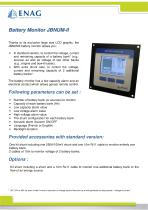
Thanks to its exclusive large size LCD graphic, the JBNUMII battery monitor allows you: • In standard version, to control the voltage, current and remaining capacity of a battery bank* (e.g.: service) as well as voltage of two other banks (e.g.: engine and bow-thruster), • With extra shunt sets, to control the voltage, current and remaining capacity of 2 additional battery banks*. The battery monitor has a low capacity alarm and an electrical contact which allows genset remote control. Following parameters can be set: • Number of battery bank (or sources) to monitor • Capacity of each battery bank (Ah) • Low capacity alarm value • Low voltage alarm value • High voltage alarm value • The shunt configuration for each battery bank • Acoustic alarm (buzzer) ON/OFF • Language (French or English) • Backlight duration One kit shunt including one 250A/100mV shunt and one 10m Rj11 cable to monitor entirely one battery bank. 2 cables of 10m to monitor voltage of 2 battery banks. Options : Kit shunt including a shunt and a 10m RJ11 cable to monitor one additional battery bank or the flow of an energy source. * 12V, 24V or 48V (or even mixed if minus is common) or energy source flow such as a wind generator or solar-panels - voltage & current.
Open the catalog to page 1
Technical characteristics Input power-supply: from 8,5 to 60VDC Consumption: • In standby mode: 25mA • without backlight: 30mA • with backlight:65mA Battery or DC source capacity: from 5 to 4000Ah Measurements : Battery voltage : from 0 to 60VDC Current : from -500A to 500A Display resolution : Battery or energy source voltage : 0,1VDC Current : 0,1 A Accuracy : Voltage: ±0,5% Current: ±1% Display : White positive graphic LCD screen 128x64 White LED Backlight Remote of the genset : by a NO/NC potential free contact Alarms : Buzzer & flashing backlight Dimensions : 120mm x 120mm Embedded body: h...
Open the catalog to page 2All ENAG catalogs and brochures
 ALT range – 72Vdc-300A
2 Pages
 ALT-ADT range – 28Vdc mobile
2 Pages
 BDB range – Mobile discharge
2 Pages
 DC/DC CONVERTER – SD RANGE
2 Pages
 RADIATOR – RAEL RANGE
2 Pages
 ADM-SB – C13100 range
4 Pages
 Grille pare-pluie marine
1 Page
 Water separator
4 Pages
 ONS range – AC/DC – Sinus
2 Pages
 Propeller pitch indicator
2 Pages
 Marine Battery
2 Pages
 SD range – 12/48/110V
2 Pages
 CDS4 H range
2 Pages
 CDS4 range – 12/24V
4 Pages
 CDS3 range – 24V – BV
2 Pages
 CDS3 range – 12/24/48V
2 Pages
 CDS range – 12/24V
2 Pages
 24Vdc alternator
2 Pages
 Shaft line alternator
1 Page
 ADM-SB range – Marine
2 Pages
 ADM-SB range – AC/DC
4 Pages
 SQ range
2 Pages
 ALM-ALT range – AC/DC
2 Pages
 DC/DC converters - SD Range
2 Pages


- Inboard engine
- Professional engine
- Electric engine
- Propulsion engine
- Ship engine
- Boat charger
- Marine inverter
- DC converter
- Voltage converter
- Brushless engine
- AC converter
- Water pressurization system
- Boat water pressurization system
- Pump water pressurization system
- Fan-extractor
- Accumulator water pressurization system
- Ship fire damper
- Combined heater-air conditioner
- Axial fan-extractor
- Nautical power supply