
- Catalogs
- Eco-Technilin
- LINEO – FLAX FABRICS

LINEO – FLAX FABRICS
LINEO – FLAX FABRICS
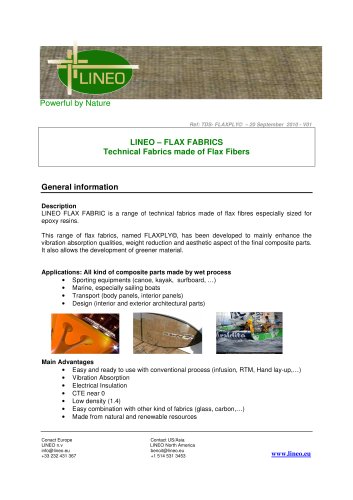
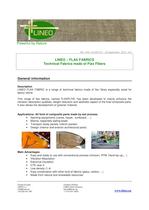
Description: LINEO FLAX FABRIC is a range of technical fabrics made from flax fibers, specifically designed for use with epoxy resins. The FLAXPLY© range is developed to enhance vibration absorption, reduce weight, and improve the aesthetic of composite parts, while promoting environmentally friendly materials.
Applications: Suitable for all composite parts made by wet processes, including sporting equipment (canoes, kayaks, surfboards), marine applications (sailing boats), transport (body and interior panels), and design (architectural parts).
Main Advantages:
- Easy to use with conventional processes (infusion, RTM, hand lay-up)
- Vibration absorption
- Electrical insulation
- Coefficient of thermal expansion (CTE) near 0
- Low density (1.4)
- Compatible with other fabrics (glass, carbon)
- Made from natural and renewable resources
Properties of Flax Fibres
Properties of Composite Parts: Values are for pressed laminates with 12 layers of unidirectional (UD) flax fibers (180 g/m2) and epoxy resin (Huntsman Epoxy 5086), with a fiber volume fraction of 58-60% and a curing cycle of 2 hours at 130°C. Users are advised to perform their own characterization.
- Traction: Tensile strength: 330 MPa, Modulus: 35 GPa, Elongation: 1.8% (ISO 529)
- Flexion: Tensile strength: 300 MPa, Modulus: 22 GPa, Elongation: 2.4% (ISO 14125)
- Composite Material Density: 1.3
Available Range of FLAXPLY©:
- 150 g/m2 UD Flax Fiber
- 180 g/m2 UD Flax Fiber
- 150 g/m2 Balanced Fabrics 0/90 Flax Fabrics
- 200 g/m2 Balanced Fabrics 0/90 Flax Fabrics
- 300 g/m2 Balanced Fabrics 0/90 Flax Fabrics
- 580 g/m2 Balanced Fabrics 0/90 Flax Fabrics
Please contact LINEO for any technical support or assistance.
Catalog excerpts
Powerful by Nature Ref: TDS- FLAXPLY© – 20 September 2010 - V01 LINEO – FLAX FABRICS Technical Fabrics made of Flax Fibers General information Description LINEO FLAX FABRIC is a range of technical fabrics made of flax fibres especially sized for epoxy resins. This range of flax fabrics, named FLAXPLY©, has been developed to mainly enhance the vibration absorption qualities, weight reduction and aesthetic aspect of the final composite parts. It also allows the development of greener material. Applications: All kind of composite parts made by wet process • Sporting equipments (canoe, kayak, surfboard, …) • Marine, especially sailing boats • Transport (body panels, interior panels) • Design (interior and exterior architectural parts) Main Advantages • Easy and ready to use with conventional process (infusion, RTM, Hand lay-up,…) • Vibration Absorption • Electrical Insulation • CTE near 0 • Low density (1.4) • Easy combination with other kind of fabrics (glass, carbon,…) • Made from natural and renewable resources Conact Europe LINEO n.v [email protected] +33 232 431 367 Contact US/Asia LINEO North America [email protected] +1 514 531 3453 www.lineo.eu
Open the catalog to page 1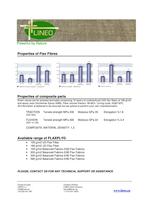
Powerful by Nature Properties of Flax Fibres Properties of composite parts Given values are for pressed laminates comprising 12 layers of unidirectional (UD) flax fibers of 180 g/m2 and epoxy resin (Huntsman Epoxy 5086). Fiber volume fraction: 58-60%. Curing cycle: 2h@130° C. All information is believed to be accurate but we advice to perform your own characterization. TRACTION Tensile strength MPa 330 Modulus GPa 35 Elongation %1.8 Tensile strength MPa 300 Modulus GPa 22 Elongation % 2.4 (ISO 529) FLEXION (ISO 14 125) COMPOSITE MATERIAL DENSITY: 1,3 Available range of FLAXPLY© • • • • • • 150...
Open the catalog to page 2All Eco-Technilin catalogs and brochures
 FLAXPREG T-UD
2 Pages
 FLAXTAPE
1 Page
 LINEO – FLAX PREPREG
3 Pages