
- Catalogs
- Dickinson Marine
- Propane Heater P9P12

Propane Heater P9P12
Propane Heater P9P12
Ensure all connections are leak-tested before use and after each tank refill. This heater is intended for marine use only and should not be used with natural gas or solid fuels. Keep children and pets away from the heater, and do not leave it unattended while in use. Follow all safety clearances and installation standards.
The heater must be disconnected from the gas supply during pressure testing. Use only DOT or CAN/CSA-B339 compliant cylinders. A pressure regulator is required, and replacement regulators must be specified by the manufacturer.
This heater is designed for small marine vessels and uses a double-walled vent pipe for combustion. It features a safety gas valve that shuts off gas if the flame is extinguished. A gas detector is recommended.
- P9000: Width 8.5", Height 14", Depth 5.5"
- P12000: Width 10", Height 16", Depth 7.25"
- BTUs: Low 3200-4000, High 4500-5500
- Gas Consumption: Low 7-5.5 hrs/lb, High 5-3.9 hrs/lb
Consider heater location for optimal heating. Ensure proper mounting and use a separate low-pressure regulator. The heater should be mounted lower for efficient heat circulation.
Maintain specified clearances from combustible materials. Use insulation or cement board with a metal liner if necessary.
The included flue pipe is 28" long and should be installed with springs to maintain air space. Extensions are available, and the maximum length is 56". Avoid cutting the pipe, but if necessary, use a fine hacksaw blade.
Ensure gradual bends in the pipe to maintain draft efficiency. Use a 4.5" exit hole for walls thicker than 3".
This appliance operates on low-pressure propane only. Use a 3/8" flare male fitting and ensure the propane tank is upright. Follow ABYC standards for separate low-pressure regulators for each appliance.
Ensure compliance with local, national, or industry-specific regulations when installing propane systems. Retain manuals for gas components like solenoids and regulators, as installation requirements may vary by manufacturer. Always follow the manufacturer's instructions for component installation.
- Do not connect the heater directly to the propane/LPG supply; an external regulator is required.
- Test all gas lines and connections for leaks with a soap solution before lighting the heater.
- Install a CAUTION plate inside the propane locker for safety reminders.
The heater's fan operates on 12V DC, 0.17 amps, and requires a 2-amp inline fuse. Ensure proper grounding according to local codes or the National Electrical Code, ANSI/NFPA 70, or the Canadian Electrical Code, CSA C22.21.
1. Ensure the gas knob is off with the door open.
2. Apply a flame above the burner.
3. Depress the knob and turn it to low.
4. Close the door and hold the knob for 15 seconds to engage the thermocouple.
Regularly clean the heater's exterior and inspect the propane supply system. Clean the orifice and thermocouple to ensure efficient operation. Avoid using metal abrasives that leave impurities.
Common issues include no gas to the burner, fire not staying lit, and fan malfunction. Remedies involve checking gas supply, ensuring proper door seal, and verifying electrical connections.
A list of available accessories and replacement parts is provided, including extension kits, hoses, regulators, and fans.
Dickinson Marine offers a one-year warranty from the purchase date, covering defects in workmanship and materials. The warranty is non-transferable and requires registration within 90 days of purchase. Returns require a Return Authorization Number, and customers are responsible for shipping costs.
Registration Requirements
To validate the warranty, complete the registration form including the serial number. Improper installations or use of unapproved materials, equipment, or procedures will void the warranty. Only use Dickinson-supplied components for the heater's valve, burner, or fan.
Dickinson Marine is not liable for damages or service loss due to unapproved modifications.
The form requires personal information, heater model and serial number, purchase date, and seller details. It must be signed to confirm understanding and agreement to the warranty terms. The form can also be completed online at www.dickinsonmarine.com.
Dickinson Marine
#101-17728 66th Avenue, Surrey, BC, V3S 7X1 Canada
Tel: 604-574-8641
Fax: 604-574-8659
Email: [email protected]
Website: www.dickinsonmarine.com
No part of the manual may be reproduced without written permission. Dickinson reserves the right to modify materials, applications, equipment, accessories, and prices without notice. All measurements and weights are approximate.
Catalog excerpts

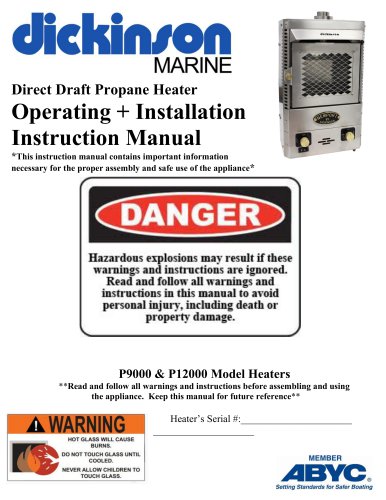
dkkin/onMARINE Direct Draft Propane Heater Operating + Installation Instruction Manual *This instruction manual contains important information necessary for the proper assembly and safe use of the appliance* Hazardous explosions may result if these warnings and instructions are ignored. Read and follow all warnings and instructions in this manual to avoid personal injury, including death or property damage. **Read and follow all warnings and instructions before assembling and using the appliance. Keep this manual for future reference** Heater’s Serial #:
Open the catalog to page 1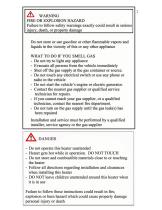
FIRE OR EXPLOSION HAZARD Failure to follow safety warnings exactly could result in serious injury, death, or property damage Do not store or use gasoline or other flammable vapors and liquids in the vicinity of this or any other appliance - Evacuate all persons from the vehicle immediately - Shut off the gas supply at the gas container or source. - Do not touch any electrical switch or use any phone or radio in the vehicle - Do not start the vehicle’s engine or electric generator. - Contact the nearest gas supplier or qualified service technician for repairs. - If you cannot reach your gas supplier,...
Open the catalog to page 2
2. LP Gas cylinder Specs and installation. Pg.6 3. About a Direct Draft Heater... Pg. 7 6. Propane Fuel Connection. Pg. 13 7. Low Pressure System Connection. Pg. 14 11. Thermocouple and Orifice Maintenance ... Pg. 19 12. Cleaning the Door Glass.Pg 21 18. Registering your Warranty ... Pg. 29
Open the catalog to page 3
■ Leak test all connections before first use ■ Leak test connections after each tank refill ■ Always check the heater, tank and hose connections prior to each use ■ This heater is configured for propane. Do not use natural gas. ■ Never use charcoal, lava rocks or any other source of solid fuel in this heater ■ Ensure that flames are coming out of the entire burner. Occasionally insects can enter in when the unit isn’t in use and create blockages which can lead to burner fires. ■ Never check for leaks using an open flame. Use soapy water on the connections and look for bubbles. ■ Never use or...
Open the catalog to page 4
A225.1/NFPA 501A, or Standard for Gas Equiped Recreational Vehicles and Mobile Housing, CSA Z240.4 Do not use this appliance if any part has been underwater. Immediately call a qualified service technician to inspect the appliance and to replace any part of the control system and any gas control which has been underwater. Toddlers, young children, and others may be susceptible to accidental contact burns. A physical barrier is recommended if there are at-risk individuals in the house. To restrict access to a fireplace or stove, install an adjustable safety gate to keep toddlers, young children,...
Open the catalog to page 5
■ The heater and its individual shutoff valve must be disconnected from the gas supply piping system during any pressure testing of that system at test pressures in excess of U PSI (3.5kPa) ■ The heater must be isolated from the gas supply piping system by closing its individual manual shut-off valve during any pressure testing of the gas supply piping system in equal or less than U PSI (3.5 kPa) ■ The LP gas supply cylinder to be used MUST be constructed and marked in accordance with the specifications for LP gas cylinders, U.S. Department of Transportation (DOT) or the standard for cylinders,...
Open the catalog to page 6
About a Direct Draft Propane Heater This direct vent propane heater fireplace is a clean burning low pressure (11”/WC) propane appliance for use on board small marine vessels and many other different applications. These heaters are equipped with a flexible stainless double walled vent pipe and a combination deckfitting/exhaust cap. Fresh air is pulled from outside, through the outer pipe into the combustion chamber while exhaust gas leaves the vessel through the inner pipe. The air from inside the cabin is not being used for combustion so a fresh air vent is not needed. Since this unit has isolated...
Open the catalog to page 7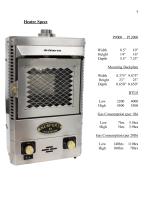
Heater Specs Mounting Backplate
Open the catalog to page 8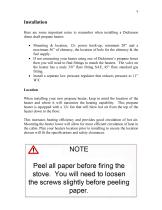
Here are some important notes to remember when installing a Dickinson direct draft propane heater: • Mounting & location, 12v power hook-up, minimum 20” and a maximum 56” of chimney, the location of hole for the chimney & the fuel supply. • If not connecting your heater using one of Dickinson’s propane hoses then you will need to find fittings to match the heaters. The valve on the heater has a male 3/8” flare fitting SAE, 45° flare standard gas fitting. • Install a separate low pressure regulator that reduces pressure to 11” W/C When installing your new propane heater, keep in mind the location...
Open the catalog to page 9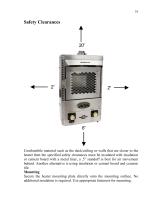
Safety Clearances Combustible material such as the deck/ceiling or walls that are closer to the heater then the specified safety clearances must be insulated with insulation or cement board with a metal liner, a .5” standoff is best for air movement behind. Another alternative is using insulation or cement board and ceramic tile. Mounting Secure the heater mounting plate directly onto the mounting surface. No additional insulation is required. Use appropriate fasteners for mounting.
Open the catalog to page 10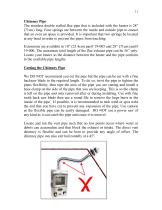
Chimney Pipe The stainless double walled flue pipe that is included with the heater is 28” (71cm) long. Four springs are between the inside and outside pipe to ensure that an even air space is provided. It is important that two springs be located at any bend in order to prevent the pipes from touching. Extensions are available in 10” (25.4cm) part# 19-005 and 28” (71cm) part# 19-000. The maximum total length of the flue exhaust pipe can be 56” only. Locate your heater so the distance between the heater and the pipe conform to the available pipe lengths. Cutting the Chimney Pipe We DO NOT recommend...
Open the catalog to page 11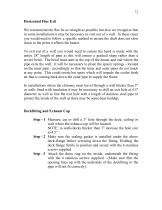
Horizontal Flue Exit We recommend the flue be as straight as possible but also we recognize that in some installations it may be necessary to vent out of a wall. In these cases you would need to follow a specific method to ensure the draft does not slow down to the point it affects the heater. To exit out of a wall you would need to ensure the bend is made with the entire 28" length of pipe as this will ensure a gradual slope rather than a severe bend. The bend must start at the top of the heater and end where the pipe exits the wall. It will be necessary to place the spacer springs - located...
Open the catalog to page 12All Dickinson Marine catalogs and brochures
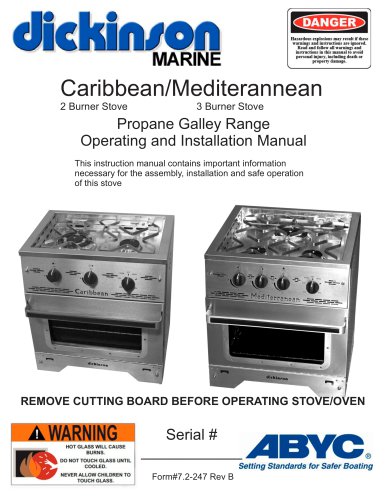 Mediterranean / Caribbean
26 Pages
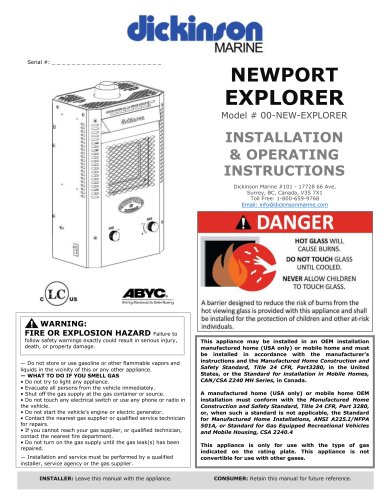 Explorer Propane Fireplace
54 Pages
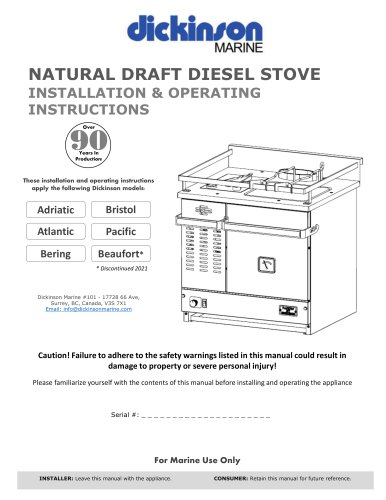 Diesel Stove
53 Pages
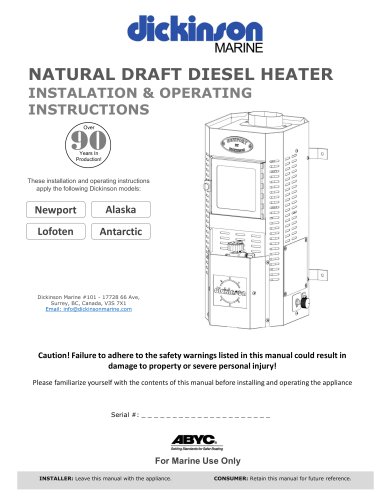 Diesel Heater
53 Pages
Archived catalogs
 LOFOTEN-00-LOF - Pdf
41 Pages
 Lofoten Diesel Heater
1 Page
 NEWPORT P9000-P12000
1 Page
 ANTARCTIC DIESEL HEATER
1 Page
 Alaska-00-ALA Pdf
41 Pages
 Pacific-00-PAC . PDF
39 Pages
 BRISTOL-00-BRI.PDF
38 Pages
 BERING-00-BER . PDF
38 Pages
 BEAUFORT-00-BEA.PDF
39 Pages
 Small SEA-B-QUE
1 Page
 Large SEA-B-QUE
1 Page
 Round SEA-B-QUE
1 Page
 Spitfire 180
1 Page
 Propane 2 Burner Cooker
1 Page
 Alaska Diesel Heater
1 Page
 Antarctic Diesel Heater
1 Page
 Newport Diesel Heater
1 Page
 Diesel Cook-Stoves
2 Pages
 Dickinson Cabin Heaters
2 Pages
 Dickinson Marine BBQ
1 Page


