
- Catalogs
- Dickinson Marine
- Diesel Stove

Diesel Stove
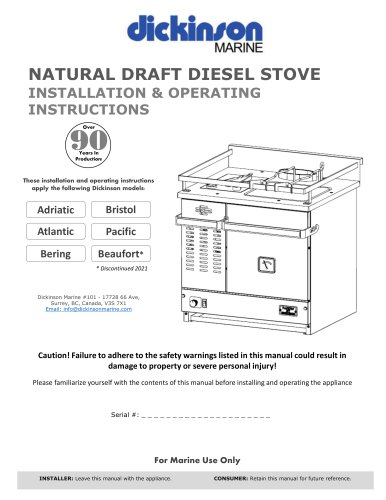
Diesel Stove
This manual provides installation and operating instructions for Dickinson Marine's natural draft diesel stoves, designed for marine use. It covers models such as Adriatic, Atlantic, Bering, Bristol, and Pacific, with Beaufort discontinued in 2021. Safety warnings are emphasized to prevent property damage or personal injury.
Key warnings include not operating the appliance unattended, ensuring an open fresh air vent, using only no. 2 Diesel fuel, and keeping children and pets away. Gasoline or solid fuels should not be used, and proper installation and maintenance are crucial.
Dickinson Marine offers a limited one-year warranty covering defects in workmanship and materials, requiring registration within 90 days of purchase. The warranty excludes normal wear, misuse, and exposure to corrosive conditions, with a 20% restocking fee for non-defective returns.
The guide provides detailed instructions for installing the appliance, including considerations for sailboats and optimal location choices. It covers chimney variations, fuel supply systems, and the importance of using only Dickinson Marine parts and accessories.
Users must read the operating instructions carefully before lighting the stove. The manual outlines the lighting procedure, fuel-air mixture, and tips for efficient operation, advising on testing the draft and using a barometric damper.
Regular maintenance is essential for safe operation. Guidelines are provided for maintaining the system, fuel filter, fuel line, burner, chimney, and metering valve, stressing the importance of keeping control compartments and air passageways clean.
A troubleshooting section addresses common issues such as soot production, insufficient heat, inconsistent fuel flow, and noisy fan operation, providing solutions and advising when to contact a professional service technician.
The manual concludes with a glossary of terms and a list of illustrations to aid in understanding and following the instructions.
To activate the warranty, register the appliance online or by sending back the warranty registration form with the appliance's serial number. Improper installations or use of unapproved materials void the warranty.
Dickinson Marine stoves have been in production for over 90 years, designed for marine use with features like a durable cast iron cooking surface, adjustable flue damper, and a sea rail to prevent pots from sliding. The stoves are made with brushed stainless steel panels and include a drip tray for maintenance spills.
- Natural Draft Appliance: These appliances use a natural draft system to burn vaporized fuel and air, requiring a fresh air vent in the cabin.
- Installation Requirements: Each appliance needs a unique chimney configuration, and installation is not certified for domestic use.
- Safety: Surfaces become hot and require regular maintenance to prevent hazards.
- Chimney Importance: The chimney's height and shape are crucial for performance, affecting the draft strength.
- Metering Valve: Maintains oil level for consistent fuel delivery, with options for alternative fuels.
- Power Requirements: Can operate without electrical power, though a draft assist fan is available.
The document lists various models like Atlantic, Adriatic, Pacific, Bering, and Bristol, with specific dimensions, BTU ratings, and features like fan control and coil options.
Minimum clearances are specified for safe installation, including a two-inch clearance to protected surfaces and a three-foot clearance above the stovetop.
Details include electrical input, fuel type, maximum capacity, and BTU ratings for different models. The appliances are made from stainless steel and include a draft assist fan.
The document explains the natural draft process, emphasizing the need for a constant fresh air source and proper burner maintenance to ensure efficient combustion.
Describes components like the superheater, burner ring, and cast iron rings, which are essential for balanced combustion and heat distribution.
The valve ensures a steady oil level for uninterrupted fuel flow, crucial for maintaining the appliance's operation.
This document provides detailed instructions for installing a natural draft diesel appliance, emphasizing adherence to guidelines to prevent property damage, injury, or death. Dickinson disclaims responsibility for issues from non-compliant installations.
Key warnings include not installing in non-conforming spaces, using only approved fuels, ensuring proper chimney installation and fresh air supply, maintaining fuel pressure below 3 PSI, and ensuring accessibility for maintenance and operation.
The document explains BTU as a measure of energy required for heating, providing a formula for calculating BTU needs based on space size, insulation, and climate conditions, with example calculations.
Factors influencing heating efficiency include insulation quality, window condition, climate, number of inhabitants, and chimney length. Proper assessment is crucial for optimal appliance performance.
For sailboats, the orientation of the appliance and fuel line alignment with the keel are critical to ensure consistent fuel supply and operation at up to 15 degrees of heel.
Choosing the right location involves considering chimney requirements, safety clearances, and the appliance's heating capacity. The document advises against using old stove locations without verifying compatibility with new requirements.
The checklist includes steps such as ensuring a level surface, planning the chimney run, verifying safety clearances, and cleaning the metering valve before use. It also recommends using a 12v draft assist fan and provides contact information for technical support.
1. Approved Fuels: Only use number 2 diesel in Dickinson appliances. Special metering valves may require number 1 diesel or kerosene. Using unapproved fuels poses explosion risks.
2. Cold Climates: Kerosene or winterized number 1 diesel is recommended for better flow in cold conditions. Consider a higher flowrate valve for consistent cold exposure.
3. Fuel Line Installation: Use flared line connections with 3/8” copper tubing for inlet and ¼” for overflow. Ensure lines are straight to avoid air locks.
4. Overflow Feature: The valve has an overflow tube to evacuate excess fuel. Steady dripping indicates servicing is needed.
5. Main Fuel Tank Supply: Overflow lines must return to the main tank. A manual shut-off is required to prevent backflow during refueling.
6. Fuel Filter and Manual Shut-off: Fuel must be filtered before reaching the pump or valve. A manual shut-off relieves pressure when not in use.
7. Fuel Pump Use: Connect the fuel line close to the tank, not from the engine supply. Use a check valve to prevent engine fuel consumption.
8. Gravity vs. Fuel Pump: Gravity feed is silent and requires a higher tank position. Pumps need a power source and may require servicing.
1. Orientation: Install the pump with the outlet pointing upwards. Side installation may increase wear.
2. Priming: Prime the pump by disconnecting the fuel line and running the pump to expel air.
3. Pressure Regulator: Set to the lowest setting for consistent flow. Adjust incrementally if needed.
4. Wiring: Use a 12v control circuit with a 5 amp fuse. Ensure proper grounding.
5. Siphon Effect: Use shut-off valves to prevent fuel flow when the pump is off.
1. When to Use: Use during light-up, high fuel settings, or windy conditions to balance combustion.
2. When to Turn Off: Once operating temperature is reached, the fan can be shut off at lower settings.
3. Fan Maintenance: Avoid continuous use to prevent motor burnout and carbon buildup.
1. Installation: Coils can be pre-installed or retrofitted. Use metal piping for connections.
2. Output: 1-turn coils produce 5-10 gallons per hour, while 2-turn coils produce 15-20 gallons.
Smaller natural draft heaters and stoves may only accommodate a 1-turn coil. It requires approximately 3000 BTU to raise the temperature of 30 gallons of water by 30 degrees. Estimating the heating capacity of an appliance is challenging due to radiant heat dispersion.
A pressure relief system is essential to prevent dangerous pressure build-up. Diagrams illustrate coil use in radiator and potable water systems. Follow manufacturer guidelines for any hot water system installation, and seek professional advice.
Operating a natural draft appliance requires understanding the manual, including installation, operation, and safety warnings. Never operate unattended, and install a carbon monoxide detector. CO is a dangerous, odorless gas that can cause severe health issues.
Never light a flooded or hot burner. Regular maintenance is crucial for safe operation. Ensure the chimney is clean to maintain proper draft. Fresh air supply is necessary to prevent negative pressure and exhaust backflow.
Install a CO detector near the appliance. CO is produced by incomplete combustion and can be deadly. Maintain a balanced operation to minimize CO risks.
Follow specific steps for lighting the appliance, including priming the burner, monitoring fuel levels, and adjusting settings for balanced combustion. Never force controls or operate if any part has been submerged in water.
Allow time for heat to accumulate in the burner. Adjust fuel settings gradually to avoid incomplete combustion and soot. Monitor flame color to ensure proper fuel-air balance.
Once the burner is hot enough, increase fuel settings gradually. Use the fan to maintain a balanced flame. Once temperature equalizes, the burner can handle any fuel setting within its rating.
The document provides detailed instructions for operating a natural draft diesel appliance, emphasizing the importance of maintaining a correct balance of fuel and air to ensure clean and efficient combustion. The appliance should be shut down by cutting off the fuel supply and allowing the fan to run to reduce carbon deposits.
Proper air flow is crucial for safe operation. The document outlines corrective actions for various burning conditions, such as adjusting fan speed and barometric damper settings to achieve a balanced fuel-air mixture. Correct operation is indicated by blue-yellow flames above the burner ring, with no smoke or soot.
The document provides guidance on fuel and fan settings based on temperature and weather conditions. It advises on cleaning and maintaining the appliance, including the metering valve and burner components, to ensure efficient heat transfer and combustion.
Regular maintenance is essential for trouble-free operation. This includes cleaning fuel tanks, filters, pumps, and burners to prevent contamination and blockages. The document highlights the importance of maintaining air supply and chimney cleanliness to support proper draft and combustion.
Adjustments to the barometric damper and fan settings are necessary to balance combustion. The document describes a method for testing draft within the cabin using a paper wick to identify air flow patterns.
The document outlines maintenance procedures for various components, including fuel tanks, filters, pumps, metering valves, fuel lines, burners, and chimneys. It emphasizes the need for regular cleaning to prevent carbon buildup and ensure consistent fuel flow.
Cleaning the chimney and cap is crucial to maintaining draft and preventing backdraft. The document provides tips for cleaning these components without damaging their surfaces.
Overall, the document provides comprehensive guidance on operating and maintaining a natural draft diesel appliance, emphasizing the importance of balancing fuel and air, regular maintenance, and proper cleaning to ensure efficient and safe operation.
The document provides guidance on troubleshooting fan noise issues, such as high-pitched whines or low rumbling noises, which may indicate the fan is receiving too little or too much power. It advises checking the vicinity of the fan for obstructions and cleaning accumulated dust. Proper reassembly with rubber washers and brackets is crucial to prevent noise.
A comprehensive glossary is included, defining terms related to stove operation and components, such as 'barometric damper,' 'burner ring,' 'carbon monoxide,' and 'chimney run.' Each term is explained in the context of its application in stove systems.
The document contains a list of illustrations and diagrams, detailing various stove models, parts, and configurations. These include images of stove clearances, burner parts, chimney variations, and valve operations, providing visual guidance for installation and maintenance.
Emphasizes the importance of correct installation to prevent noise and ensure safety. It includes instructions for securing fans and stoves, using leveling blocks, and ensuring proper chimney connections.
The document concludes with contact information for Dickinson Marine, including their address and email, and notes on the rights reserved by the company regarding modifications and reproductions of the manual.
Catalog excerpts

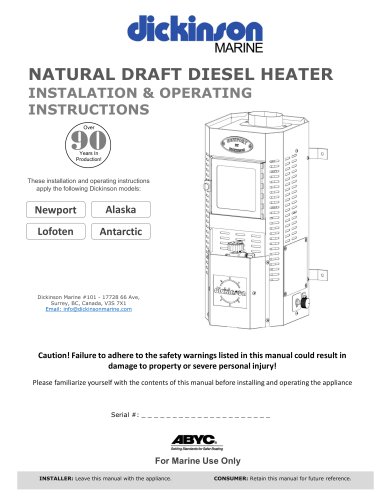
NATURAL DRAFT DIESEL STOVE INSTALLATION & OPERATING INSTRUCTIONS These installation and operating instructions apply the following Dickinson models: Dickinson Marine #101 - 17728 66 Ave, Surrey, BC, Canada, V3S 7X1 Email: [email protected] Caution! Failure to adhere to the safety warnings listed in this manual could result in damage to property or severe personal injury! Please familiarize yourself with the contents of this manual before installing and operating the appliance For Marine Use Only INSTALLER: Leave this manual with the appliance. CONSUMER: Retain this manual for future reference.
Open the catalog to page 1
All rights reserved. No part of this manual may be reproduced without permission in writing from Dickinson Marine. Dickinson also reserves the right to modify or change without notice, any materials, applications, equipment, accessories, and/or prices. All dimensions, measurements and weights are approximate. [email protected] @dickinsonmarine @dickinsonmarine1932 /dickinsonmarine We’d love to see your Dickinson Marine pictures & videos, please follow, tag us and share! Service notes: Appliance model: Fuel Type:
Open the catalog to page 2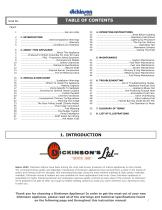
………………………………………………………….…...Service notes 1. INTRODUCTION .…………………………………………General Appliance Warnings …………………………………………………………………………Warranty ………………………………………………..Conditions & Limitations 2. ABOUT THIS APPLIANCE .…………………………………….…………..…About This Appliance …………Produced In British Columbia For Over 90 Years ……………….………………FAQ - Frequently Asked Questions ……..……………………………………………..Dimensions & Models …………………………………………………………..Safety Clearances ………………………………………………..Ratings & Specifications …………………………………………………………………..Natural Draft ……….………………………………..Internal Burner Components ……..……………………………………………The Oil Metering...
Open the catalog to page 3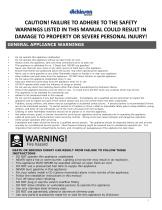
GENERAL APPLIANCE WARNINGS ■ Do not operate this appliance unattended. ■ Do not operate this appliance without an open fresh air vent. ■ Always check the appliance, tank and hose connections prior to each use ■ This appliance is calibrated for no. 2 Diesel fuel. NEVER use gasoline! ■ Never use charcoal, lava rocks or any other source of solid fuel in this appliance. ■ Ensure that flames are positioned above the burner ring when operating the appliance. ■ Never use or store gasoline or any other flammable vapors or liquids in or near your appliance ■ Keep children and pets away from the appliance....
Open the catalog to page 4
WARRANTY We at Dickinson wish to maintain a reasonable and easy system for returns, warranty, returns and exchanges. To accomplish this, we would like to inform you of some helpful guidelines and procedures to use and follow when sending back product to the Dickinson Marine. All correspondence regarding returns, warranties and exchanges will go through the factory of Dickinson Marine in Surrey, BC, Canada and the product must be returned to this location. DICKINSON WARRANTY POLICY Dickinson Marine appliances are covered under limited warranty for a period of one year dated from the purchase of...
Open the catalog to page 5
WARRANTY CONDITIONS & LIMITATIONS WARRANTY PROVISIONS: Dickinson warrants this product to be free of defects in workmanship and materials for a period of one year. This warranty is limited to claims submitted in writing within a one-year period following the date of purchase. If any part of your new product fails because of a manufacturing defect within the warranty period Dickinson offers to replace said parts free of charge, provided, however, that such parts have not been improperly repaired, altered or tampered with or subjected to misuse, abuse or exposed to corrosive conditions. This warranty,...
Open the catalog to page 6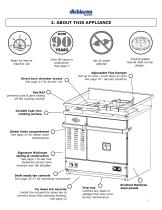
2. ABOUT THIS APPLIANCE OVER Made for Marine install & use Over 90 years in production! See page 7 Direct burn chamber access See page 13 for burner info Tried & tested natural draft burner design. Adjustable Flue Damper Pull up to close / push down to open see page 19 - damper positions Sea Rail prevents pots & pans sliding off the cooking surface Durable Cast Iron cooking surface Diesel Valve compartment See page 43 for diesel valve maintenance Signature Dickinson styling & construction See page 7 to see how Dickinson stoves have evolved over the decades. Draft assist fan controls See page...
Open the catalog to page 7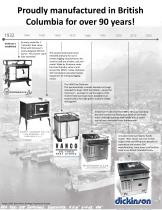
An early model No. 2 'Columbia' boat stove, fitted with Dickinson's newly designed AIR-FLO burner. This version came fully enameled. The Country Cook Camp stove. Intended primarily for use in remote logging encampments, the country cook was a heavy, cast iron model. Made by Dickinson under the Coast Foundry name in and around the 1950's. Today, Dickinson still manufacture specialty heating equipment for mining & logging camps. This was essentially a smaller domestic oil range intended for boats. With the VANCO - named for Vancouver - we begin to see the origins of the modern Dickinson boat stove....
Open the catalog to page 8All Dickinson Marine catalogs and brochures
 Mediterranean / Caribbean
26 Pages
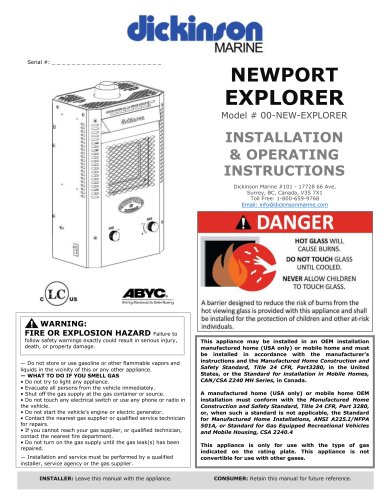 Explorer Propane Fireplace
54 Pages
 Propane Heater P9P12
31 Pages
 Diesel Heater
53 Pages
Archived catalogs
 LOFOTEN-00-LOF - Pdf
41 Pages
 Lofoten Diesel Heater
1 Page
 NEWPORT P9000-P12000
1 Page
 ANTARCTIC DIESEL HEATER
1 Page
 Alaska-00-ALA Pdf
41 Pages
 Pacific-00-PAC . PDF
39 Pages
 BRISTOL-00-BRI.PDF
38 Pages
 BERING-00-BER . PDF
38 Pages
 BEAUFORT-00-BEA.PDF
39 Pages
 Small SEA-B-QUE
1 Page
 Large SEA-B-QUE
1 Page
 Round SEA-B-QUE
1 Page
 Spitfire 180
1 Page
 Propane 2 Burner Cooker
1 Page
 Alaska Diesel Heater
1 Page
 Antarctic Diesel Heater
1 Page
 Newport Diesel Heater
1 Page
 Diesel Cook-Stoves
2 Pages
 Dickinson Cabin Heaters
2 Pages
 Dickinson Marine BBQ
1 Page


