

sales-brochures-tech-data-sheets-cable-grips

sales-brochures-tech-data-sheets-cable-grips
- AS Grips: Made with para-Aramid fiber, these are suitable for oceanographic, seismic, and industrial applications.
- TS Grips: Manufactured using Teijin Technora® fiber, offering a 20% strength advantage over standard para-Aramids, with high abrasion and temperature resistance.
- VS Grips: Made with Vectran® fibers, ideal for dynamic applications due to superior abrasion resistance and dynamic loading durability, with strength ratings similar to TS Grips.
- AS Grips: Range from 5,000 lbs to 150,000 lbs average break strength, with working loads from 1,000 lbs to 30,000 lbs.
- TS and VS Grips: Range from 6,000 lbs to 180,000 lbs average break strength, with working loads from 1,200 lbs to 36,000 lbs.
- Cable size range, average break strength, working load, standard tail length, and eye size are provided for each grip type.
- Custom-sized grips can be manufactured to accommodate specific load requirements.
Catalog excerpts
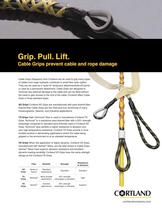
Grip. Pull. Lift. Cable Grips prevent cable and rope damage Cable Grips (Stoppers) from Cortland can be used to grip many types of cables from large hydraulic umbilicals to small fiber optic cables. They can be used as a "quick fit" temporary attachments/tie-off points or used as a permanent attachment. Cable Grips are designed to minimize any external damage to the cable and can be fitted without the need to gain access to the end of the cable. Cortland offers Cable Grips in three standard types. AS Grips Cortland AS Grips are manufactured with para-Aramid fiber. Aramid fiber Cable Grips are the 'tried and true' workhorse of many Océanographie, Seismic, and Industrial applications. TS Grips Teijin Technora® fiber is used to manufacture Cortland TS Grips. Technora® is a copolymer para-Aramid fiber with a 20% strength advantage compared to standard para-Aramids used in Cortland AS Grips. Technora® also exhibits a higher resistance to abrasion and very high temperature resistance. Cortland TS Grips provide a more durable product in demanding applications where the cable being gripped or the environment is at an elevated temperature. VS Grips When the application is highly dynamic, Cortland VS Grips, manufactured with Vectran® fibers, are the best choice in Cable Grips. Vectran® fibers have superior abrasion resistance and excellent dynamic loading durability. Cortland VS Grips have the same strength ratings as the Cortland TS Grips.
Open the catalog to page 1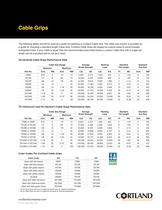
Cable Grips The following tables should be used as a guide for selecting a Cortland Cable Grip. The cable size column is provided as a guide for choosing a standard length Cable Grip. Cortland Cable Grips will always be custom-sized to accommodate anticipated loads. If your cable is larger than the recommended sizes listed below, a custom Cable Grip with a longer tail length can be manufactured to suit your need. AS (Aramid) Cable Grips Performance Data Cable Size Range Average Working Standard Standard TS (Technora") and VS (Vectran") Cable Grips Performance Data Cable Size Range Average Working...
Open the catalog to page 2All Cortland catalogs and brochures
 Tug
Tug8 Pages
 Heavy Lifting
12 Pages
 Tether
4 Pages
 ROV Tethers Flyer
1 Page
 Cortland Brochure
12 Pages
 Seismic Brochure
12 Pages
 ROV Cables flyer
1 Page


