
- Catalogs
- Cooney Marine
- Interlock Block Fitting

- Products
- Catalogs
- News & Trends
- Exhibitions
Interlock Block Fitting

Interlock Block Fitting
Cooney Marine has developed a patented system for the secure and stable stowage of dinghies and tenders. The system includes two shaped interlock blocks and two flat pads, all made from heavy-duty neoprene. These components are designed to prevent chafing and ensure stability when the dinghy is winched up.
Installation Instructions:
The interlock blocks should be attached to the side of the dinghy closest to the main craft, allowing the davit jib to slot in when winched. The flat pads are fixed to the outer side where the davit's extending arm touches. The components are adhered to the dinghy using adhesive, with positions marked when the dinghy is raised.
Adhesive Use:
Bostik 2402 or equivalent is recommended, but compatibility with the dinghy should be confirmed with the manufacturer. The dinghy must be fully inflated, surfaces cleaned with a fine abrasive, and adhesive applied as per instructions. Weighted battens or clamps should hold the surfaces together during drying, which can be accelerated with a fan heater.
Jib Blocks:
Jib blocks are used when the davit is too wide for the interlock blocks. They are fitted with 2 M6 screws, requiring drilling and tapping of the davit. It is advised to remove the gearbox and wire before drilling to avoid damage. Screws should be 25mm long to prevent interference with the gearbox or lift wire.
Contact Information:
For further information, contact Cooney Marine Ltd. at their Kettering office via phone or email.
Catalog excerpts

FITTING OF INTERLOCK BLOCKS INSTALLATION: Cooney Marine have developed a patented system to ensure the safe, stable and chafeproof stowage of dinghies and tenders. This system consists of two shaped interlock blocks and two flat pads (plus 2 jib blocks when required), all made from heavy duty neoprene. The shaped interlock blocks should be fixed on the side of the dinghy that is nearest to the main craft. They should be positioned so that they allow the underside of the davit jib (or jib blocks) to slot in when the tender or dinghy is winched up. The two flat pads should be fixed to the outer side of the dinghy at the point where the underside of the davit's extending arm touches. (See diagram below). JIB BLOCK (Screwed to davit) INTERLOCK BLOCK (Glued to tube) FLAT PAD (Glued to tube)
Open the catalog to page 1
The interlock blocks and flat pads are fixed to the tube by adhesive. The fitting position can be easily marked on the dinghy when it is raised in the davits. The interlock block and pad profiles can then be traced with a pencil on to the dinghy tube. USE OF ADHESIVE: We recommend Bostik 2402 or equivalent. However, we strongly advise that you check the compatibility of any adhesive to your dinghy with your dinghy manufacturer before proceeding. 1. Ensure the dinghy is fully inflated. Clean all surfaces to be joined with a fine abrasive. Apply the adhesive according to the manufacturer's instructions....
Open the catalog to page 2All Cooney Marine catalogs and brochures
 3D Measurement Solutions
2 Pages
 S10 Dyneema Retro Kit
2 Pages
 3D Scanning
2 Pages
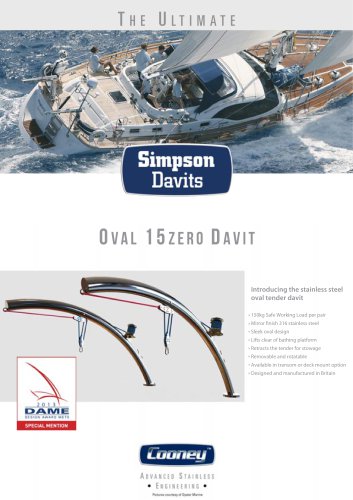 OVAL 15ZERO Davit 2013
2 Pages
 number 38
27 Pages
 Main Display
1 Page
 3D Digitising Fact Sheet
2 Pages
 Laser Cutting Fact Sheet
2 Pages
 Dynamic Waterjet XD
2 Pages
 Series10 Davits 2013
2 Pages
 Cleats & Fairleads
4 Pages
 Product Catalogue 38
27 Pages
 Tender-Ring-Davit-
1 Page
 OVAL-15ZERO-Davi
2 Pages
 CNC TUBE BENDING
2 Pages
 Care of stainless for_marine
2 Pages
 Series-8-Davits
2 Pages
 TraditionalDavits
2 Pages
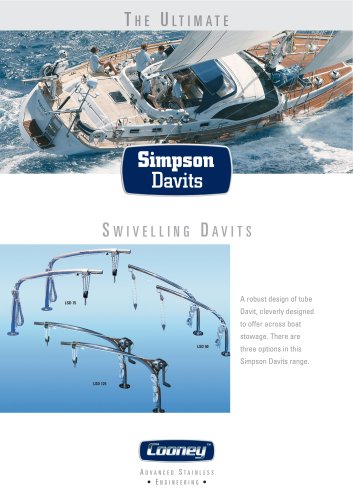 Swivelling-Davits
4 Pages
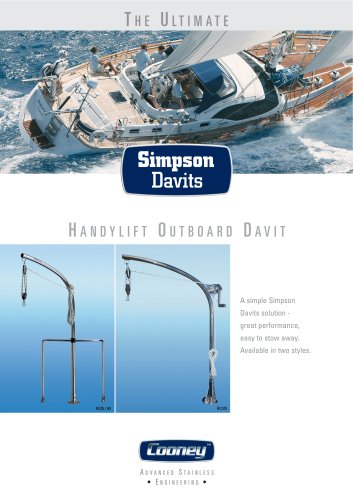 Handylift-Outboard-Davits
2 Pages
 Cobra-Davits
2 Pages
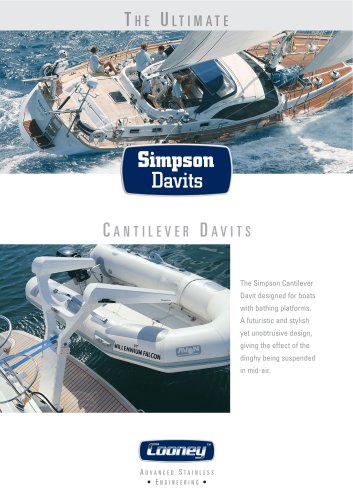 Cantilever-Davits
2 Pages

Archived catalogs
 Catalogue
28 Pages