
- Catalogs
- Cabrinha Kites
- OMEGA user manual


OMEGA user manual

OMEGA user manual
Catalog excerpts

DO NOT USE THIS PRODUCT UNLESS YOU HAVE READ AND UNDERSTAND THESE WARNINGS, CAUTIONS, AND INSTRUCTIONS WHICH ARE FOR YOUR SECURITY AND PROTECTION. THIS INFORMATION MAY BE SUBJECT TO CHANGE AT ANYTIME. FOR CURRENT UPDATES, PLEASE VISIT OUR WEBSITE AT: WWW.CABRINHAKITES.COM IF YOU ARE BELOW THE AGE OF 18, YOU SHOULD HAVE YOUR PARENT OR GUARDIAN READ THESE WARNINGS, CAUTIONS AND INSTRUCTIONS AND SHOULD NOT USE THIS PRODUCT UNLESS YOU ARE UNDER THE PROPER GUIDANCE AND SUPERVISION OF SUCH A PERSON. The use of this product exposes the user to many unavoidable and unexpected risks, dangers and hazards....
Open the catalog to page 3
continued from previous page.. KITESURFING PRACTICE: KITESURFING is an extremely diverse sport, with many disciplines and ability levels. As with all sports, there can be certain inherent risks. The fol- lowing contains key security points to remember when operating your Cabrinha kite. • Kitesurfing is a HAZARDOUS activity and the use of Kitesurf- ing equipment involves the risk of serious personal injury to any part of the user's body or death. • Injuries are an INHERENT RISK of kitesurfing and the par- ticipation in kitesurfing implies the user's acceptance and assumption of those risks. •...
Open the catalog to page 4
4 Wind, Water, & Weather Conditions / Wind Range Chart 5 Know Your Ability Level / Kiteboarding Location KITE OVERVIEW & CONTROL SYSTEM 10 Sprint Inflation System 12 Tips for Securing Your Kite 14 Attaching Control Lines USER MANUAL Area of Operation / Kite Positions, Zones & Power Planning Your Launch Launching & Landing with a Partner Repairs - Tears / Struts Bladders Repairs - Leading Edge Bladders
Open the catalog to page 5
dynamic and fastest growing sports in the for purchasing a Cabrinha kite and welcome to the sport of kiteboarding. is attracting people of all ages from all corners of the globe. It's one of the most CAUTION ■ It can also be overwhelming if not approached in an educated man- ner. That's why we have supplied this extensive user's manual. It will help to educate you about your new kite and about the ways in which to use it. It contains information regarding the setup, care and maintenance of your Omega kite. For information about operation of the kite including how to power up and de-power your...
Open the catalog to page 6
IMPORTANT INFORMATION IMPORTANT INFORMATION KITEBÜARDING is an extremely diverse sport, with many disciplines and ability levels. As with all sports, there are certain inherent risks. The following contains key points to remember when operating your Cabrinha kite. Be familiar with the set up and use of the supplied security systems: OVERRIDE and the Harness Loop Quick Release Make sure your control system is rigged and used according to the supplied instructions. Make sure your kite is compatible with the control system. Always use your Cabrinha kite with a security system. NEVER permanently...
Open the catalog to page 7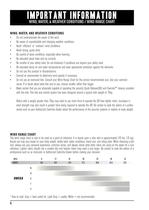
IMPORTANTCONDITIONS / WIND RANGE CHART INFORM A T I O N WIND, WATER, & WEATHER WIND, WATER, AND WEATHER CONDITIONS • Do not underestimate the power of the wind. • Be aware of unpredictable and changing weather conditions. • Avoid “offshore” or “onshore” wind conditions. • Avoid strong, gusty wind. • Be careful of wave conditions, especially when learning. • Be educated about tides and rip currents. • Be mindful of your ability level. Do not kiteboard if conditions are beyond your ability level. • Be educated about air and water temperatures and wear appropriate protection against the elements....
Open the catalog to page 8
IMPORTANT INFORMATION KNOW YOUR ABILITY LEVEL / KITEBOARDIMG LOCATION KNOW YOUR ABILITY LEVEL • Do not attempt kiteboarding without appropriate instruction. • Launch, land, and ride together with a partner or have some- • Make sure you are in good physical condition before using this product. • Practice flying a small, traction kite or a "trainer kite" before flying this kite. • The more time spent on the "trainer kite", the faster you will • Make sure you are a proficient swimmer before using this product in or near the water. • Make sure the wind and water conditions are within your ability...
Open the catalog to page 9
IMPORTANT INFORMATION KITE CARE Due to the often extreme nature of kiteboarding, a thorough approach should be taken when caring for your kite and all its as- sociated rigging, as well as your protective gear. PREPARING FOR YOUR SESSION • Thoroughly check your protective equipment (helmet, etc.) to make sure it is in working order and in good condition. • A frequent inspection of the kite and the control system should be made in order to identify punctures, tears, or abrasions in the canopy, struts, or security systems. It is also necessary to check the fly lines for wear and for unwanted knots,...
Open the catalog to page 10
BEACH ETIQUETTE BEACH ETIQUETTE Here are some basic things to consider when sharing beaches and water accesses with other users: • Follow the instructions outlined in this manual. • Follow the instructions and rules and regulations posted at the beaches you use. • Check with local kiteboarding associations and shops prior to launching in a new area. There may be local rules and regula- tions to follow which are not posted. • Utilize common sense. • Do not touch other people's gear, unless instructed to do so by the owner. Picking up their bars, kites, etc. may disrupt a setup ritual they have....
Open the catalog to page 11
KITE OVERVIEW The Omega kite can tie switched from a 2:1 bridle configuration to a 1:1 bridle configuration. The 2:1 configuration is for use with a 2:1 [pulley] equipped control system. The 1:1 configuration is for use with a 1:1 [no pulley] control system. The kite above is shown in the 2:1 Br i d i I e Configuration
Open the catalog to page 12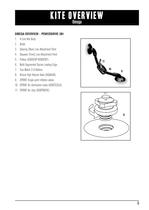
KITE OVERVIEW OMEGA OVERVIEW - POWERDRIVE 2N1 3. Steering (Rear) Line Attachment Point 4. Depower (Front) Line Attachment Point 6. Multi-Segmented Dacron Leading Edge 7. True Match 3-D Battens 8. Airlock High Volume Valve (KS6ALVA) 9. SPRINT Single point inflation valves 10. SPRINT Air distribution tubes (KS6STC0LA)
Open the catalog to page 13All Cabrinha Kites catalogs and brochures
 CATALOG 2020
47 Pages
 Cab Brochure
60 Pages
 2008_Product_Brochure
74 Pages
 2012-2013
60 Pages
 Catalogue 2010
75 Pages
 brochure_2012
74 Pages
 2017
201784 Pages
 2013
201340 Pages
 Catalog 2013-2014
140 Pages
 2015-2016
43 Pages
 2010-2011
47 Pages
 2014-2015 Product catalog
84 Pages
 Cabrinha_Brochure_2011
28 Pages

Archived catalogs
 Switchblade 2
33 Pages
 Contra Bow Kite
33 Pages
 Powerdrive 121
28 Pages
 Powerdrive 221
28 Pages
 Crossbow 2
34 Pages
 Powerdrive 2N1
30 Pages
- Kitesurf kite
- Twin-tip kiteboard
- Surfboard
- Freeride kiteboard
- C-shape kitesurf kite
- Freestyle kiteboard
- Freeride kitesurf kite
- Watersports helmet
- Intermediate surfboard
- Wave kiteboard
- Nautical leash
- Hand air pump
- Inflatable air wing
- Adult helmet
- Kitesurf bar
- Wakeboard binding
- Wing foil board
- Hybrid inflatable air wing
- Freestyle kitesurf kite