
- Catalogs
- Bonomi srl
- TDS TAM Injection


TDS TAM Injection
TDS TAM Injection
Document Overview
This technical document appears to be a standard or guideline related to welding procedures and qualifications, dated around 2011. It covers specifications, procedures, and requirements for welding operations, including qualifications of personnel and equipment.
1. Scope and Purpose
The document defines the scope of welding operations, focusing on the qualification of welding procedures and personnel. It aims to ensure quality and safety in welding through standardized testing and certification processes.
2. Welding Procedure Specifications (WPS)
It outlines the requirements for developing and qualifying welding procedure specifications. This includes parameters such as welding technique, materials, thickness ranges, and acceptable welding positions. The document emphasizes the importance of adhering to these specifications to maintain weld integrity.
3. Qualification of Welders and Operators
There are detailed provisions for the qualification of welders and welding operators. This includes testing methods, performance standards, and certification validity periods. The document specifies that welders must demonstrate proficiency in specific welding processes and positions to be certified.
4. Testing and Inspection
The document describes the types of tests required to qualify welding procedures and personnel, including destructive and non-destructive testing methods. It highlights the importance of maintaining records of test results and certifications.
5. Equipment and Materials
Specifications for welding equipment and consumables are included to ensure compatibility and quality. The document stresses the need for proper maintenance and calibration of welding machines.
6. Standards and References
The document references international and national standards relevant to welding practices, such as ISO and other recognized codes. It encourages compliance with these standards to ensure consistency and reliability.
7. Recommendations and Best Practices
Best practices for welding operations are recommended, including safety measures, environmental considerations, and quality control procedures. The document suggests continuous training and evaluation to maintain high standards.
8. Summary of Key Parameters
- Welding process types and classifications
- Qualification test ranges (material thickness, welding positions)
- Certification validity and renewal procedures
- Equipment maintenance and calibration requirements
- Documentation and record-keeping standards
Note: The original document contains tables and coded data related to welding parameters and classifications, which are essential for detailed application but are summarized here for clarity.
Catalog excerpts
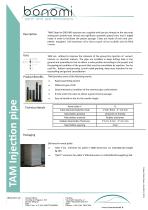
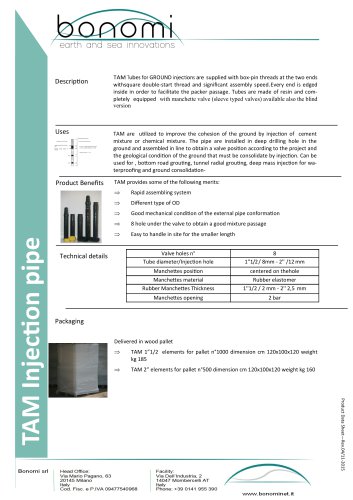
TAM Tubes for GROUND injections are supplied with box-pin threads at the two ends withsquare double-start thread and significant assembly speed.Every end is edged inside in order to facilitate the packer passage. Tubes are made of resin and completely equipped with manchette valve (sleeve typed valves) available also the blind version TAM are ufilized to improve the cohesion of the ground by injecfion of cement mixture or chemical mixture. The pipe are installed in deep drilling hole in the ground and assembled in line to obtain a valve posifion according to the project and the geological condifion of the ground that must be consolidate by injecfion. Can be used for, bottom road groufing, tunnel radial groufing, deep mass injecfion for waterproofing and ground consolidafion- Product Benefits TAM provides some of the following merits: ^ Rapid assembling system ^ Good mechanical condifion of the external pipe conformafion ^ 8 hole under the valve to obtain a good mixture passage ^ Easy to handle in site for the smaller length TAM Injection pipe Technical details Delivered in wood pallet ^ TAM l"l/2 elements for pallet n°1000 dimension cm 120x100x120 weight kg 185 ^ TAM 2" elements for pallet n°500 dimension cm 120x100x120 weight kg 160 Head Office
Open the catalog to page 1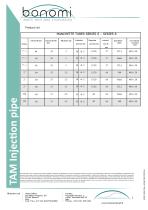
Product List TAM Injection pipe MANCHETTE TUBES SERIES S - SERIES R The information, and, in particular the recommendations relating to the application and end-use of Bonomi products, are given in good faith based on Bonomi's current knowledge and experience of the products when properly stored, handled and applied under normal conditions in accordance with Bonomi's recommendations. In practice, the difference in material, substrates and actual site conditions are such that no warranty in respect of merchantability or of fitness for a particular purpose, nor any liability arising out of any legal...
Open the catalog to page 2All Bonomi srl catalogs and brochures
 TDS packer
1 Page
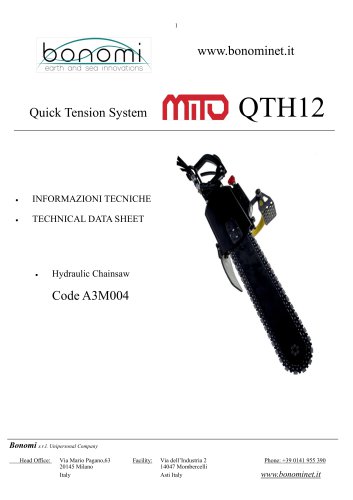 MITO QTH 12
11 Pages
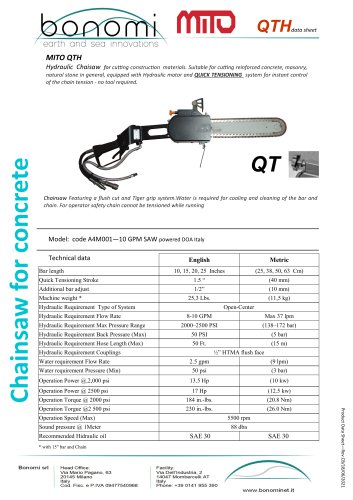 TDS MITO QTH 8-10 gpm
1 Page
 2026 Price List
1 Page
 Joy Product Catalogue 2024
29 Pages
Archived catalogs
 JOY CLEAT FLYERS
2 Pages
 Mets magazine 2022
1 Page
 Ibi magazine 2022
1 Page
 Drawing of B1A241H
1 Page
 B3C121H LOWER PLATE
1 Page
 OUR PHILOSOPHY
1 Page


