

m-Series Battery Switch, Single Circuit ON-OFF on

m-Series Battery Switch, Single Circuit ON-OFF on
This document provides an overview of Blue Sea Systems' products, focusing on power conversion, battery management, circuit protection, connectors, insulators, power distribution, and monitoring systems. It highlights specifications, features, and applications for marine and rugged environments.
The PACIFIC SERIES Battery Chargers are multi-stage chargers with a rugged aluminum case, designed to meet global electrical requirements. They feature Battery Specific Charging (BSC) and integrate with Automatic Charging Relays, including a remote display for setup and monitoring.
Includes manual and remote battery switches, battery management panels, and automatic charging relays. The ML-Series Remote Battery Switches offer 500A switching and can be controlled with SPST or SPDT switches.
Covers circuit breakers, fuses, and fuse holders. The SMS Surface Mount System provides waterproof enclosures for large frame circuit breakers, and the ST-Blade Fuse Block consolidates and insulates multiple branch circuits.
Includes BusBars, terminal blocks, and insulators for secure and efficient power distribution. The MaxiBus Common BusBar features press-fit studs to eliminate loose connections.
Products like the WeatherDeck™ Waterproof Panel and the Custom AC/DC 360 Panel are designed for harsh environments, offering reliable power distribution solutions.
The Vessel Systems Monitor (VSM 422) provides comprehensive monitoring of AC, DC, tanks, and bilge systems. Digital and analog meters are available for various applications.
Includes toggle switches, socket-plug systems, lockout slides, and labels to enhance system functionality and safety.
Contains discussions on DC and AC systems, marketing materials, and merchandising plans.
Highlights new additions like the PACIFIC SERIES Battery Chargers and DeckHand Dimmers, designed to improve boating safety and experience.
Universal line voltage of 90-265V AC 50/60 Hz allows global usage. Power factor correction ensures efficient charging, and MOSFET output prevents voltage differences between batteries.
Rugged, finned aluminum case for optimal heat dissipation, integrated drip-proof design compliant with ABYC standards, and conformal coated circuit boards for durability.
Supports charging for up to three battery banks with user-selectable charge profiles for various battery types. Features battery temperature compensation and a Battery Health Mode for extended storage.
Ignition protected for safe mounting in gasoline-powered boat engine compartments, with protection against over/under temperature, overheating, DC over voltage, AC reverse polarity, surge, and short circuits.
Large, bright backlit display showing charge current, voltage, and cycle for each battery. Optional remote display available for convenient monitoring.
Five-year warranty with Blue Sea Systems support.
Part numbers 7521, 7522, 7523 with maximum output currents of 20A, 40A, and 60A respectively. Nominal voltage of 12V DC with three outputs and maximum output voltage of 15.9V DC.
Compliant with UL 1236 marine, E marked, CSA C22.2 No. 107.2-01 standards, and ABYC A-31 standards.
Controls dimming of non-regulated LEDs, incandescent, and halogen lights with memory for last setting. Provides continuous pulse width modulation control and includes a bulb saver feature.
Manual and remote battery switches for managing single or multiple battery banks. SafetyHub 250 Fuse Block combines battery switch with remote control and ignition-protected fusing.
References compliance with UL 1500 and SAE J1171 standards, ensuring external ignition protection. IP66 protection indicates resistance against powerful water jets.
AFD protects alternator diodes if the switch is turned off while the engine is running. An LED can indicate the battery switch status.
Various panel systems are described, including the 360 Panel System and Traditional Metal Panels, each with specific configurations of battery switches, circuit breakers, and LED indicators.
Details features of battery switches and circuit breakers, such as high-amp load protection, emergency cross-connect capabilities, and protection against voltage sags and spikes.
Specifications for solenoid switches and remote battery switches are provided, including cranking ratings, continuous ratings, and switching cycles.
ACRs manage charging between two battery banks, combining them when charging and isolating them when not.
Tables provide information on wire sizes and their corresponding current ratings for different cranking and continuous scenarios.
Emphasizes compliance with various standards, including UL, SAE, and ISO, ensuring safety and reliability in marine applications.
Provides detailed information on battery management systems, focusing on Automatic Charging Relays (ACRs) and related components by Blue Sea Systems.
- Battery Isolators: Allow current to flow to the battery but not from it, using diodes that cause a voltage drop.
- Automatic Charging Relays (ACRs): Automatically combine batteries during charging and isolate them during discharging or engine starting.
- Specifications: Lists detailed specifications for different ACR models.
- Features: Key features of the ACRs include high amperage contacts, remote control capabilities, manual override options, and start isolation configurations.
- Regulatory Compliance: Products meet various standards such as ISO 8846, UL 1500, and SAE J1171 for ignition protection.
- Diagrams and Illustrations: Includes diagrams illustrating battery configurations and the operation of ACRs in different scenarios.
Serves as a comprehensive guide for selecting and understanding the operation of Blue Sea Systems' battery management products.
Provides detailed specifications for various electrical components, including manual control options, nominal voltage ratings, cranking ratings, intermittent and continuous ratings, amperage operating currents, switching cycles, coil functions, control switch inclusions, control circuit connections, mounting options, terminal stud sizes and lengths, maximum terminal stud torque, cable sizes, terminal ring diameter clearance, dimensions (width, height, depth), weight, ignition protection standards, and ingress protection ratings.
Emphasizes the importance of circuit protection in electrical systems, particularly in marine environments.
Recommends using circuit breakers for situations where resetting is preferable to replacing the device after a fault.
Details various circuit breakers and fuse blocks, including push button reset-only circuit breakers, medium duty push button reset-only circuit breakers, 285-Series and 187-Series circuit breakers, and SafetyHub fuse blocks.
Tables provide specific data on electrical ratings, dimensions, and regulatory compliance for different models of circuit breakers and fuse blocks.
Outlines the specifications for various circuit breakers, including A-Series Toggle, Rocker, and C-Series Toggle Circuit Breakers.
Circuit breakers combine switching and protection in a single device.
Provides details on mounting panels and screws.
Circuit breakers meet various international standards.
Emphasizes the importance of using Ground Fault Circuit Interrupters (GFCIs) and Equipment Leakage Circuit Interrupters (ELCIs) to prevent electrical hazards.
Provides a comprehensive analysis of electrical safety devices used in marine environments.
RCBOs offer overcurrent protection similar to standard circuit breakers.
Emphasizes the importance of installing ELCIs to mitigate risks associated with shore power connections.
Highlights the dangers of faulty grounds and ground faults.
References ABYC regulations, which require the use of GFCIs in specific environments.
Details the features of various circuit breakers.
Tables provide detailed specifications for different models of GFCI and ELCI circuit breakers.
Various fuse blocks and holders are detailed, each with specific amperage and voltage ratings.
Many products include features like weatherproofing, easy access to fuses, and compliance with ABYC/USCG insulation requirements.
Fuses are sold separately and should be selected based on the specific amperage and voltage requirements of the application.
Includes diagrams illustrating the application of fuse blocks in various circuit configurations.
Ensure the correct fuse type and rating are used to prevent electrical failures.
Details specifications for various fuse blocks including AMI® or MIDI® and ATO® or ATC® types.
Combines a fuse block with a remote battery switch, suitable for gasoline-powered boats.
Compares different fuse types and their specifications.
Various busbars are described, including MiniBus, DualBus, and MaxiBus.
Connectors allow wire termination from multi-conductor cables.
Products are designed for high electrical contact and efficiency.
Outlines various specifications for electrical components used in marine applications.
Provides detailed instructions on the use of terminal blocks, terminal block jumpers, and various types of cable connectors.
Several products are described, including PowerBar Common BusBars, Terminal Feed Through Connectors, and CableClams.
Recommendations include using specific products for certain applications.
Contains tables listing product part numbers, descriptions, specifications, and weights.
Describes various panel systems, including the 360 Panel System and WeatherDeck™ Waterproof Panels.
Serves as a comprehensive guide for selecting and using electrical components in marine environments.
Maximum Operating Voltage: 24 Volts DC.
Maximum Operating Voltage: 12 Volts DC.
IP67—protected against immersion up to 1 meter for 30 minutes.
Designed for open-cockpit and flybridge applications.
Various models with specific dimensions and weights provided for circuit breakers and fuses.
Rugged design for wet environments.
Open frame allows future replacement or upgrade of panel modules.
Styled to match existing panels.
A-Series Circuit Breakers, Push Button Reset-Only Circuit Breakers, ON-OFF, SPST Rocker Switches.
ON-indicating LEDs in all circuit positions.
Provides detailed specifications and features of various AC Source Selection Circuit Breaker Panels and Rotary Switch Panels used in marine power distribution systems.
- Allow selection between two or three AC sources to supply power to the AC Branch distribution system.
- Heavy-duty industrial-rated switches provide a compact solution for managing AC sources.
- Reduce the risk of fire and shock hazards caused by defects in boat appliances and circuit wiring.
- Provide source selection and circuit protection for boats with 240 Volt AC systems.
- A-Series Circuit Breakers, AC Analog and Digital Meters, and various label sets are referenced throughout the document for specific panel configurations.
Provides detailed specifications for various panel systems, including weight, style, total AC and DC positions, circuit breakers, voltage, and dimensions.
Instructions for designing and ordering custom panels are outlined.
Mentions the inclusion of insulating covers, backlit label positions, and circuit identification label sets as standard features.
Key features include ON indicating LEDs, toggle switches for monitoring multiple batteries, and comprehensive monitoring capabilities with the Vessel Systems Monitor VSM 422.
Tables and diagrams provide measurements for panel dimensions, weight, and meter specifications.
Emphasizes the importance of monitoring onboard systems for safety and efficiency.
Provides detailed specifications and features of various analog and digital meters used for monitoring AC and DC electrical systems.
Each meter type is described with its specific measurement range, resolution, accuracy, and connection requirements.
Outlines various mounting options for the meters.
Many meters include programmable sleep modes, audio/visual alarms for high and low voltage, and are designed to be splash-proof.
Provides general specifications for display character size, input voltage, power consumption, and regulatory compliance.
Serves as a comprehensive guide for selecting and installing various electrical monitoring meters.
AC Amperes (Current): 0.01–400 Amps.
For use with AC Ammeters.
For use with DC Ammeters.
Blue Sea Systems offers a range of accessories for deck panels and custom panel labels.
12 to 24 Volt Conversion Kit for indicator LEDs.
Available in single and double pole configurations.
Water Resistant, suitable for Blue Sea Systems panels.
Provides detailed specifications and descriptions for various electrical components and accessories used in circuit breaker panels and related systems.
Outlines specifications for toggle and push button switches.
Describes various components such as toggle circuit breakers, push button reset-only circuit breaker adapters, and circuit breaker mounting screws.
Instructions for mounting various components are provided.
Blue Sea Systems offers a range of labels for panel identification.
Highlights features such as corrosion-resistant materials, twist-lock systems for plugs and sockets, and reverse polarity protection for label backlight systems.
Suitable for various applications, including generator starters, bilge pumps, horns, wipers, engine controls, and other systems requiring specific switching actions or pole configurations.
Outlines the specifications for wire and circuit protection, emphasizing the importance of cooling for wires and the impact of bundling wires in cables or conduits.
Provides ratings for Total Connected Battery Cold Cranking Amperes (CCA) and Ampere Interrupt Capacity (AIC) for different voltage systems.
A detailed table lists the ampacity ratings for wires at different temperature ratings.
Includes a wire selection chart based on current flow, circuit type, and length.
Guidelines for selecting the appropriate fuse and fuse holder are provided.
Describes the purpose of AC main power distribution systems.
Three common AC systems used on boats are discussed.
Catalog excerpts

Power Conversion Battery Chargers and Remote Display 8-10 DeckHand Dimmers Battery Management Manual Battery Switches Battery Management Panels Remote Battery Management Circuit Protectioi Circuit Breakers Fuse Holders and Blocks Terminal Feed Through Connectors 64 PowerPost Cable Connectors 65 WeatherDeck™ Waterproof Contura Switch Water Resistant Traditional Metal DC Branch Circuit Breaker AC Branch Circuit Breaker AC Main Circuit Breaker AC Source Selection Circuit Breaker AC Source Selection Rotary Switch AC RCBO, GFCI, ELCI Circuit Breaker AC/DC Combination Circuit Breaker Custom 360 Panel System Analog Meters and Panels Digital Meters and Panels Mounting Panels Vessel Systems Monitor VSM 422 2 Inch Round Gauges and Panels Mini Clamp Multimeter Shunts and Current Transformers WeatherDeck™ Toggle Switches 110 Water Resistant Contura Switches 111 12 Volt Socket-plug System 113 Protect Your Boat Marketing Materials Merchandising Plans Quick Reference page 54 page 55 page 55 page 64 page 64 page 65 page 67 pages 70-71 pages 72-73 pages 86-87 pages 86-87 pages 86-87 page 76 page 82 page 84 ) 96 pages 97-98 pages 99-100 pages 102-103 page 104 page page 108 page 110 page 111 page 112
Open the catalog to page 1
Blue Sea Systems Products on Water or Land In addition to the marine industry, Blue Sea Systems products can be found on emergency vehicles, RVs, agricultural equipment, off-road vehicles, and other industries where rugged, dependable products Rating Symbols Shown in This Catalog: Amperage Continuous Rating Ampérage continu Amperaje continuo Amperaggio continuo IlO ■ Amperage Cranking Rating (10 Seconds) Ampérage au lancement (10 secondes) Amperaje de potencia de rotación (10 segundos) Amperaggio alla rotazione del motorino di avviamento (10 secondi) 160 ■ Amperage Cranking Rating (1 Minute)...
Open the catalog to page 2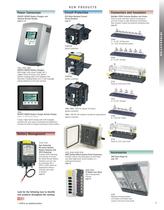
Power Conversion PACIFIC SERIES Battery Chargers and Optional Remote Display Circuit Prot ELCI Main Residual Current Circuit Breakers Ignition protected PACIFIC SERIES Battery Chargers Multi-stage, three output charger with a rugged, finned aluminum case, Battery Specific Charging (BSC) that integrates with Automatic Charging Relays, and a multi-language display. Backed by a five year warranty Ignition protected MaxiBus 250A Common BusBars and Covers Press fit studs eliminate need for securing nut and risk of loose or high resistance connections. New compact models and optional Insulating cover....
Open the catalog to page 3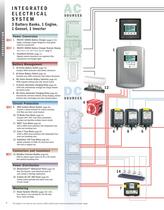
3 Battery Banks, 1 Engine, Power Conversion EEiW 1. PACIFIC SERIES Battery Charger (pages 8-10) Digital, multistage charger designed to meet global electrical requirements EE W 2. PACIFIC SERIES Battery Charger Remote Display Mounted in the 360 Panel System (page 9) 3. DeckHand Dimmer (page 11) Digitally controls dimming of non-regulated LEDs, incandescent and halogen lights oaiiery ivianaj 4. m-Series Battery Switch (page 15) Compact 300A continuous rated battery disconnect e-Series Battery Switch (page 16) Standard case 350A continuous rated battery disconnect ML-Series Remote Battery Switches...
Open the catalog to page 4
AC 9 AC LOADS 17 15 16 Microwave Refrigerator 3 DC DC LOADS Horn LEGEND Power AC Power DC Monitor and Control Ground Running Lights 10 Cabin Lights 13 GPS VHF Stereo 5 Windlass 11 Bow Thruster 5 INTRODUCTION Outlets
Open the catalog to page 5
Select ENGLISH Selezionare ITALIANO Escoge ESPAÑOL CHARGtNG BULK ABSORB FLOAT EQUALIZE
Open the catalog to page 6
ower Conversion For over two decades Blue Sea Systems has designed and manufactured products that operate Detween the source of power and the load. These products switch, protect, distribute and monitor Doth AC and DC systems. Drawing on experience gained from design, manufacturing, and bustomer service, Blue Sea Systems is introducing power conversion products, beginning with pimmers and battery chargers. Dimmers have been part of the product offering over the years, but advances in LED and halogen lighting have emphasized the need fora new and more versatile dimmer. DeckHand Dimmers add new...
Open the catalog to page 7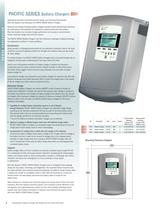
PACIFIC SERIES Battery Chargers EE Applying two decades of electrical product design and manufacturing expertise, Blue Sea Systems has developed the PACIFIC SERIES Battery Chargers. Research and testing of existing battery chargers revealed several shortcomings Impacting the performance, and ultimately the experience, customers had with their product. Blue Sea Systems has Improved charger performance by focusing on environmental factors, electronic design, and technical support. The PACIFIC SERIES Battery Chargers, with their advanced multistage charging technology, are engineered to perform...
Open the catalog to page 8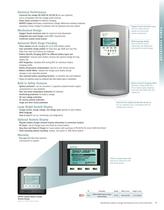
Electrical Performance ■ Universal line voltage 90-265V AC 50/60 Hz for use anywhere, and is compatible with low voltage power sources ■ Power factor corrected for efficient charging ■ MOSFET output eliminates unintentional voltage differences between batteries providing a faster charge for batteries with the greatest amp-hour deficit Mechanical Design ■ Rugged, finned aluminum case for maximum heat dissipation ■ Integrated drip proof design meets ABYC requirements ■ Conformai coated circuit boards Advanced Multi Stage Charging ■ Three outputs provide charging for up to three battery banks ■...
Open the catalog to page 9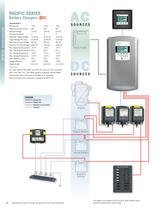
PACIFIC SERIES Part Number Maximum Output Current Nominal Voltage Maximum Output Voltage Output Voltage Accuracy Minimum AC Input Voltage Maximum AC Input Voltage UL 1236 marine, CC marked and CSA C22.2 No. 107.2-01 standards SAE 1455, SAE J1171, ISO 8846 (ignition protection) specific NMEA requirements and all elements of the ABYC A-31 standards. Wire terminations and enclosure is compliant to ABYC A-31 Shore Power 10 Specifications subject to change. See bluesea.com for current information. This diagram is for reference only. Consult an ABYC certified marine electrical professional for system...
Open the catalog to page 10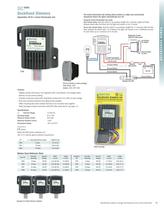
DeckHand Dimmers Adjustable off for a timed illuminated exit The timed illuminated exit setting allows boaters to safely and conveniently disembark before the lights automatically turn off. Using the timed illuminated exit mode One minute delay: Hold the switch in up position (bright) for 2 seconds. Lights will flash Release switch after first flash and the lights will remain on for 1 minute. Two to five minute delay: Hold the switch In up position (bright) for 1-4 seconds after the first flash. Release the switch after 2 to 5 flashes.The lights will remain on for 1 additional minute for each...
Open the catalog to page 11All Blue Sea catalogs and brochures
 BLUE SEA SYSTEMS 2017
164 Pages
 BLUE SEA SYSTEMS
156 Pages
 Blue sea system 2014
134 Pages
 ML Solenoid
2 Pages
 ML-ACR Automatic
2 Pages
 BatteryLink?
2 Pages
 Deckhand Dimmer
1 Page
 P12 Battery Charger
4 Pages
 Battery boxes
2 Pages
- Boat indicator
- Analog indicator
- Boat monitoring and control panel
- Boat switch
- Boat charger
- Boat switch panel
- Digital indicator
- Electrical circuit switch
- Current switch panel
- Boat selector
- Tank indicator
- Current selector
- Waterproof switch panel
- Selector battery switch
- Boat circuit breaker
- Smart charger
- Boat relay
- Female electrical plug
- Battery charge controller