

Blue sea system 2014

Blue sea system 2014
The P12 Battery Charger LED Remote is designed to indicate the battery charger's stage and control basic functions. It features several LED indicators and control buttons for user interaction.
LED Indicators:
- Charging LED: A green light confirms charging.
- Charge Stage: Displays the current charging stage.
- Equalize LED: Indicates when the charger is in equalization mode.
- Fan Mode: Shows the internal fan mode of the charger.
- Charge Output: Displays the percentage of output current for each battery and indicates maximum output settings.
- Alert: Icon LEDs provide warning and alert status for diagnostics.
Control Buttons:
- Fan: Allows user-adjustable settings.
- Dim/Alarm: Adjusts LED brightness and silences alarms.
- Output: Adjusts charger output to accommodate AC source limitations.
- Power: Puts the charger into standby mode.
Mounting Options: The device can be mounted using a 360 Panel system.
DeckHand Dimmers control the dimming of non-regulated LED, incandescent, and halogen lights. They feature an illuminated exit with adjustable time delay, support multiple switch locations, and have a memory for the last dimmer setting.
Specifications:
- Nominal Voltage: Varies by model.
- Operating Range: Varies by model.
- Maximum Output Current: Varies by model.
- Maximum Parasitic Current: Less than 2mA.
- Temperature Rating: -40°C to 85°C.
Regulatory Compliance: E marked, meets ISO 8846 and SAE J1171 requirements.
Battery management is crucial for safe boat or vehicle operation. Blue Sea Systems offers a range of battery switches and automatic charging relays (ACRs) to manage large battery banks efficiently.
Key Features:
- Manual Battery Switches: Isolate battery energy during non-use or emergencies.
- Automatic Charging Relays (ACRs): Automatically combine batteries during charging and isolate them during discharging.
- Low Voltage Disconnect (m-LVD): Saves battery power for engine starting by disconnecting non-essential loads.
Regulatory Compliance: E marked, UL Listed, meets ABYC and SAE J1171 requirements.
The document provides detailed specifications and features of various battery management panels and related components. It includes information on battery switches, circuit breakers, and automatic charging relays, focusing on their specifications, features, and regulatory compliance.
The document lists several battery switches with varying voltage capacities (12V, 24V, 32V, 48V DC) and dimensions. It also details the cranking, intermittent, and continuous ratings for different wire sizes, emphasizing the importance of selecting the appropriate wire size for specific current ratings.
Key features of the battery management panels include the ability to isolate engine circuits from house circuits, emergency cross-connect between isolated battery banks, and protection of electronics from voltage sags and spikes. The panels also provide 24-hour circuit protection and include ON indicating LEDs and spare apertures for additional circuit breakers.
The document references various components such as m-Series and e-Series battery switches, C-Series flat rocker circuit breakers, and push-button reset-only circuit breakers. It also mentions the inclusion of a square format label set for circuit identification.
The products meet UL 1500 and SAE J1171 external ignition protection requirements, ensuring safety and reliability in marine and automotive applications.
The document explains the operation of automatic charging relays, which manage the charging of multiple battery banks from a single source. ACRs are preferred over battery isolators due to their lower voltage drop and ability to fully charge batteries.
Additional related products include solenoid switches, remote control switches, and low voltage disconnects. The document highlights features such as manual override knobs, LED outputs for switch state indication, and integrated coil control to minimize heating and amperage draw.
The document provides comprehensive technical details on battery management systems, emphasizing the importance of proper component selection and installation to ensure efficient and safe operation in various applications.
The document outlines the specifications for various Automatic Charging Relays (ACRs) and related battery management products. Key specifications include:
- Operating current for combined and open states, with values such as 90mA and 15mA respectively.
- Nominal voltage options of 12V and 24V DC.
- Cable size requirements, with a minimum of 6 AWG and a maximum of 1/0 AWG.
- Terminal stud size and length specifications.
- Relay contact positions with specific voltage requirements for different durations.
- Over and under voltage lockout and recovery thresholds.
The document describes the operational procedures and features of the ACRs:
- Automatic combination of batteries during charging and isolation during discharging and engine starting.
- Optional start isolation to protect sensitive electronics during engine cranking.
- Remote LED indication of ACR states.
- Integrated LED for status indication and quick connect terminals for optional features.
The products meet various regulatory standards, including:
- E marked and ISO 8846 compliance.
- SAE J1171 external ignition protection requirements.
- IP67 rating for protection against immersion up to 1 meter for 30 minutes.
The document suggests:
- Using ACRs to prevent battery discharge and ensure reliable engine starting.
- Adding a second battery to avoid being stranded due to a dead starting battery.
- Choosing the right ACR based on continuous and intermittent ratings above the maximum alternator output and auxiliary battery load.
The document references related products such as battery switches, toggle switches, and LEDs, providing page numbers for additional information.
- ATM® Fuses: Mini blade-type fuses with amperage ratings ranging from 5A to 30A. They feature tin-plated connector blades for corrosion resistance and have an interrupting capacity of 1,000A at a maximum operating voltage of 32V DC.
- easyID™ ATC® Fuses: These fuses use LED technology to indicate when a fuse has blown. They are available in amperage ratings from 3A to 40A and have similar specifications to ATM® fuses.
- MEGA® or AMG® Fuses: Designed for 100 to 300 Amp circuit protection, these fuses are economical and suitable for high-current applications.
- Class T Fuses: These fuses offer high interrupt capacity for large battery banks, including Lithium-Ion and TPPL batteries, with amperage ratings from 35A to 225A.
- ANL Fuses: Suitable for 35–750 Amp loads, these fuses provide robust protection for high-current circuits.
- MAXI™ Fuse Block: Designed for 30–80 Amps, it features screw termination that accepts a variety of wire sizes and provides a consolidated location for fuses.
- ST Blade Fuse Blocks: These blocks offer a space-saving solution for adding circuit protection and are available in configurations for 6 or 12 circuits.
- Terminal Fuse Blocks: Marine Rated Battery Fuse (MRBF) blocks are designed for space-saving and ignition protection, suitable for 30 to 300 Amp loads.
- Safety Fuse Blocks: These blocks are ignition protected and suitable for use on gasoline-powered boats, with a maximum operating voltage of 32V DC.
- Many fuses and blocks feature visible indication of blown condition and corrosion-resistant materials.
- Several products meet SAE J1171 external ignition protection requirements and are rated IP66 for protection against powerful water jets.
- Specifications are subject to change, and users are advised to check the manufacturer's website for the most current information.
1. The document outlines various fuse blocks and their specifications, including MEGA®, AMG®, AMI®, MIDI®, ATO®, and ATC® fuses.
2. Terminal stud sizes and mounting options are specified for different parts, with details on the materials used, such as tin-plated copper and stainless steel for corrosion resistance.
3. The fuse blocks are designed to meet regulatory standards like SAE J1171 and ISO 8846, ensuring ignition protection and water resistance (IP66 rating).
Product Descriptions:
1. SafetyHub Fuse Blocks: These blocks consolidate multiple circuits and are ignition protected, suitable for gasoline-powered boats. They feature integrated connecting plugs to reduce wiring complexity.
2. ANL and Class T Fuse Blocks: These blocks support a wide range of amperages and are designed for fast-acting circuit protection.
3. SafetyHub 100, 150, and 250: These models offer different configurations for circuit consolidation and include features like remote battery switches and integrated negative buses.
Regulatory Compliance:
1. Products meet various standards, including SAE J1171 for external ignition protection and ISO 8846 for marine applications.
2. IP66 rating ensures protection against powerful water jets, making these products suitable for harsh marine environments.
Applications and Use Cases:
1. The fuse blocks are used in marine applications, particularly on gasoline-powered boats, to protect high-amp loads and consolidate circuits.
2. They are suitable for main or branch circuit protection, with specific models designed for use with electronic equipment and inverters.
Additional Features:
1. Insulating covers meet ABYC/USCG requirements, and cover breakouts allow wire access in any direction.
2. The design includes features like insert molded studs for secure mounting and storage space for spare fuses.
Product Comparisons:
1. The document provides a comparison of different fuse blocks, highlighting their maximum voltage, amperage range, and regulatory compliance.
2. It also compares in-line fuse holders and their compatibility with various fuse types.
- Designed to protect push button circuit breakers in wet environments.
- Features include incorporation into waterproof panels and replacement of dress nut mounting.
- Specifications: Nickel-Plated Brass thread material, 3/8"-27 thread, IP67 rating for water immersion protection.
- Compact surface mount solution with secure screw termination.
- Features quick connect clips, tin-plated copper busses, and clear insulating cover.
- Specifications include a maximum operating voltage of 32V DC and amperage up to 100A per block.
- Provides circuit protection for 15 to 60 Amp loads.
- Features weatherproof design and trip-free operation.
- Specifications include interrupting capacity of 5,000A @ 32V DC and 3,000A @ 120V AC.
- Medium duty circuit protection for 25 to 150 Amp loads.
- Features visible reset lever and trip-free design.
- Specifications include a maximum operating voltage of 48V DC and IP67 rating.
- Heavy duty circuit protection for 25 to 200 Amp loads.
- Features single lever operation and trip-free design.
- Specifications include a maximum operating voltage of 48V DC and IP66 rating.
- Combines switching and circuit protection into a single device.
- Available in single and double pole configurations.
- Specifications include a maximum operating voltage of 65V DC / 250V AC and magnetic hydraulic trip-free type.
- Products meet various regulatory standards including UL 1077, SAE J1171, and IP ratings for water protection.
- Interrupting Capacity: 5,000 Amps for AC circuit breakers.
- Temperature Range: Operating temperatures from -35°C to 66°C.
- Switching Cycles: 10,000 cycles at rated amperage and voltage.
- Type: Magnetic Hydraulic—Trip free.
- Mounting: Uses #6-32 stainless steel screws with a recommended torque of 6–8 in-lb.
- UL 1077, UL 943 Class A, and UL 1500 certifications for various models.
- AC and AC/DC circuit breakers are E marked.
- ELCI Main and GFCI Branch circuit breakers available in different series (A-Series, C-Series) with varying voltage and amperage ratings.
- Models include options for 120V, 230V, and 240V applications, with leakage trip settings of 5mA or 30mA.
- SMS Surface Mount System designed for ELCI Main circuit breakers, featuring glass-filled polycarbonate bases and clear covers for easy status viewing.
- Includes waterproof glands and stainless steel mounting hardware.
- Enclosures are IP66 rated, providing protection against powerful water jets.
- Green LEDs for backlighting and ON indication, with red LEDs for reverse polarity indication.
- Various panel configurations available, accommodating different circuit breaker setups.
- Contura switches designed for use in water-resistant panels, offering vibration, shock, and moisture resistance.
- Available in different styles and configurations, including dimmer switches for deck lighting control.
1. Continuous Rating: 130A AC/150A DC
2. Voltage Max. Operating: 300V AC/48V DC
3. Mounting Holes: Accepts #10 (M5) Screws
4. Bus Material: Tin-Plated Copper CDA 110/UNS C11000
5. Regulatory: E Certified
Product Overview
This document provides detailed specifications and descriptions for various electrical components such as BusBars, Terminal Blocks, and Cable Connectors used in electrical systems. These components are essential for ensuring reliable and efficient electrical connections in various applications, including marine environments.
Key Components
- BusBars: Available in different amperage ratings (e.g., 150A, 250A, 600A) and configurations, these are used for distributing electrical power efficiently. They come with optional insulating covers and are made from tin-plated copper for durability.
- Terminal Blocks: These are used to isolate circuits and can be combined using Terminal Block Jumpers to create common circuits. They are fully insulated to prevent power leakage.
- Cable Connectors: Designed to connect high amperage cables securely, these connectors include insulators and are rated for IP66 protection against water jets.
Mounting and Installation
Components are designed with specific mounting hole sizes to accommodate standard screws, ensuring secure installation. The document provides detailed dimensions for each component to assist in proper installation and integration into existing systems.
Regulatory Compliance
All components are E Certified, ensuring they meet industry standards for safety and performance. The insulating covers meet ABYC insulation requirements, providing additional safety in marine applications.
Additional Features
Some components include features like insulating covers with breakouts for easy wire access, and stainless steel studs for enhanced durability. The document also highlights related products and compatible enclosures for comprehensive system integration.
The document outlines specifications for various marine electrical components, including ring and gasket materials made from UV-stabilized thermoplastic and Buna-N rubber, respectively. Mounting holes are designed to accept specific sizes of stainless steel screws.
Product Features:
The document describes CableClams with stainless steel dress caps, which provide waterproof side entries for antenna cables without removing factory-installed connectors. These products are available in different part numbers, each supporting specific maximum connector and cable diameters.
Panel Systems:
Blue Sea Systems offers a range of panel systems, including WeatherDeck® Waterproof Panels, Contura Switch Water Resistant Panels, and the 360 Panel System. Each system is designed for specific applications, such as wet environments or open-cockpit installations, and offers features like LED indicators, circuit protection, and customizable configurations.
WeatherDeck® Panels:
These panels are designed for extreme weather conditions and are available in switch-only, fuse, and circuit breaker models. They feature bicolored LEDs for circuit status indication and can be mounted in multiple orientations.
Contura Switch Panels:
Designed for wet environments, these panels use industry-standard Contura switches and are available in various configurations. They offer features like watertight mounting gaskets and LED indicators.
360 Panel System:
This system provides an open frame for mounting a broad selection of modules, allowing for future upgrades and customization. It supports both DC and AC circuits and offers unmatched design flexibility.
Key Features and Benefits:
- Waterproof and weather-resistant designs suitable for marine environments.
- Customizable panel systems for specific electrical needs.
- Integrated LED indicators for easy monitoring of circuit status.
- Compatibility with existing marine hardware and systems.
The document provides detailed specifications for various Blue Sea Systems products, including rotary switches, circuit breaker panels, and custom panel solutions. Key specifications include:
- Rotary Switches: Operate at a maximum voltage of 600V AC and 240V AC, with a wire size range of 12–6 AWG. They are designed to switch between three AC sources.
- Panel Dimensions: Various panel sizes are listed, with dimensions provided in inches and millimeters.
- Circuit Breakers: Include both AC and DC options, with specific part numbers and amperage ratings provided.
The document outlines procedures for designing and ordering custom panels using the Panel Wizard or Custom 360 Panel Worksheet. The process involves designing the panel, confirming the design, and submitting an order, with panels shipping within seven business days.
Products are E marked and UL listed, ensuring compliance with relevant safety and performance standards.
Blue Sea Systems recommends using their products for comprehensive monitoring and management of AC and DC systems on boats and other vehicles. The Vessel Systems Monitor VSM 422 is highlighted for its ability to monitor multiple systems, including DC, AC, tanks, and bilge pumps.
Highlighted features include:
- ON indicating LEDs and backlit label positions for easy monitoring.
- Insulating covers included with 360 Panel System AC/DC panels.
- Custom labels available in multiple languages.
The document includes tables with detailed dimensions and specifications for various panel configurations, as well as descriptions of available modules and frames for custom panels.
- Designed for use with VSM 422, the tank senders are available in two models: 1811 and 1810, supporting tanks up to 24" and 32" deep, respectively.
- Features include anti-slosh algorithms for accurate readings and ignition protection.
- Installation requires specific conditions: calibration with VSM 422, a minimum 4" distance from tank sides, and perpendicular mounting to the liquid surface.
- Various models are available for monitoring DC and AC functions, including multimeters, voltmeters, and ammeters.
- Key features include large LED displays, splash-proof designs, and programmable alarms for voltage and current monitoring.
- Specifications detail measurement ranges, resolutions, and accuracy percentages.
- Available in micro and standard sizes, these meters offer backlighting for low-light conditions and include external shunts when necessary.
- They are designed for both DC and AC applications, with specific models for different voltage and current ranges.
- Panels are provided for easy installation of both digital and analog meters, accommodating standard sizes and including necessary mounting hardware.
- DC shunts and AC current transformers are specified for use with respective ammeters, detailing their ratios and dimensions.
- A compact tool for measuring AC/DC current without circuit disturbance, featuring auto-ranging and additional functions like data hold and overload display.
- Components are E-marked and designed for specific operational conditions, with recommendations for continuous operation and maximum current ratings.
This document provides detailed specifications and descriptions of various metering and accessory products offered by Blue Sea Systems. The products include analog and digital ammeters, voltmeters, multimeters, and various panel accessories designed for marine and other applications.
Metering Products
- Vessel Systems Monitor VSM 422: Measures AC and DC currents and voltages, bilge, tank, and state of charge. Dimensions: 4.00" x 3.00" x 2.00".
- DIN Ammeters: Available in various ranges and styles, including analog and digital with or without alarms.
- Analog and Digital Meters: Various models measuring different ranges of AC and DC currents and voltages.
Gauges
- 2 Inch Round Gauges: Designed for boat operation monitoring, featuring watertight, fog-resistant, and anti-scratch glass faces.
- Specifications include maximum operating voltage, temperature ranges, and amperage operating current.
Panel Accessories
- Includes insulating back covers, dual USB chargers, socket-plug systems, and label systems.
- Designed to meet ABYC safety requirements and provide electrical insulation and mechanical protection.
Label Systems
- Offers a variety of label formats for different panel systems, made from durable polycarbonate material with waterproof adhesive.
- Custom labels are available for specific applications.
Specifications and Compliance
- All products are subject to change, and current information can be found on the Blue Sea Systems website.
- Products comply with various regulatory standards, including FCC and UL ratings.
Catalog excerpts
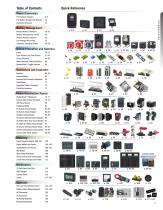
Power Conversion P12 Battery Charger LED Remote 10 Battery Management Manual Battery Switches 14-19 Battery Management Panels 20 Remote Battery Switches 22 Automatic Charging Relays 24-28 cuit Protection and Switches Fuse Holders and Fuse Blocks 37-45 Water Resistant Contura Switches 60 WeatherDeck™ Toggle Switches 62 Terminal Blocks Terminal Feed Through Connectors 70 PowerPost Cable Connectors 70 Distribution Panels Contura Switch Water Resistant 78-79 DC Branch Circuit Breaker 82-85 AC Branch Circuit Breaker 86-87 AC Main Circuit Breaker 88-89 AC Source Selection Circuit Breaker 90 AC RCBO,...
Open the catalog to page 2
PRODUCTS Power Conversion Circuit Protection and Switches SMS Surface Mount System (p. 57) Waterproof Rated IP66 panel enclosure with a 240V AC, 50A ELCI circuit breaker. 7521, 7522 Four-stage, three-output charger with a rugged cast aluminum case. PreFloat stage helps to prevent overcharging. Designed, assembled, and tested in the USA. Features pre-drilled rubber inserts for easier installation. Stainless steel dress cap conceals mounting hardware and matches stainless steel deck fittings. Provides side entry for antenna cables. Stainless steel dress cap conceals mounting hardware and matches...
Open the catalog to page 3
2 BATTERY BANK, 1 ENGINE ELECTRICAL SYSTEM Power Conversion 1. DeckHand Dimmer (p. 11) Digitally controls dimming of non-regulated LED, incandescent, and halogen lights. Batter y Management 2. m-Series Battery Switch (p. 15) Compact 300A continuous rated battery disconnect. Running Lights 3. m-ACR Automatic Charging Relay (p. 25) Automatically combines batteries during charging, isolates batteries when discharging. Cabin Lights Circuit Protection and Switches 4. ST-Blade Fuse Block (p. 39) Compact ATO®/ATC® Fuse Block with independent source to protect both switched and 24-hour circuits. Switched...
Open the catalog to page 4
3 BATTERY BANK, 1 ENGINE ELECTRICAL SYSTEM INTRODUCTION Power Conversion Shore Power Digital, four-stage charger designed to meet global electrical requirements. 2. P12 Battery Charger LED Remote (p. 10) 3. DeckHand Dimmer (p. 11) Digitally controls dimming of non-regulated LEDs, incandescent, and halogen lights. Battery Management 4. m-Series Battery Switch (p. 15) Compact 300A continuous rated battery disconnect. e-Series Battery Switch (p. 16) Standard case 350A continuous rated battery disconnect. 6. ML-Series Remote Battery Switches (p. 22) 500A magnetic latching relay with manual control....
Open the catalog to page 5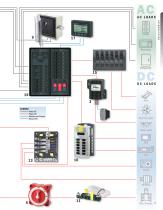
Power AC Power DC Monitor and Control Ground DC Running Lights Cabin Lights
Open the catalog to page 6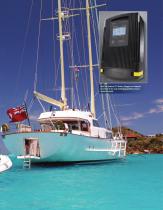
Blue Sea Systems P12 Battery Chargers are designed to perform in the most challenging conditions found around the world.
Open the catalog to page 7
POWER CONVERSION Drawing on experience gained from years of design, manufacturing, and customer input, Blue Sea Systems introduces the P12 Battery Chargers. SECTION INDEX Customers have asked for a battery charger with the latest technology and features built with the integrity and engineering expertise applied to every Blue Sea Systems product. Customers want a charger that can work anywhere, in any conditions, with any battery type, is easy to install, and intuitive to operate. They also demand a high level of product support for questions and troubleshooting. Blue Sea Systems P12 Battery Chargers...
Open the catalog to page 8
Scan for additional product information P12 Battery Chargers POWER CONVERSION The P12 Battery Charger is designed, assembled, and tested at Blue Sea Systems company headquarters in Bellingham, Washington. The P12 Battery Charger was designed to support three core company philosophies: 1. Reliability • Rugged, finned aluminum case • Universal line voltage 90–265V AC, 50/60 Hz • AC over and under voltage shut down and automatic restart • PreFloat stage prevents over charging by allowing each battery to end absorption stage individually Large, bright display Multi-language: English, French, German,...
Open the catalog to page 9
TOP 7.80" (198mm) TOP MOUNTING SCREW CENTERS FOR DRIP PROOF PERFORMANCE, CHARGER MUST BE MOUNTED VERTICALLY AS SHOWN Charge Coordination Explained A boat’s batteries typically spend less than 2% of their time being charged by the alternator. For the remaining 98% of the time they are being maintained by the AC battery charger. During this time, it is important that the proper charging stage of Bulk, Absorption, PreFloat, or Float be applied to each battery. POWER CONVERSION Ø0.3" (6.6mm) CLEARANCE FOR: M6, 1/4", or #12 MOUNTING HARDWARE U N D E RWAY When engine is running and alternator is charging...
Open the catalog to page 10
Scan for additional product information P12 Battery Charger LED Remote POWER CONVERSION Indicates battery charger stage and alerts and controls basic battery charger functions. LED Indicators • Charging LED- Quick check for green light confirms charging • Charge Stage- Displays charging stage • Equalize LED- Indicates the charger is currently in equalization mode • Fan Mode- Indicates charger's internal fan mode • Charge Output- Displays the percentage of output current for each battery. Will also indicate maximum output setting when maximum output is adjusted to accommodate for AC source limitations....
Open the catalog to page 11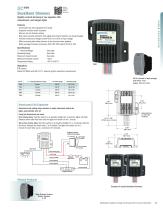
Scan for additional product information DeckHand Dimmers POWER CONVERSION Digitally controls dimming of non-regulated LED, incandescent, and halogen lights Features • Illuminated exit with adjustable time delay • Supports multiple switch locations • Memory for last dimmer setting • Bulb saver prevents excessive bulb aging while boat’s batteries are being charged • Provides continuous voltage control from 0 to 100% of input voltage • Offset mounting tabs allow dimmers to be mounted close together • Retail package includes momentary (ON)-OFF-(ON) switch 8216 (p. 60) Specifications Vn Nominal Voltage...
Open the catalog to page 12
Boston Whaler manages three outboards and three battery banks on the 370 Outrage with Blue Sea Systems ML-Automatic Charging Relays and ML-Remote Battery Switches.
Open the catalog to page 13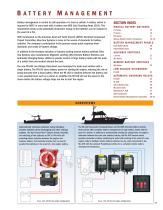
Battery management is central to safe operation of a boat or vehicle. A battery switch is required by ABYC in every boat with a battery over 800 Cold Cranking Amps (CCA). This requirement exists so the potentially destructive energy in the batteries can be isolated in With involvement on the American Boat and Yacht Council (ABYC) Electrical Component Project Committee, Blue Sea Systems is close to the source of standards for battery switches. The company's participation in the process means quick response when standards and needs of boaters change. In addition to the broadest selection of industry...
Open the catalog to page 14All Blue Sea catalogs and brochures
 BLUE SEA SYSTEMS 2017
164 Pages
 BLUE SEA SYSTEMS
156 Pages
 ML Solenoid
2 Pages
 ML-ACR Automatic
2 Pages
 BatteryLink?
2 Pages
 Deckhand Dimmer
1 Page
 P12 Battery Charger
4 Pages
 Battery boxes
2 Pages

- Boat indicator
- Analog indicator
- Boat monitoring and control panel
- Boat switch
- Boat charger
- Boat switch panel
- Digital indicator
- Electrical circuit switch
- Current switch panel
- Boat selector
- Tank indicator
- Current selector
- Waterproof switch panel
- Selector battery switch
- Boat circuit breaker
- Smart charger
- Boat relay
- USB socket
- Boat USB socket