
- Catalogs
- Ascorium Industries
- CompoLite®: material information data sheet

CompoLite®: material information data sheet
CompoLite®: material information data sheet
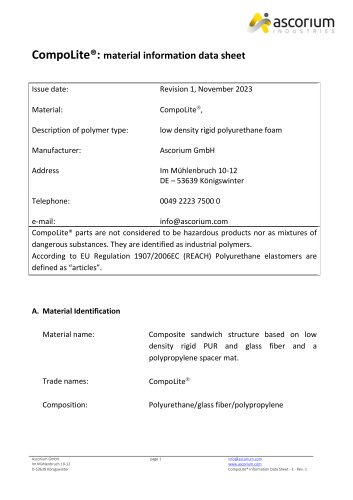
CompoLite® is a low-density rigid polyurethane foam manufactured by Ascorium GmbH. It is classified as an industrial polymer and is not considered hazardous under EU regulations. The material is a composite sandwich structure incorporating glass fiber and a polypropylene spacer mat.
Physical Properties
The material appears as a sandwich structure with a specific gravity of 200-400 kg/m³. It is insoluble in water, has no significant odor, and a flash ignition point between 315°C and 370°C. It remains stable between -40°C and +120°C.
Fire Hazards
CompoLite® is combustible, producing intense heat and dense smoke when burned. It has an auto-ignition point between 370°C and 427°C. Suitable extinguishing methods include water, CO2, dry powder, and liquid foam. Firefighters should use self-contained breathing apparatus in large fires.
Storage & Processing
No special storage requirements are needed, but standard safety protocols should be followed. Adequate ventilation is necessary during processing, especially in operations that produce dust or fumes.
Toxicological Data
CompoLite® is not toxic if ingested, with an LD50 (oral-rats) >5000 mg/kg. Chronic exposure to dust may cause respiratory issues. It does not irritate the skin or eyes unless dust is present.
Protective Measures
No special protective equipment is required, except for processes generating dust, where goggles are recommended. Gloves should be used when handling fresh polymers.
Transport Information
CompoLite® is not classified as hazardous for transportation under current EU/UN regulations.
Disposal Considerations
Recycling options exist for uncontaminated trim and off-cuts. If recycling is not feasible, disposal should be in licensed landfill sites or through controlled incineration.
Composition and Chemical Characterization
CompoLite® is a glass fiber reinforced polymer. It includes isocyanates and polyols, fully reacted into the PU matrix. Additives such as catalysts and pigments may be present. Substances like Hg, Cd, Pb, and Cr (VI) are not intentionally added.
Disclaimer
The information is provided without warranty and is accurate to the best of the manufacturer's knowledge. Users should contact the manufacturer for specific application guidance.
Catalog excerpts
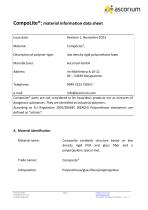
CompoLite®: material information data sheet Issue date: Description of polymer type: low density rigid polyurethane foam Ascorium GmbH e-mail: [email protected] CompoLite® parts are not considered to be hazardous products nor as mixtures of dangerous substances. They are identified as industrial polymers. According to EU Regulation 1907/2006EC (REACH) Polyurethane elastomers are defined as “articles”. A. Material Identification Material name: Composite sandwich structure based on low density rigid PUR and glass fiber and a polypropylene spacer mat. Trade names: Polyurethane/glass fiber/polypropylene Ascorium GmbH Im Mühlenbruch 10-12 D-53639 Königswinter [email protected] www.ascorium.com CompoLite® Information Data Shee
Open the catalog to page 1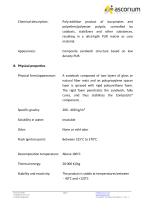
Chemical description: Poly-addition product of isocyanates and polyether/polyester polyols, controlled by catalysts, stabilizers and other substances, resulting in a ultra-light PUR matrix as core material. Composite sandwich structure based on low density PUR. B. Physical properties Physical form/appearance: A sandwich composed of two layers of glass or natural fiber mats and an polypropylene spacer layer is sprayed with rigid polyurethane foam. The rigid foam penetrates the sandwich, fully cures, and thus stabilizes the CompoLite® component. . Specific gravity: None or mild odor Flash ignition...
Open the catalog to page 2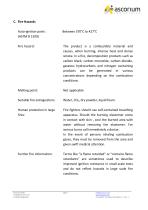
C. Fire Hazards Auto-ignition point : (ASTM D 1929) Fire hazard: The product is a combustible material and causes, when burning, intense heat and dense smoke. In a fire, decomposition products such as carbon black, carbon monoxide, carbon dioxide, gaseous hydrocarbons and nitrogen containing products can be generated in various concentrations depending on the combustion conditions. Melting point: Suitable fire extinguishers: Water, CO2, dry powder, liquid foam. Human protection in large fires: Fire fighters should use self-contained breathing apparatus. Should the burning elastomer come in contact...
Open the catalog to page 3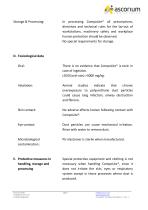
Storage & Processing: In processing CompoLite® all prescriptions, directives and technical rules for the lay-out of workstations, machinery safety and workplace human protection should be observed. No special requirements for storage. D. Toxicological data Oral: There is no evidence that CompoLite® is toxic in case of ingestion. LD50 (oral-rats) >5000 mg/kg. Animal studies indicate that chronic overexposure to polyurethane dust particles could cause lung infection, airway obstruction and fibrosis. Skin contact: No adverse effects known following contact with CompoLite®. Dust particles can cause...
Open the catalog to page 4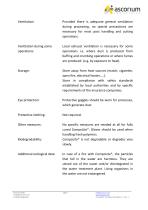
Provided there is adequate general ventilation during processing, no special precautions are necessary for most post handling and cutting operations. Ventilation during some operations: Local exhaust ventilation is necessary for some operations i.e. where dust is produced from buffing and crumbing operations or where fumes are produced (e.g. by exposure to heat). Store away from heat sources (match, cigarette, open fire, electrical heater, …). Store in compliance with safety standards established by local authorities and by specific requirements of the insurance companies. Protective goggles...
Open the catalog to page 5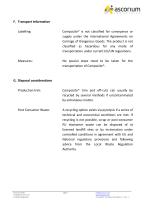
F. Transport information Labelling: CompoLite® is not classified for conveyance or supply under the International Agreements on Carriage of Dangerous Goods. The product is not classified as hazardous for any mode of transportation under current EU/UN regulations. No special steps need to be taken for the transportation of CompoLite®. G. Disposal considerations Production trim: CompoLite® trim and off-cuts can usually be recycled by several methods if uncontaminated by extraneous matter. Post Consumer Waste: A recycling option exists via pyrolysis if a series of technical and economical conditions...
Open the catalog to page 6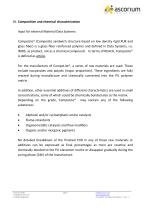
H. Composition and chemical characterization Input for external Material Data Systems: CompoLite® (Composite sandwich structure based on low density rigid PUR and glass fiber) is a glass fiber reinforced polymer and defined in Data Systems, i.e. IMDS, as product, not as a chemical compound. In terms of REACH, CompoLite® is defined as article. For the manufacture of CompoLite®, a series of raw materials are used. These include isocyanates and polyols (major proportion). These ingredients are fully reacted during manufacture and chemically converted into the PU polymer matrix . In addition, other...
Open the catalog to page 7
Substances like Hg, Cd, Pb and Cr (VI) are not intentionally added to the formulation. When reporting to customers in the Automotive sector, the use of IMDS is required. Besides the material PU elastomer, additives are to be reported according to the requirements of GADSL (Global Automotive Declarable Substance List). I. Disclaimer of liability The local legislation is to be followed. This information is furnished without warranty, expressed or implied, except that it is accurate according to the best available knowledge of the CompoLite® manufacturer. The data on this sheet relate only to the...
Open the catalog to page 8