


AQUADOR 23 HT/DC, 26 HT/DC, 28 HT/DC

AQUADOR 23 HT/DC, 26 HT/DC, 28 HT/DC
Catalog excerpts
ENG NOR SWE FIN A2 V. 2.7 AQUADOR 23 HT/DC AQUADOR 23 HT/DC AQUADOR 26 HT/DC AQUADOR 26 HT/DC AQUADOR 28 HT/DC AQUADOR 28 HT/DC
Open the catalog to page 1
V. 2.7 © Bella-Veneet Oy We reserve the right to make changes without prior notice.
Open the catalog to page 2
Dear Owner of the Aquador boat! The intention of this handbook is to help you to operate your craft with safety and pleasure. It contains details of the craft and of the equipment and systems supplied with It or fitted in it and information on its operation, care and maintenance. Please read It carefully, and familiarise yourself with the craft before Naturally, the owner's handbook is not a course on boating safety or seamanship. If this is your first craft or you have changed to a type of craft you are not familiar with, please ensure for your own comfort and safety that you obtain handling...
Open the catalog to page 3
ENG Table of contents GENERAL SECTION General information Definitions Guarantee Before use Registering Insurance Before leaving shore Transporting the boat Hoisting the boat Transportation Before launching the boat Mooring the boat to the quay Towing the boat Anchoring and mooring Leaving shore Safety instructions Starting the engine After starting the engine Controls Indicators Steering Emergency switch Trim (adjusting trim angle) Stability Risk of fire or explosion Engines Other fuel-consuming appliances Fire protection Fire extinguishers Proper use other recommendations and guidelines 13.1...
Open the catalog to page 4
1 1. General information This owner's handbook will help you to familiarise yourself with the properties and features of your new boat, as well as with its care and maintenance. Separate handbooks for the equipment installed are attached and are referred to in many sections. You may of course complement this owner's handbook with the handbooks of the devices that are bought and installed afterwards. There is also space for your own notes at the end of this handbook. 1.2 Definitions The warnings and cautions in this handbook are defined as following: DANGER! Denotes an extreme hazard that would...
Open the catalog to page 5
2 2. Before use 2.1 Registering In Finland, according to Boating regulations, a boat equipped with an outboard or inboard motor or a stern drive engine of over 15 kW, or a watercraft which has a hull length of at least 5,5 m according to the manufacturer and is equipped with a motor or a sail, must be registered. Please, refer to local authorities for more information about registering. 2.2 Insurance ENG Boat insurance may be used to recover damages following accidents on the water or during transport or docking. Ensure separately that the insurance also covers damages resulting from hoisting...
Open the catalog to page 6
3 3. Before leaving shore Familiarise yourself with this owner's handbook. Always check at least the following items before leaving shore: Weather and forecast Consider the wind, waves and visibility. Is the design category, size and equipment of your boat, as well as the skills of the skipper and crew sufficient for the waters you are going to? In strong winds and rough seas portholes, doors, hatches and vents must be closed to prevent water from getting into/onto the boat. Loading Do not overload the craft, distribute loads suitably. For stability, do not place heavy loads high up. Passengers...
Open the catalog to page 7
4 4. Transporting the boat 4.1 Hoisting the boat When hoisting the boat, use an appropriate frame, so that the railing and bodywork do not get damaged. Adjust the hoists so that the boat is horizontal when lifted. Cover the hoists with soft material to prevent scratches. Do not stand under the boat as it is hoisted. CAUTION! Never attach hoists to bollards, railings or other detachable parts of the boat. Lifting area ENG AQ 21 WA aquador Trestle 4.2 Transportation If you transport the boat by trailer, check with the dealer that it is suitable for the model in question. Ensure that the keel is...
Open the catalog to page 8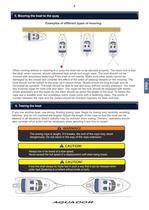
5. Mooring the boat to the quay Examples of different types of mooring When coming ashore or mooring to a quay the boat has to be secured properly. The basic rule is that the boat, when moored, should withstand high winds and rough seas. The boat should not be moored with temporary fastenings if the crew is not nearby. Make sure other boats cannot be damaged by the vessel and consider the effect of the wake of passing vessels on the mooring. The boat should not be lashed to the quay so it cannot move. Ropes should be long enough and as horizontal as possible. The boat should be able to rise and...
Open the catalog to page 9
6 7. Anchoring and mooring Moor your boat carefully, even in sheltered places, because weather conditions can change rapidly. Do not moor the boat with the stern facing the open sea, because high waves could wash onto the boat. Mooring ropes should be equipped with elastic shock absorbers to slacken the tension. To prevent abrasion, use suitable fenders. It is the owner's/operator's responsibility to ensure that mooring, towing and anchor ropes, anchor chains and anchors are appropriate for the vessel's intended use, i.e. the ropes or chains do not exceed 80% of the breaking strength of respective...
Open the catalog to page 10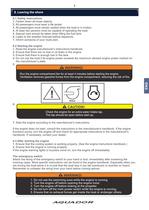
7 8. Leaving the shore 8.1 Safety instructions 1. Fasten down all loose objects. 2. All passengers must wear a life jacket. 3. All passengers must remain seated when the boat is in motion. 4. At least two persons must be capable of operating the boat. 5. Special care should be taken when filling the fuel tank. 6. Listen to the weather forecast before departure. 7. Inform someone of your route plan. 8.2 Starting the engine 1. Read the engine manufacturer's instructions handbook. 2. Ensure that there are no fuel or oil leaks in the engine. 3. Ensure that there is enough fuel in the tank. 4. Do...
Open the catalog to page 11
8 9. Controls 9.1 Indicators Speedometer Indicates the speed of the boat in km/h, knots or nautical miles/h. Tachometer Indicates the revolutions of the engine per minute (RPM). CAUTION! ENG Check the engine manufacturer's handbook for the proper rpm range. Engine cooling thermometer Indicates the engine coolant temperature. See the engine instructions handbook for the normal temperature range. Trim Indicates the position of the stern drive and shows the position of the bow on the horizontal level. Voltmeter Measures the condition of the battery in volts (DC). Ammeter Measures the current in...
Open the catalog to page 12All Aquador catalogs and brochures
 Aquador 300 HT
19 Pages

Archived catalogs
 AQUADOR 21 WAE/S, 23WA, 25WAE
51 Pages
 AQUADOR 25 C, 28C, 32C
56 Pages
 AQUADOR BROCHURE 2010 ADDITION
5 Pages
 Aquador brochure 2009
38 Pages
 32 C
32 C1 Page
 28 C
28 C1 Page
 26 HT
26 HT1 Page
 26 DC
26 DC1 Page
 25 C
25 C1 Page
 23 WA
23 WA1 Page
 23 HT
23 HT1 Page
 23 DC
23 DC1 Page
 21 WA
21 WA1 Page
