
- Catalogs
- SEA TECH & FUN - SPADE
- Tests and comparisons of anchors part 2

- Company
- Products
- Catalogs
- News & Trends
- Exhibitions
Tests and comparisons of anchors part 2
1 /6Pages

Tests and comparisons of anchors part 2
1 /6Pages
Catalog excerpts
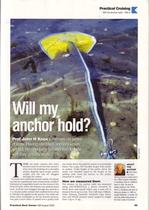
Practical Cruising Will my anchor hold - Part 2 annhnr hnlri Prof John H Knox continues his series of tests. Having identified anchors which roll out, he now turns his attention Tpfopw THERE are many reasons why some anchors tend to roll but this month I show how the holding of a roll-stable anchor depends upon scope, anchor weight and the rate it's dragged For those who missed last month's article, I'd simply say that my experiments were conducted in a shallow tidal pool at Longniddry beach on the shores of the Firth of Forth, where the bottom was medium-hard sand. Anchors were dragged through the sand by a 5 or 10-part pulley system that enabled forces of up to 700 kg to be applied at the anchor. The cable was either nylon multiplait or, for the heavier anchors, wire plus K-inch chain. It passed over a pulley held one metre above the sand by means of a pyramidal frame. The scope, S/D (S=cable length from pulley to anchor, D=the height of the pulley above the sand), was therefore equal to the length of the pulling cable from the anchor to the pulley, The tension on the anchor cable was measured using ANCHORWATCH, a device invented by Kevin Scott and myself which uses a load cell to measure forces up to a ton. The CQR type, HiBlade, Delta, Brittany, Danforth, Danforth copy, Bruce, claw and SPADE anchors tested ranged in weight lifelong interest in boats and in in kayaking while on sabatical leave in Utah. He took to first in a Graduale and later an bought Myfanwy, a Hustler 35, the west coast of Scotland. Practical Boat Owner 428 August 2002
Open the catalog to page 1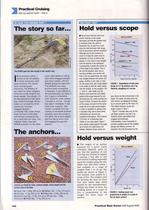
Practical Cruising Will my anchor hold? - Part 2 IN CASE YOU MISSED PART 1 The SPADE gave the best results in last month's test I looked at the roll stability I of some commonly used yacht anchors. The results kg) rolled out when dragged some five shank lengths and when veered. The plough (10 lb) also behaved in the same rolled out consistently when concluded that, under stress, these anchors could drag - with serious consequences HiBlade, Delta, claw and SPADE anchors, on the other hand, were stable to rolling, both when dragged straight and when veered, with the SPADE giving the best hold....
Open the catalog to page 2
Basically, what this all comes down to is scope and angle. As the scope gets less and the angle becomes bigger, the less likely your anchor is to hold well. In Prot Knox's experiment, the SPADE gave the flattest dependence on scope, while the claw and HiBlade gave the steepest. angle at the anchor increased, and the scope lowered. The decrease in hold was more or less linear with the angle but wasn't the same for all anchors. Those which showed the least decrease as the angle steepened were the SPADE and Danforth. The Delta came next. The steepest decline of hold with angle was found on the claw...
Open the catalog to page 3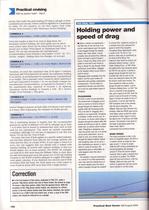
Practical cruising Will my anchor hold? - Part 2 precise, that under the peak loading it'll drag or plough at three centimetres per second, which could be regarded as a maximum for safety. For this situation, we can then replace 'Peak Cable Tension' from Formula 3 with 'Maximum Anchor Holding': Maximum Anchor Holding = (1/500) x (L0A); x What this implies is that if we want to keep below the Maximum Anchor Holding, the wind speed can't be above some critical value which can be found from Formula 4. So, we should now re-label 'Wind Speed' as 'Maximum Safe Wind Speed'. We can also incorporate the...
Open the catalog to page 4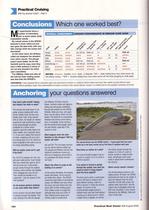
Practical Cruising Will my anchor hold? - Part 2 Which one worked best? and, in some cases, quite unpalatable results. My overall winner is the SPADE because it never rolled out and also gave the best hold, with very little change when the scope was On the other hand, the Brittany rolled out whatever the situation, even when veered. The plough wasn't much better. As tor the Danforth and its copy, even they were a little dubious in terms of roll out and shouldn't be relied upon completely. The HiBlade, Delta and claw all did well but their holding power was less than the SPADE's. OVERALL ASSESSMENT...
Open the catalog to page 6All SEA TECH & FUN - SPADE catalogs and brochures
 SKREW ANCHOR
12 Pages


Archived catalogs
 Benefits of the SPADE anchor
11 Pages

- Boat gangway
- Nautical boat anchor
- Yacht gangway
- Manual gangway
- Plow anchor
- Wooden gangway
- Stainless steel anchor
- Nautical swivel
- Teak gangway
- Mooring shock absorber
- Galvanised steel anchor
- Boat shock absorber
- Aluminum gangway
- Folding gangway
- Lightweight gangway
- Sailboat swivel
- Rotating gangway
- Sailboat gangway
- Aluminum anchor