
- Catalogs
- SEA TECH & FUN - SPADE
- SPADE ANCHOR : Product of the week

- Company
- Products
- Catalogs
- News & Trends
- Exhibitions
SPADE ANCHOR : Product of the week
1 /2Pages

SPADE ANCHOR : Product of the week
1 /2Pages
Catalog excerpts
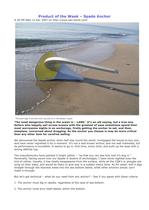
Product of the Week - Spade Anchor 'The point digs in and the more you pull on it, the deeper it goes' 'The most dangerous thing in the ocean is - LAND.' It's an old saying, but a true one. Sailors who happily sail across oceans with the greatest of ease sometimes spend their most worrysome nights in an anchorage, firstly getting the anchor to set, and then, sleepless, concerned about dragging. So the anchor you choose is may be more critical than any other item for carefree sailing. We discovered the Spade anchor when half way round the world, mortgaged the house to buy one, and have never regretted it for a moment. It's not a well known anchor, and not well marketed, but its performance is incredible. It seems to go in, first time, every time, and pulls up the boat with a The manufacturers have painted it bright yellow - "so that you can see how well it's dug in." Personally, having swum over our Spade in dozens of anchorages, I have never sighted even the hint of yellow. Usually, it has totally disappeared from the surface, while all the CQR's or ploughs are lying on their sides, and would be likely to give way in a sudden heavy blow. As for weed, well it digs straight through the heaviest weed into the sea bottom below, while other anchors simply can't But let's get technical - what do you need from any anchor? - See if you agree with these criteria: 1. The anchor must dig in rapidly, regardless of the type of sea bottom. 2. The anchor must bury itself deeply within the bottom.
Open the catalog to page 1
3. Once set, the anchor must give the maximum holding power without dragging. 4. If the traction force exceeds the bottom holding characteristics, the anchor must offer constant, and maximum, resistance to dragging - even if it moves under extreme load. 5. The anchor must keep on holding, regardless of the shift in direction of either the wind or the 6. The anchor design must not allow the anchor rode to become snagged by the anchor. 7.The anchor must be built strongly enough to withstand very high loads. After two years of using the Spade in all types of bottoms - coral, sand, mud, deep weed...
Open the catalog to page 2All SEA TECH & FUN - SPADE catalogs and brochures
 SKREW ANCHOR
12 Pages


Archived catalogs
 Benefits of the SPADE anchor
11 Pages
- Boat gangway
- Nautical boat anchor
- Yacht gangway
- Manual gangway
- Plow anchor
- Wooden gangway
- Stainless steel anchor
- Nautical swivel
- Teak gangway
- Mooring shock absorber
- Galvanised steel anchor
- Boat shock absorber
- Aluminum gangway
- Folding gangway
- Lightweight gangway
- Sailboat swivel
- Rotating gangway
- Sailboat gangway
- Aluminum anchor