

Tethers and harnesses
1 /4Pages

Tethers and harnesses
1 /4Pages
Catalog excerpts
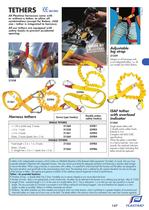
All Plastimo harnesses come with or without a tether, to allow all combinations (except for Bolero, child size : tether is integrated to harness). All our tethers are equipped with safety hooks to prevent accidental Adapts on all harnesses with our models but child's Bolero. ISAF tether with overload Single elastic tether with 2 double action safety hooks. Complies with ISAF/ORC When the tether is submitted to a heavy load (ex. man over board), the overload indicator exposes a label indicating that tether should be replaced. A tether is the indispensable accessory which makes an inflatable lifejacket a fully featured safety equipment. Provided, of course, that you have originally selected a lifejacket with integrated harness : the only version providing the adequate resistance and featuring a stainless steel triangle to secure the tether. When using a harness in conjunction with a tether, it is essential to check that both the harness and the tether are designed to the same standard, and specifically to the same breaking strain level. The breaking strain is defined by the original standard, but also by the age of the harness or tether : the ageing and general condition of the webbing impacts negatively its level of performance. Tether : its essential features • Number of lines : a double tether has 2 lines. It enables you to remain clipped as you move about the boat. • Number of hooks : there is not systematically a hook at both ends ; the tether can be attached to the harness via a webbing loop (see photo : tether ref. 31558). • Length of lines : standard length is 2 m. In the case of a double tether, the 2nd line is reduced to 1 m so that you can clip yourself on a shorter length. The very principle of a harness is to prevent a man falling overboard and being dragged ; one must therefore be clipped on a short length, as often as possible. Tethers on children harnesses are shorter. • Elasticity : this tether stretches out when needed and contracts when not under tension, which contributes to a greater freedom of movement and improved safety, as it stays out of your way on the deck. The elastic tether is the obvious choice for yachtsmen who wear their harness regularly.
Open the catalog to page 1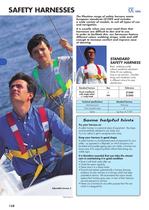
SAFETY HARNESSES The Plastimo range of safety harness meets European standards CE 1095 and includes a wide variety of models, to suit all types of use It is usually when you most need them that In order to facilitate this, our harnesses feature different colour webbing straps, wide and stiff enough to increase comfort and improve ease SAFETY HARNESS Basic, webbing model, without waistband adjustment. straps and waistband come in different colours for easy Some helpful hints A safety harness is a personal piece of equipment : the straps must be perfectly adjusted to your body size. Try it on,...
Open the catalog to page 2
ADJUSTABLE SAFETY HARNESSES 'Except on Bolero models ref. 31553 and 31555, which already feature a permanently integrated tether. Webbing harness, with adjustable straps and waistband come in different colours for easy Fully adjustable, at waistband patch holds the shoulder straps in the correct position ; it also contributes to comfort and makes donning easier. Also available in Child size Child and Adult size are clearly identified by different colours. Bolero Harness The simplest to use : Bolero vest with built-in harness. children (see Child model next
Open the catalog to page 3
CHILDREN'S SAFETY HARNESSES Bolero harness Particularly recommended for children, the Bolero vest with built-in harness is definitely the simplest to use. It is equipped with a permanently integrated tether, to prevent the child from releasing it himself. It also features a chest pouch to store
Open the catalog to page 4All Plastimo catalogs and brochures
 catalogue
676 Pages
 2021 NEW PRODUCTS
83 Pages
Archived catalogs
 liferaft
1 Page
 SURFACE PREPARATION
1 Page
 blooks
1 Page
 Plastimo 2014
620 Pages
 THE PLASTIMO ANCHORS
1 Page
 Electronics, Navigation
35 Pages
 Plastiimo tenders
22 Pages
 Plastimo liferafts
22 Pages
 Plastimo compasses
32 Pages
 Personal equipment
16 Pages


- Nautical motor-boat
- Inflatable boat
- Outboard inflatable boat
- Boat pump
- Marine rope
- LED light
- Marine sail
- Sacrificial anode
- Nautical fender
- Boat sacrificial anode
- Nautical boat light
- Nautical boat seat
- Nautical light
- Zinc sacrificial anode
- Nautical paddle
- Yacht tender inflatable boat
- Nautical lifejacket
- LED navigation light
- Sailboat sail
- Buoyancy aid