

Plastimo buoyancy aids and lifejackets
1 /23Pages

Plastimo buoyancy aids and lifejackets
1 /23Pages
Catalog excerpts

BUOYANCY AIDS Buoyancy aids and lifejackets used in recreational or professional activities must comply with the specifications of the European Directive 89/686/CE on Personal Protective Equipment. e CE mark of approval must be printed on the garments label and testifies that the lifejacket complies with the European Directive. 4 CE standards have been defined, rankina lifejackets in 4 categories according to their use, performance Coastal sailing, beach/shore activities. Inshore, coastal sailing. Open sea/blue water sailing. Open sea/blue water sailing. Extreme conditions and professional use. Canoe-kayak, windsurf, Sail and power crafts. Sail and power crafts. Sail and power crafts Professional vessels*. Keeps the airway out of the water, wearer being conscious. Self-righting : turns wearer safely on his back Self-righting : turns wearer safely on his back Self-righting : turns wearer safely on his back within 5 seconds, user wearing heavy protective clothing. both sides of the head and at the back. Bright colour imposed. Bright colour imposed. Bright colour imposed. Reflecting material Grab handle Crutch strap SOME SELECTION HINTS The primary function of a lifejacket is to keep the victim's airways out of the water and to allow an efficient spotting in order to facilitate the rescuing manoeuvres. A lifejacket keeps the wearer safely on his back and provides enough buoyancy for use in different open and rough sea conditions. It provides self-righting capacity. A buoyancy aid provides sufficient buoyancy for use in sheltered waters and does not offer self-righting capacity. In addition, the type of sports or activity defines the level of performance expected from a PFD (personal floatation device) : in some cases, comfort and softness are critical, while other activities require durability and buoyancy first. Clubs Cruising, sailing schools coastal and high sea • Which lifejacket for your size Check your bodyweight vs. the weight indicated on Always try the lifejacket on prior to purchase. A lifejacket must be perfectly adjusted and worn ON your foul weather gear. • Choose between 2 technologies Lifejacket with permanent floatation (foam technology) Designed to be used either in the water/water surface or in case of accidental fall into the water. Also provides a good protection against knocks and contributes to thermal protection. Inflatable lifejacket (air bladder technology) Designed specifically to be used in case of accidental fall into the water. Extremely compact when non inflated, the inflatable lifejacket provides optimum freedom of movement. In the event of a man over board, the inflatable lifejacket (automatic or manual) provides ample floatation capacity.
Open the catalog to page 1
Read the label and understand -your purchase You have selected a 100 Newton category lifejacket. The CE mark of approval and no. EN 395 testily that this lifejacket is fully approved. Within the 100 N category which you selected, it is your own body weight (hence the lifejacket size) which determines the actual buoyancy of the garment. In this example, the wearer weighs between 50 and 70 kg. (It is only in the case of a wearer weighing 70 kg or more that the required buoyancy For a wearer from 50 to 70 kg, within the 100 N category, the buoyancy required by CE standards is 80 N. In a given category,...
Open the catalog to page 2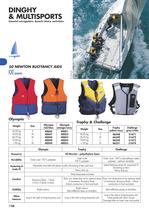
Coastal navigation, beach/shore activities Trophy & Challenge
Open the catalog to page 3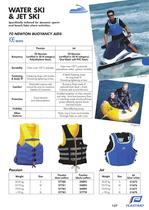
Specifically tailored for dynamic sports and beach/lake shore activities. 70 NEWTON BUOYANCY AIDS
Open the catalog to page 4
CANOE & KAYAK Lake, river and seashore activities. 70 NEWTON BUOYANCY AIDS The European standard requires a 50 Newton buoyancy for canoe and kayak practice, mostly carried out in sheltered water or where help is close at hand. However, for extra safety, Plastimo has uprated its range to a 70 Newton buoyancy. Our buoyancy aids are approved in the 50 N category, although they provide an increased buoyancy. Specifically tailored for paddling activities : paddler is seated and does the same ample arm/shoulder movement repeatedly.
Open the catalog to page 5
CLUBS & SAILING beach and snore activities ^ BUOYANCY AIDS Designed for intensive use : reinforced where wear Voiles & Voiliers© Sailing schools and kayak clubs must check lifejacKets and buoyancy aids at regular intervals. Regular care consists in rinsing in fresh water after use, and drying away from direct sunlight. An annual inspection consists in a buoyancy test and a visual control of the various components (webbing, cover, Club Master, XS size with self-righting capacity, features a wrap-around collar
Open the catalog to page 6
CHILDREN'S LIFEJACKETS 100 NEWTON Some helpful hints Inflatable or traditional foam lifejacket Both types meet the specifications required by the EC standard ; they are self-righting and feature a large flotation pillow collar to support the child's head efficiently and keep the airway out of the water. • Inflatable lifejacket for children is always an automatic inflation type ; even if the child falls into the water unconscious or cannot swim, the lifejacket inflates automatically, by mere contact with the water.However, we tend to recommend inflatable jackets only for children aged 6 or 7 and...
Open the catalog to page 7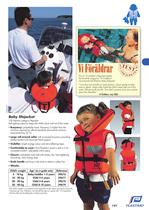
Baby lifejacket 100 Newton category lifejacket. Self-righting capacity, keeps the child's head well out of the water. • Buoyancy: polyethylen foam. Buoyancy is higher than the minimum required by official standards (transcends minimum • Large roll-around collar with increased buoyancy providing added comfort and improved head support. • Visibility : bright orange colour and retro-reflecting tapes. • Comfortable to wear : front floatation panel is split in 2 for increased comfort ; adjustable crotch piece. • Closure : adjustable waist belt with plastic clip, hem tightening drawstring, neck closing...
Open the catalog to page 8
Typhoon lifejackets Self-righting capacity, keeps the child's head well out of the water. Buoyancy : polyethylen foam. Buoyancy is higher than the minimum required by official standards (transcends minimum requirements • Large roll-around collar with increased buoyancy providing added comfort and improved head support. Visibility : bright colours and retro-reflecting • Closure : zip + adjustable waist belt with plastic clip, hem tightening drawstring for snug fit. • Crotch strap. • Grab handle.
Open the catalog to page 9All Plastimo catalogs and brochures
 catalogue
676 Pages
 2021 NEW PRODUCTS
83 Pages
Archived catalogs
 liferaft
1 Page
 SURFACE PREPARATION
1 Page
 blooks
1 Page
 Plastimo 2014
620 Pages
 THE PLASTIMO ANCHORS
1 Page
 Electronics, Navigation
35 Pages
 Plastiimo tenders
22 Pages
 Plastimo liferafts
22 Pages
 Tethers and harnesses
4 Pages
 Plastimo compasses
32 Pages
 Personal equipment
16 Pages

- Nautical motor-boat
- Inflatable boat
- Outboard inflatable boat
- Boat pump
- Marine rope
- LED light
- Sacrificial anode
- Nautical fender
- Boat sacrificial anode
- Nautical boat light
- Nautical boat seat
- Nautical light
- Zinc sacrificial anode
- Nautical paddle
- Yacht tender inflatable boat
- Nautical lifejacket
- LED navigation light
- Sailboat sail